

On this page
Almost every student memorises the formula for the area of a triangle: Area = ½ × base × height. Yet many treat it as an arbitrary rule rather than a spatial fact. When an exam question tilts the triangle or makes an angle obtuse, confusion sets in: which side is the base, and where does the height go? The explanation rests on three geometric insights: every triangle is half of a parallelogram, every parallelogram equals an equivalent rectangle, and obtuse triangles obey the exact same algebra when external regions are subtracted.
Why does cutting a parallelogram along a diagonal give the formula?
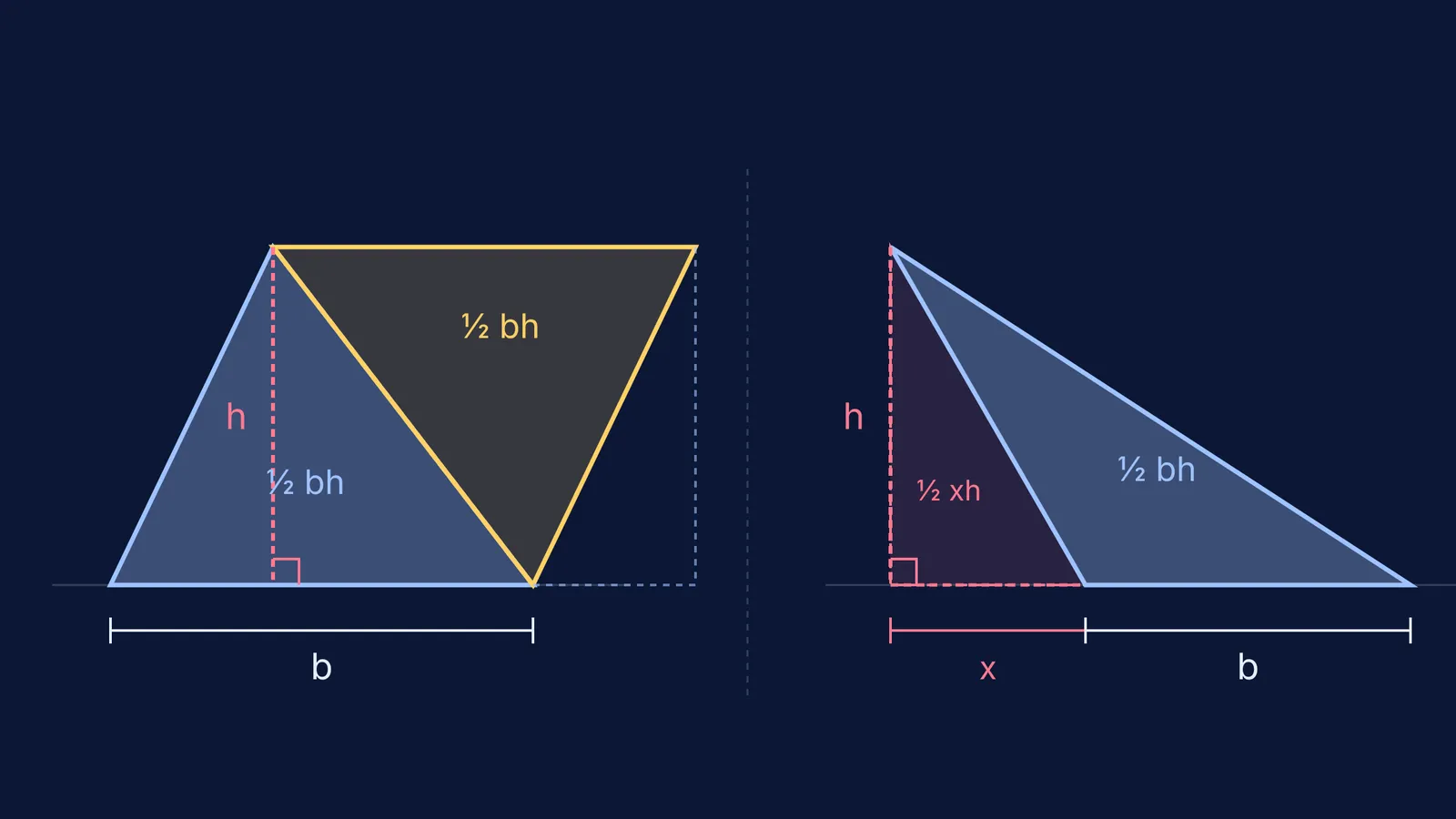
Take any triangle ABC. If you make a duplicate copy rotated by 180° and join the two copies along a shared side, they form a parallelogram.
A diagonal divides any parallelogram into two congruent triangles. Euclid established this bisection in Book I, Proposition 34, and proved in Proposition 41 (Clark University edition) that if a parallelogram and a triangle share the same base and lie between the same parallel lines, the parallelogram has double the area of the triangle. Because congruent figures have identical area, each triangle is exactly half the parallelogram. In the Indian curriculum, this principle anchors congruent triangles in Class 9 in the official NCERT Mathematics textbook. Knowing the parallelogram's area immediately gives the triangle's area by dividing by 2.
How does a slanted parallelogram turn into a rectangle?
Why is a parallelogram's area base × height instead of base × slant length?
Picture a parallelogram with base b and perpendicular height h. Drop a vertical line from the top-left vertex to the base line, forming a right-angled triangle. Slice off this triangle and translate it horizontally to the opposite edge; it fits against the slanted side. The parallelogram becomes a rectangle with width b and height h.
Euclid proved in Book I, Proposition 35 (Euclid's Elements) that parallelograms on the same base and between the same parallels share equal area. Because a rectangle's area is base × height, the parallelogram's area is also base × height. Halving that area gives the triangle formula: Area = ½ × b × h. If height is unknown, students can apply Heron's formula in Class 9 to find the area directly from the three side lengths.
What happens to the height when a triangle is obtuse?
In an obtuse triangle, the altitude from an acute vertex falls outside the triangle on the extended base line.
In a study of 190 preservice primary teachers in the *Journal of Mathematics Teacher Education* (Gutiérrez & Jaime, 1999), researchers observed widespread confusion when altitudes fell outside the figure. As David Tall and Shlomo Vinner noted in *Educational Studies in Mathematics* (Tall & Vinner, 1981), students often develop a restrictive "concept image" where height must always drop inside the shape.
The formula still holds through simple subtraction:
Let triangle ABC have base BC = b, with an obtuse angle at C.
Drop altitude AD of length h to the extended base line at D, creating an external segment CD of length x.
The large right triangle ABD has base (b + x) and area ½(b + x)h.
The empty external right triangle ACD has base x and area ½xh.
Subtracting the empty region gives: Area(ABC) = ½(b + x)h − ½xh = ½bh + ½xh − ½xh = ½bh.
The external distance x cancels out completely. This consistency is also why coordinate-based triangle areas using determinants work uniformly for all triangle types.
A practical checklist for finding base and height correctly
To calculate triangle areas accurately under exam conditions, use this four-step checklist:
Choose any side as the base: Any side can serve as base b.
Identify the perpendicular height: Trace a segment from the opposite vertex meeting the base line at 90°.
Exclude external extensions: For obtuse triangles, measure b strictly along the triangle's actual side, ignoring the extension x.
Sanity-check against the slant side: The height h must always be shorter than the adjacent slanted edges.
Worked example: For an obtuse triangle with base b = 14 cm, height h = 8 cm, and external extension x = 6 cm, the formula gives Area = ½ × 14 × 8 = 56 cm². Checking by subtraction confirms: ½ × (14 + 6) × 8 − ½ × 6 × 8 = 80 − 24 = 56 cm².
When revising geometric concepts, the Fermi Concept Library maps every concept in mathematics with its own lesson and its place in the map. For problem practice, the Fermi Problem Library offers worked problems with a step-by-step solver that explains the reasoning rather than printing an answer.


