On this page
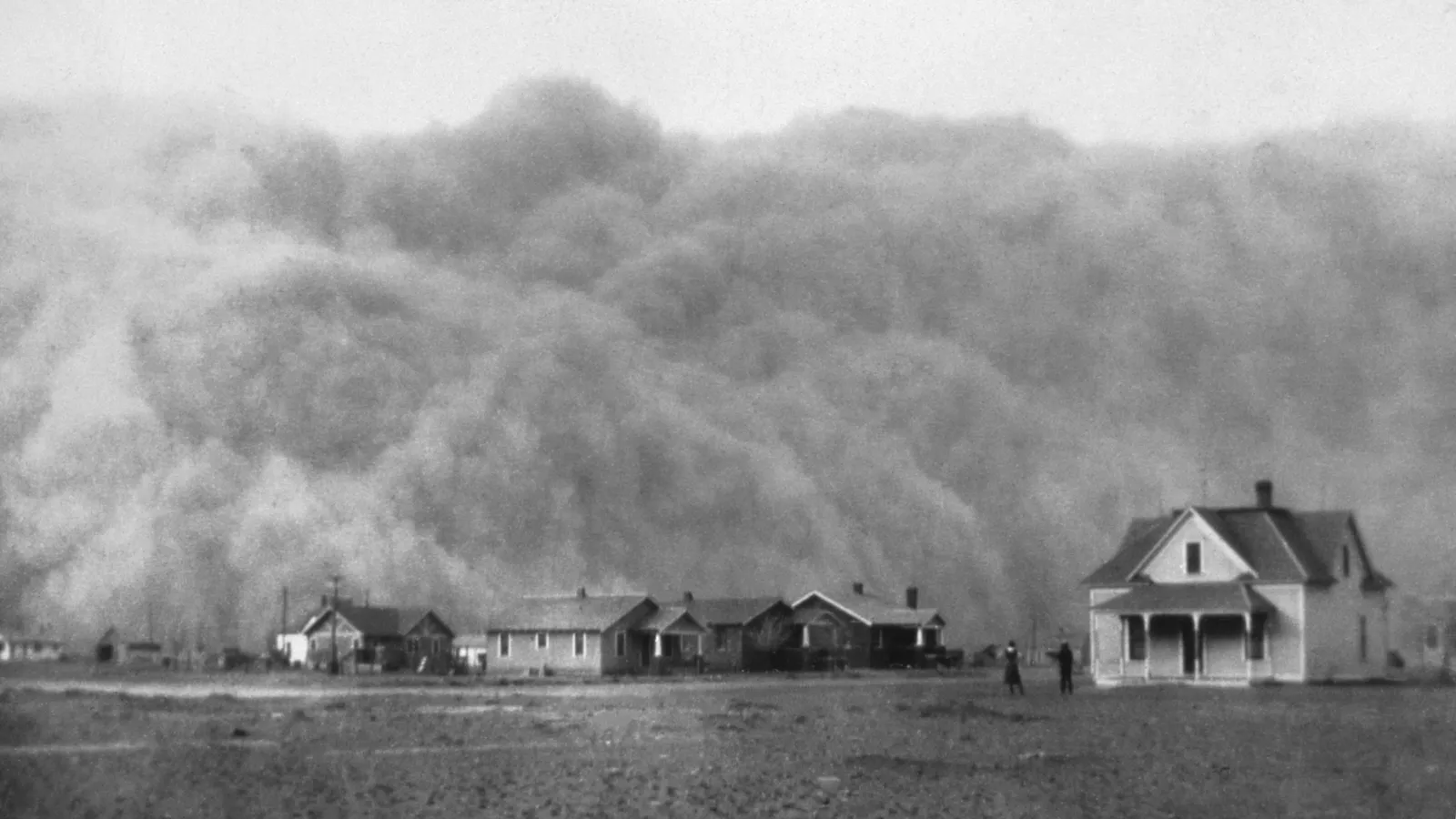
In the 1930s, dust storms stripped so much topsoil from the southern Great Plains of the United States that the region got a name. After the Black Sunday storm of 14 April 1935, an Associated Press article by Robert E. Geiger, published the next day, described “the southwestern dust bowl”. The US National Weather Service says this is believed to be the first use of the phrase.
What caused the Dust Bowl?
Three things came together: ploughed grassland, drought and wind.
The Great Plains were grassland, and the short buffalo grass “held the soil in a tightly woven network of roots”, says a USDA Agriculture in the Classroom lesson. Farmers ploughed this sod under for cash crops such as wheat, and tractors let them work far bigger fields than horses had. The National Drought Mitigation Center adds that low crop prices and high machinery costs pushed poorer land into production, and that the switch to the one-way disc plough “greatly increased the risk of blowing soil”.
Then the rain failed. The drought centre counts at least four droughts, in 1930-31, 1934, 1936 and 1939-40, covering virtually the entire Plains for almost a decade. Crops died, the bare fields had nothing holding them down, and the wind did the rest.
Was it mainly drought or mainly farming? A 2009 climate-model study in PNAS by Cook, Miller and Seager found that 1930s ocean temperatures alone produced a drought centred in southwestern North America. Adding the lost vegetation and the dust from failed crops was needed to reproduce what happened. The authors conclude that human-caused land degradation likely amplified the drought itself, turning a modest one into a disaster.
Why does bare soil blow away?
Roots and plant cover bind soil grains together and slow the wind right at the ground. Remove them, let the soil dry, and a strong gust lifts the finest particles into the air while heavier grains hop along the surface, the same motion explained in our post on why sand dunes move.
A storm on 11 May 1934 carried fine soil over Washington, DC and far out into the Atlantic Ocean, according to the USDA Natural Resources Conservation Service. On Black Sunday, winds in the Oklahoma and Texas panhandles reached upwards of 60 miles per hour, the National Weather Service records. The FDR Presidential Library says that one storm is estimated to have blown away 300 million tons of topsoil.
How did the Dust Bowl change soil conservation?
Hugh Hammond Bennett, a former USDA soil surveyor, had long campaigned about erosion; his 1928 publication “Soil Erosion: A National Menace” was highly influential. In March 1935, dust darkened the sky over Washington just as Congress began hearings on a soil conservation law, and Bennett used the moment to argue for a permanent agency, the NRCS history records. President Roosevelt signed the Soil Conservation Act on 27 April 1935, creating the Soil Conservation Service with Bennett as its chief. The first local soil conservation district followed in 1937, in North Carolina; NRCS counts over 3,000 districts today.
Each method answered a cause, as the USDA lesson and the FDR Library describe:
Bare ground: crop rotation, and leaving stubble to rot into the field instead of burning it.
Long, unbroken fields: strip cropping, with wheat alternated with strips of native grass, so a failed crop still left something holding the soil.
Wind across open furrows: planting in zigzag contours against the prevailing wind, plus terracing.
Flat, open land: windbreaks. The Shelterbelt Project set out to plant over 200 million trees in a belt from Bismarck, North Dakota, to Amarillo, Texas.
Land too poor to farm: back to grass for controlled grazing.
Try it: a wind erosion test at home
This activity comes from the same USDA lesson.
Cut one side off a cardboard box and lay white paper inside.
Pour a small heap of very dry, loose soil on the paper.
Point a fan or hairdryer at it, first on low, then on high.
Push a few pencils upright into the soil, like stalks or a windbreak, and repeat.
Dampen the soil slightly and repeat once more.
Predict each result before you switch on, and write down what happens. You should see fine dust coat the paper, with more and bigger particles moving at high speed, and less blowing with “stalks” in place or with damp soil: the Dust Bowl in miniature, and the two things that hold soil down, cover and moisture.
If the physics of why faster air lifts bigger particles feels fuzzy, the Fermi Concept Library covers every concept in physics, chemistry, biology, mathematics and computing, each with its own lesson. Then see the same mechanism closer to home in why Rajasthan gets dust storms before the monsoon, or another human-made collapse in why the Aral Sea dried up.