

On this page
Dunes in the Thar or the Sahara look still in photos, but they walk downwind. The mechanism is neat physics: wind does the lifting, gravity does the sliding, and the dune's shape decides where each happens.
How does wind move sand grains?
Wind rarely carries dune sand high into the air. Most grains move by saltation, which the US Geological Survey defines as "downwind movement of particles in a series of jumps or skips" (USGS, Eolian processes). A grain is lifted, the wind pushes it forward as it falls, and when it lands it knocks other grains loose. The US National Park Service describes this as a chain reaction, and notes that on a windy day you can see a hazy zone of moving sand just a foot or two above the ground (NPS, Sand dune geology).
Grains too heavy to hop get nudged along the surface instead. Surface creep accounts for as much as 25 percent of grain movement in a desert, according to the USGS.
Why does a dune have one gentle side and one steep side?
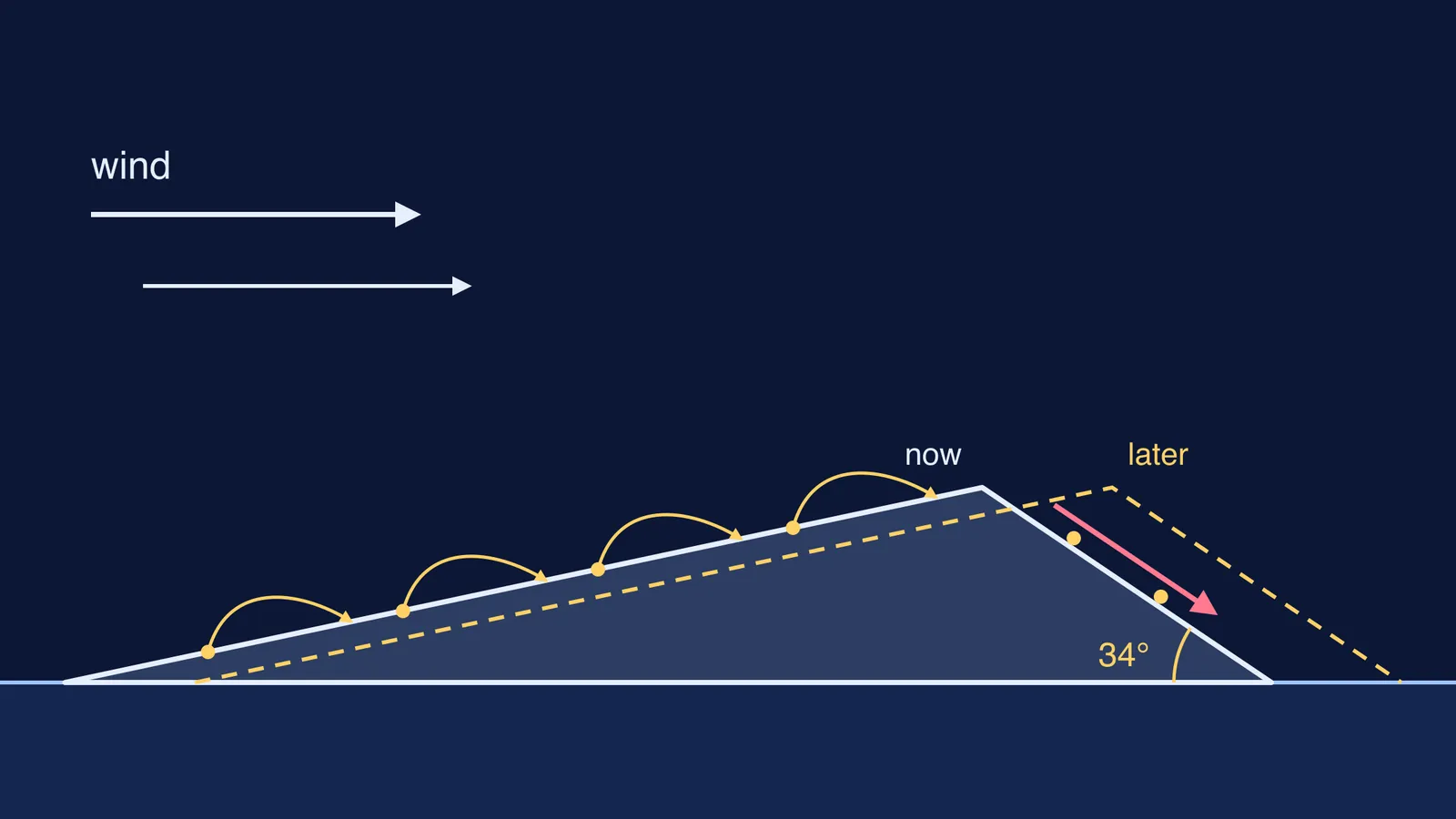
Picture the wind arriving from the left. The side facing it, the windward slope, is long and gentle, so hopping grains can climb it. Past the crest, the grains drop out on the sheltered lee side.
Sand piled there cannot get steeper forever. "Dry, loose sand can take on a maximum slope of 34 degrees, known as the angle of repose," says the National Park Service. Add more sand and a small avalanche slides down, resetting the slope. That steep lee side is the slip face. If you have met the tan θ = μ result in mechanics, this is the same idea; our post on the angle of repose and the angle of friction works it through.
Why do sand dunes move across the desert?
The windward slope loses sand: that is wind erosion. The slip face gains sand: that is deposition. Take grains off the back, add them to the front, and the whole heap shifts forward. In the USGS's words: "Grain by grain, the dune moves downwind" (USGS).
Speeds vary a lot. At the Dune Climb in Sleeping Bear Dunes, Michigan, the average advance has been about 1.2 metres per year in recent years (NPS). In China's Ningxia Province, a group of dunes moved more than 100 metres per year between 1954 and 1959 (USGS, Types of dunes).
How fast does a sand dune move?
You can work this out with Class 9 algebra. Take a slice of dune 1 metre wide. Each year the wind carries a volume Q of sand (cubic metres per metre of width) over the crest and onto the slip face. For a slip face of height H to advance a distance c, you must fill a strip H tall and c long, which takes H × c cubic metres.
Sand delivered per year = Q
Sand needed to advance by c = H × c
Set them equal: c = Q / H
A 2007 study of 50 barchan dunes in Mauritania, 2 to 5 metres tall, found their speeds fit this relation with Q of about 50 cubic metres per metre per year (Ould Ahmedou and colleagues, Journal of Geophysical Research: Earth Surface). Plug in that value:
A 2 m dune: c = 50 / 2 = 25 metres per year
A 5 m dune: c = 50 / 5 = 10 metres per year
The smaller dune moves two and a half times faster, because it needs less sand to push its front forward. The same study found that, over its year of measurements, moderate wind events moved much more sand in total than strong wind events.
How can you check you really understand it?
Try this quick self-test with a pencil:
Draw a dune with wind from the left. Mark the gentle side, the crest and the slip face.
Shade where erosion happens and where deposition happens.
Draw the dune one year later as a dashed outline. Which way did it go?
Two dunes sit in the same wind; one is twice as tall. Which reaches the road first, and why?
Explain why the slip face never gets steeper than the angle of repose.
If step 4 or 5 trips you up, try seeing it rather than rereading it. The Fermi Simulation Lab has interactive simulations for ideas that are easier to see than to read, and the Fermi Concept Library gives each physics concept, friction included, its own lesson.
For where India's desert sand country gets its dryness, read why the Thar Desert gets so little rain, and for what happens once plants pin a dune in place, see how Henry Cowles read the sand dunes of Lake Michigan.


