

On this page
Why does the Arabian Sea monsoon pass over Rajasthan without raining?
Every summer, the southwest monsoon brings immense moisture to the subcontinent. Yet across Western Rajasthan, the landscape remains parched. According to the India Meteorological Department summary on Rajasthan's climate, the Southwest Monsoon accounts for 91% of the state's annual rainfall, yet West Rajasthan receives a normal average of just 32.7 cm, compared to 64.9 cm in East Rajasthan, with Jaisalmer recording barely 17 cm.
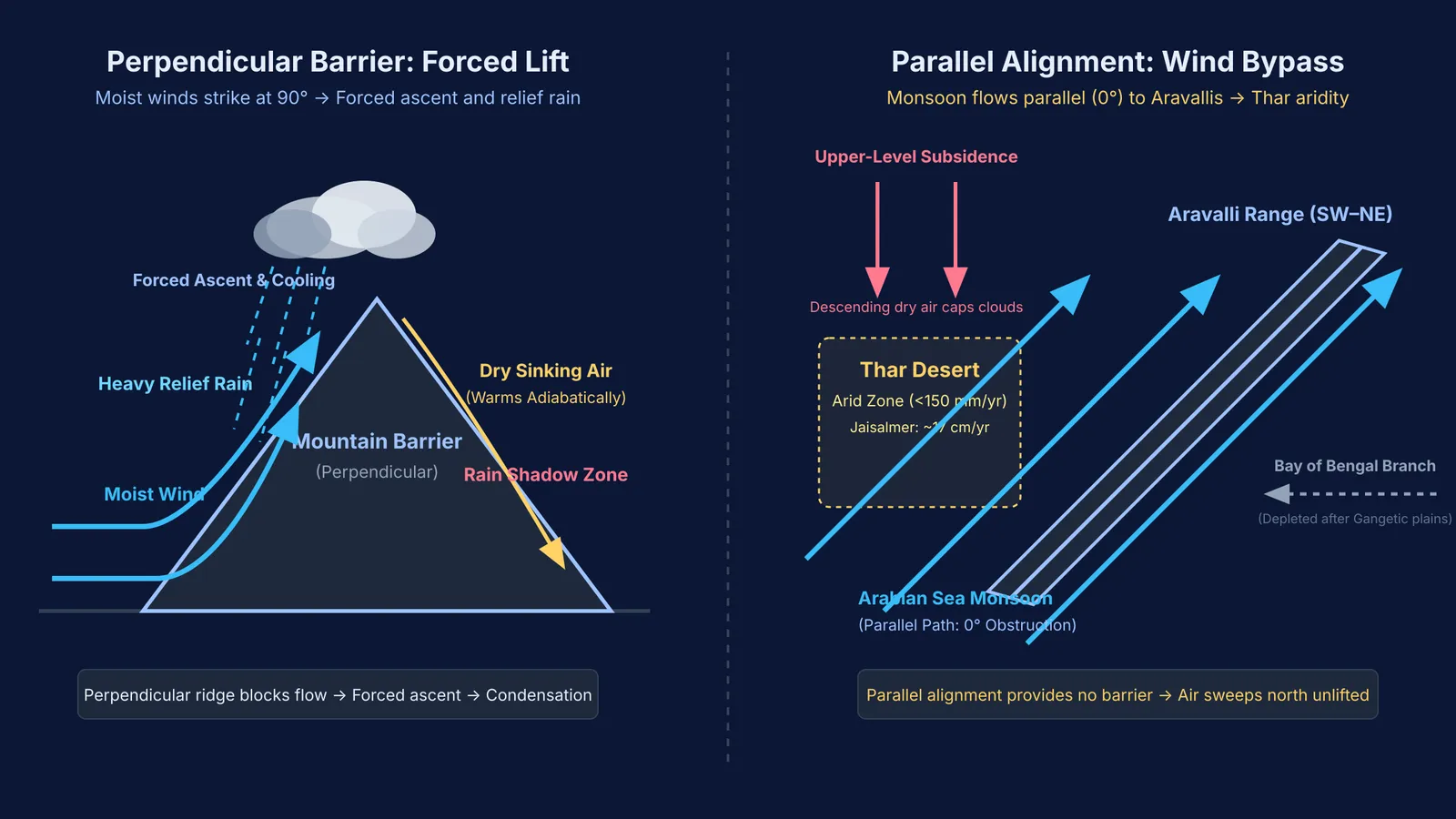
The primary cause is mountain alignment. The NCERT Class 9 Geography curriculum explains that the Aravalli Range runs in a southwest-to-northeast direction. The Arabian Sea branch of the monsoon moves across Gujarat along this exact trajectory. Because the mountain ridge runs parallel to the prevailing wind rather than perpendicular to it, the hills present no barrier. Moisture-laden air streams through open terrain toward northern India without being forced upward.
How does relief rainfall work when mountains block moisture?
To understand why Rajasthan remains dry, compare it with how relief rainfall—or orographic precipitation—functions across India. As detailed in NCERT physical geography textbooks, relief rain occurs when an elevated landform obstructs moisture-laden winds.
When humid air strikes a perpendicular mountain barrier, it is forced to ascend. As air rises, atmospheric pressure drops and the parcel undergoes expansion; see how gas temperature drops during adiabatic expansion. This cooling brings water vapour to its dew point, forming clouds and torrential rain on the windward slope, as seen on the Western Ghats.
In Rajasthan, this vertical ascent never occurs. The Aravallis are eroded relict mountains whose highest point, Guru Shikhar, reaches 1,722 m according to NCERT Class 11 physiography records. Because the range does not cross the wind's path, air glides past smoothly. Without forced ascent, there is no adiabatic cooling, no condensation, and no rain. For ideas that are easier to see than to read, the Fermi Simulation Lab offers interactive simulations showing how atmospheric wind currents move around physical barriers.
Why is the Bay of Bengal branch already dry when it reaches the Thar?
The Arabian Sea branch is only one component of the monsoon; the Bay of Bengal branch is the other. If the Arabian Sea branch bypasses Rajasthan, why does the eastern branch not bring rain?
Distance and depletion provide the answer. The Bay of Bengal branch travels thousands of kilometres westward along the Himalayas and the Indo-Gangetic plain. By the time it arrives in western India, it has shed most of its moisture over West Bengal, Bihar, and Uttar Pradesh. The eastern Aravalli slopes catch whatever humidity remains, leaving Western Rajasthan in a dry rain shadow. As the NCERT Class 11 physical geography survey records, the Thar Desert receives under 150 mm of precipitation annually, making it intensely water-deficient.
What atmospheric factors stop rain clouds from forming over Rajasthan?
Topography is only part of the explanation; atmospheric thermodynamics completes it. Two subtle aerial mechanisms suppress cloud formation over the Thar: atmospheric subsidence and thermal inversions.
Rajasthan sits beneath the subtropical high-pressure belt, characterised by descending air currents. Sinking air compresses and warms, increasing its capacity to hold moisture without condensing. In an influential 1967 study in the Bulletin of the American Meteorological Society, climatologists Reid A. Bryson and David A. Baerreis showed that dense atmospheric dust over northwest India enhances radiative cooling aloft, reinforcing upper-air subsidence and capping vertical cloud growth.
Simultaneously, a persistent temperature inversion acts as a lid over the lower troposphere. Hot, dry continental air from the west overlies the shallow, humid marine layer. Because warmer air floats above cooler air, vertical convection is blocked. Indian meteorologists have studied these complex systems for generations, from Anna Mani's work developing India's early meteorological instruments to Jagadish Shukla's research on seasonal monsoon predictability. To review the thermodynamic principles governing gas expansion, the Fermi Concept Library covers every concept in physics, chemistry, biology, mathematics and computing, each with its own lesson and its place in the map.
How should students structure this answer for Class 9 exams?
Questions on why the Thar Desert receives scanty rainfall are staples of Class 9 CBSE, ICSE, and school examinations. Examiners look for precise physical mechanisms. You can structure your answer using this four-step checklist:
Orientation of the barrier: State that the Aravalli Range lies parallel to the southwest Arabian Sea monsoon, offering no obstruction to force winds upward.
Physics of relief rainfall: Note that without perpendicular blocking, air cannot undergo forced ascent, adiabatic cooling, or condensation into rain clouds.
Depletion of eastern winds: Explain that the Bay of Bengal branch loses its moisture traversing the Gangetic plain before reaching Rajasthan.
Atmospheric stability: Highlight that extreme heat raises the air's moisture capacity, while upper-level subsidence and temperature inversions suppress vertical cloud development.


