On this page
Every weather forecast starts with a measurement: how much rain fell, how hard the wind blew, how much sunlight reached the ground. Those numbers are only as good as the instruments behind them. Anna Mani led the work that let India design and make its own. This post covers her life, her physics and a simple instrument calculation that shows why careful design matters.
Who was Anna Mani?
The World Meteorological Organization's centenary article on Anna Mani records that she was born on 23 August 1918. She started her research career in 1940 at the Indian Institute of Science, Bengaluru, "under the supervision of Nobel Laureate Sir C. V. Raman, working on the spectroscopy of diamonds and rubies". The years of her life, 1918 to 2001, appear in the title of a 2001 tribute published in Meridians.
What did she study with C. V. Raman?
Her papers from this period appear in the Proceedings of the Indian Academy of Sciences. In 1944 alone she published on the fluorescence and absorption spectra of diamond in the visible region, polarisation of Raman scattering and of fluorescence in diamond and luminescence patterns in diamond, followed by work on the excitation of luminescence in 1945.
This was careful optical measurement: shining light on a crystal and recording exactly which wavelengths came back, how strongly and with what polarisation. If you want to know what Raman scattering is, our post on C. V. Raman and the scattering of light explains it.
How did she build India's weather instruments?
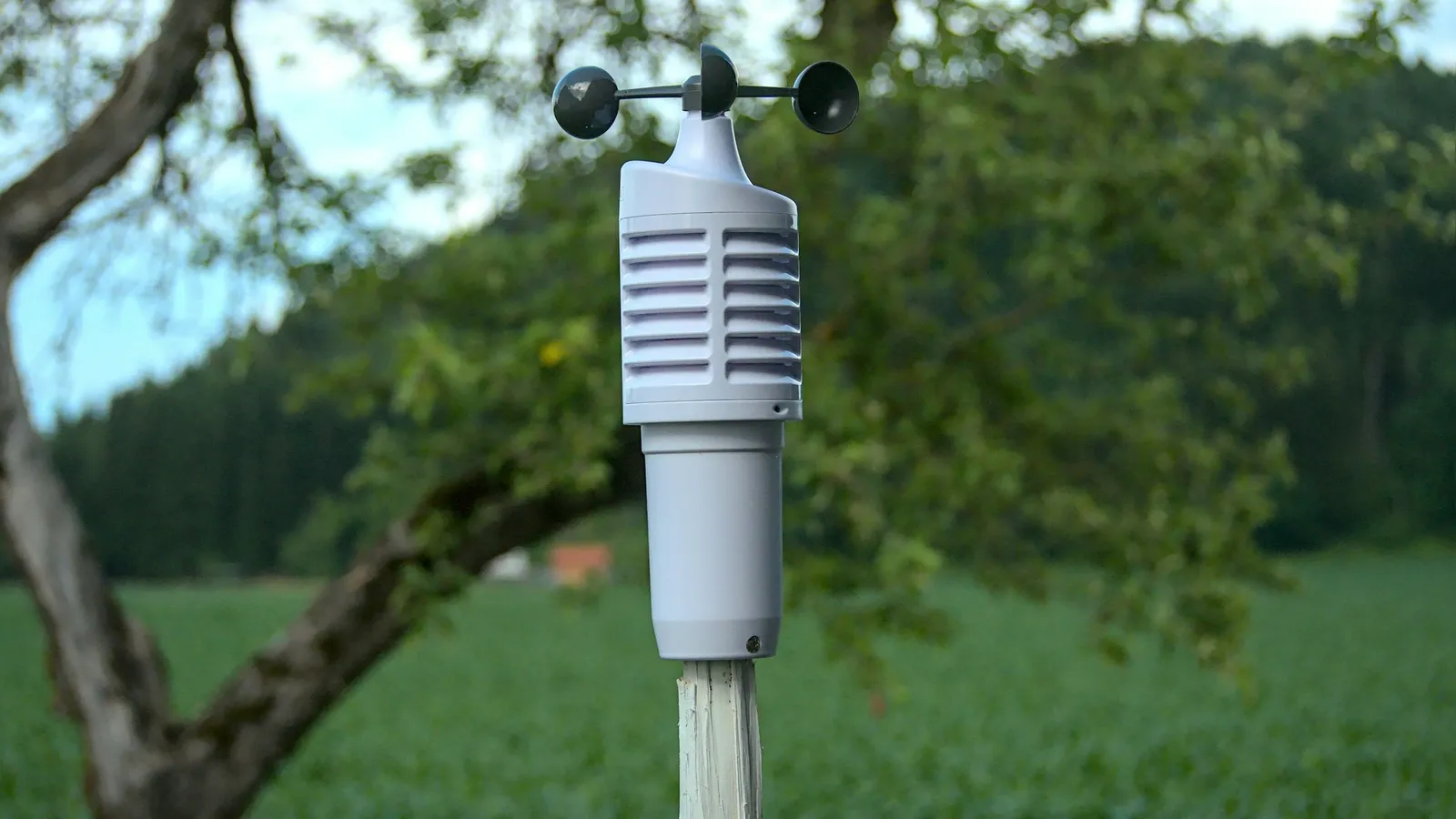
The WMO article says she joined the India Meteorological Department (IMD) in 1948 and "worked on an ambitious programme that made India self-sufficient by designing and manufacturing its own weather instruments". Her first job was to construct recording rain gauges, hygrographs, thermographs, barographs, barometers and anemographs. Over her career she became an expert in radiosondes, ozone and radiation instruments, anemometers, rain gauges and pyranometers, and rose to Deputy Director-General of the IMD.
The work reached beyond India. The WMO notes that she served on its Commission for Instruments and Methods of Observation advisory working group in the mid-1960s and helped revise the WMO Guide to Instruments and Observing Practices. A photograph in the article shows her at the international radiosonde comparison at Payerne, Switzerland, in 1956.
Worked example: how a rain gauge measures rainfall
Rainfall is reported as a depth, such as 10 mm, not a volume. A rain gauge turns one into the other.
A gauge has a circular funnel 20.0 cm in diameter. After a shower, the collected water measures 314 mL. What was the rainfall in millimetres?
Funnel radius r = 10.0 cm. Area A = πr² = π × 10.0² ≈ 314.2 cm².
314 mL is 314 cm³.
Depth = volume ÷ area = 314 ÷ 314.2 ≈ 1.00 cm = 10.0 mm.
Now see why design matters. If the funnel's rim is dented so the real diameter is 19.6 cm, the area is π × 9.8² ≈ 301.7 cm². The same 314 cm³ would then mean a true rainfall of about 10.4 mm, but anyone using the nominal 20 cm would still report 10.0 mm. A 2% error in diameter gives about a 4% error in rainfall, because area depends on the square of the radius.
Common mistakes to avoid:
Using diameter in place of radius in πr². Your area comes out four times too big.
Mixing mL and cm³ with m². 1 mL = 1 cm³. Keep all lengths in centimetres until the end.
Ignoring how errors grow. A quantity that depends on r² doubles the percentage error in r. Our guide to dimensional analysis as a fast check also helps catch unit slips.
What did she do after the IMD?
She retired from the IMD in 1976 and worked at the Raman Research Institute in Bengaluru. Later, with the Indian Institute of Tropical Meteorology, she set up a field unit for the Department of Science and Technology to assess India's potential solar and wind energy resources. The WMO says she headed this project almost until the end of her life.
Asked what advice she had for young people considering meteorology, she told the WMO: "We have only one life. First equip yourself for the job, make full use of your talents and then love and enjoy the work, making the most of being out of doors and in contact with nature."
What can a student learn from how Anna Mani worked?
Precision is a skill you can practise. Her diamond spectra and her rain gauges needed the same care: know what you are measuring and what could make it wrong.
Physics leads to many careers. She moved from spectroscopy to meteorology to renewable energy, using the same habits each time.
Build what you need. She helped India design and make the instruments it relied on.
If an experiment in your practical file involves a measurement you do not fully understand, the Fermi Concept Library covers every concept in physics with its own lesson, so you can understand the principle before you take readings. For turning a question into your own project, see our guide to a science project that starts from a question.
Try it now: measure the diameter of a cylindrical bottle, leave it outside during the next rain, and calculate the rainfall in millimetres from the depth of water collected.