

On this page
The shores of Lake Michigan are not just sand and water. To Henry Cowles in the 1890s, they were a living map of time.
In 1899, Cowles published "The Ecological Relations of the Vegetation on the Sand Dunes of Lake Michigan" in the *Botanical Gazette* (10.1086/327796). It became a founding document of American ecology. Cowles, a University of Chicago professor, demonstrated that landscapes are not static, but constantly changing, and that the plants themselves drive this change. His work earned the Indiana Dunes the title of the "Birthplace of American Ecology" (NPS).
What is ecological succession on sand dunes?
Ecological succession is the predictable process by which a biological community changes over time. On the dunes of Lake Michigan, it starts with an unstable, wind-swept beach where only hardy annual plants like the sea rocket can briefly take hold.
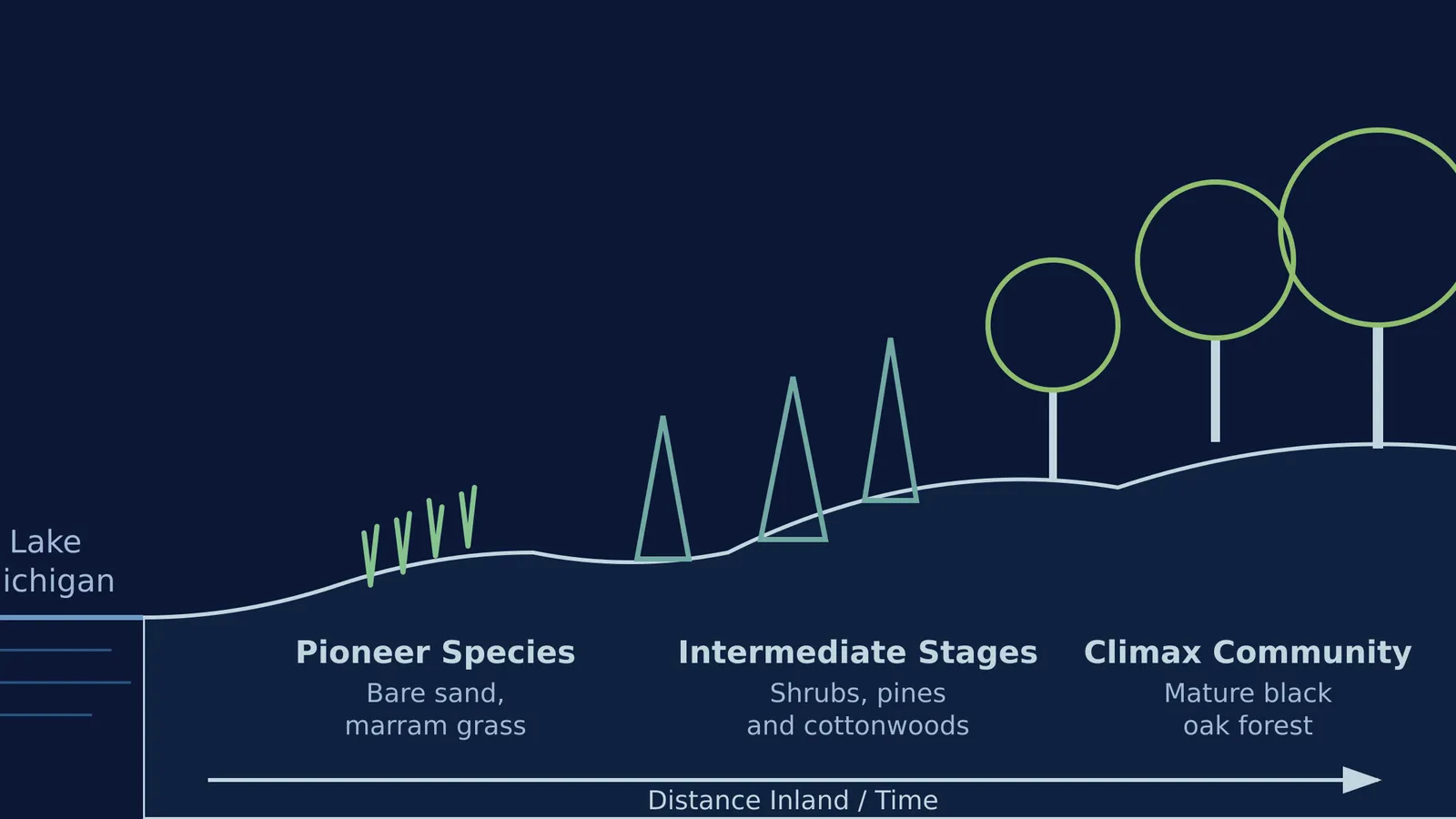
Behind the immediate shoreline, true pioneer species, such as marram grass, begin to survive in the bare sand. These plants act as ecosystem engineers: their deep roots trap the blowing sand and stabilize the growing dunes. As the grasses die and decay year after year, they add organic matter to the ground, slowly creating a thin layer of soil.
This new soil allows shrubs and dune-building trees like Eastern cottonwoods to take root. They provide shade and further enrich the earth, paving the way for little bluestem, wildflowers, and eventually jack pines and white pines. Finally, the environment becomes stable and nutrient-rich enough to support a mature forest, dominated by black and red oaks. Each generation of plants changes the environment in a way that makes it suitable for the next species.
How did Henry Cowles study ecological succession?
Cowles could not wait hundreds of years to watch a forest grow on a beach. Instead, he used a method called "space-for-time substitution," also known as a chronosequence.
Because Lake Michigan's water levels had been slowly falling over thousands of years following the retreat of the glaciers, the lake shoreline had steadily moved away. As the lake receded, it left behind a series of sandy ridges. The dunes furthest from the water were therefore the oldest, having been exposed for the longest time. Cowles realized that as he walked inland from the shore, he was walking through a chronological record of the landscape.
The beach represented the youngest stage, constantly battered by wind and waves. A few hundred yards inland, on slightly older sand, he found the intermediate stages of grasses, shrubs and pines. A mile inland, on the oldest dunes, he found the final stage: stable, mature oak woodlands. By studying these different zones simultaneously, he reconstructed how a single patch of land changes over centuries without having to observe the entire timeline. Cowles shifted the study of plants from a static description of species to a dynamic study of processes over time.
His scientific validation of the dunes' uniqueness provided the primary justification for early efforts to preserve them. Today, you can still walk the Dune Succession Trail at the Indiana Dunes National Park to see the very stages Cowles first described.
If you are studying ecological succession for your biology exams, keeping track of how pioneers give way to a climax community can be difficult if you just read a textbook. Fermi's AI tutor can help. A student brings a topic, a course, a problem set or a scanned assignment. Fermi works out what they already know, builds a plan for the session, and teaches through it — writing on a board, drawing the figure, running the simulation, and checking understanding as it goes.
If you struggle to picture how a barren beach transforms into a forest, the Fermi Simulation Lab has interactive simulations for the ideas that are easier to see than to read.
How can you identify the stages of succession?
When studying succession, do not just memorize the list of plants. Ask yourself these three questions about any ecosystem:
Who is the pioneer? Identify the first organism that can survive the harsh, bare environment (like marram grass on sand, or lichens on bare rock).
How do they change the soil? Look for what the current plants are adding to or taking from the ground (usually adding organic matter, trapping moisture, or changing the pH).
What is the climax? Identify the final, stable community that takes over once the soil is rich and deep enough to sustain a mature forest.
By reading the landscape as a time sequence, Cowles proved that ecology is a dynamic study of processes.
Read more about how other pioneers read the natural world, from Vladimir Vernadsky and the biosphere: life as a geological force to the mathematics of populations in Stabilising, directional and disruptive selection: reading curves.


