On this page
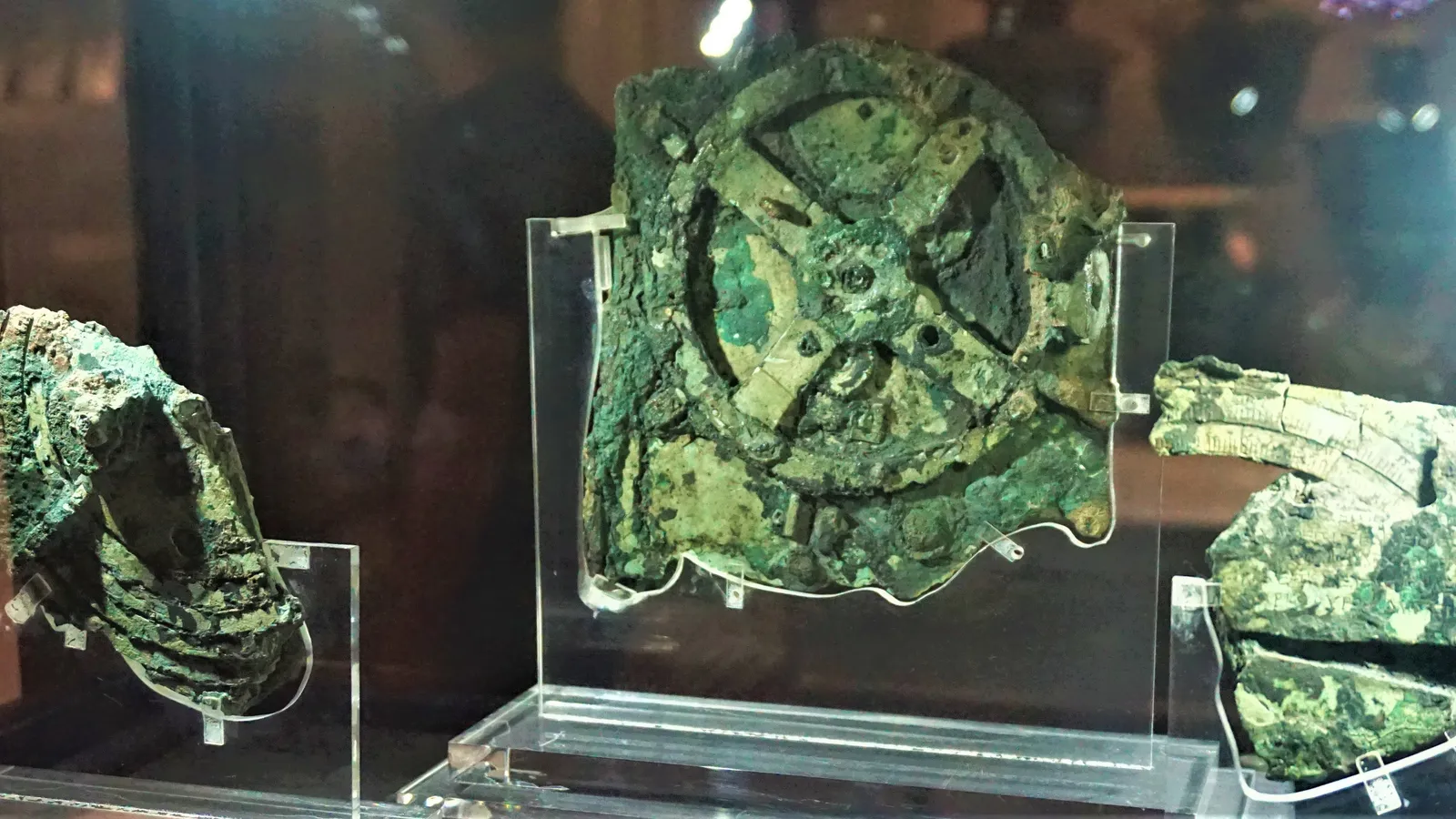
In 1901 a Roman shipwreck off the Greek island of Antikythera gave up lumps of corroded bronze with gearwheels inside. A century later, X-ray scans showed how that machine turned the sky into gear ratios.
What is the Antikythera mechanism?
The Antikythera mechanism is "a unique Greek geared device, constructed around the end of the second century BC", according to Freeth and colleagues in Nature (2006). The same paper calls it "technically more complex than any known device for at least a millennium afterwards".
It calculated and displayed celestial cycles, including the phases of the Moon and a calendar that tracked both the Sun and the Moon (Nature, 2006). Its main drive wheel carried the mean motion of the Sun, and in the 2021 reconstruction the planetary gear trains are mounted on that wheel (Freeth et al., Scientific Reports, 2021).
The back held two spiral dials. The upper one was a 19-year calendar based on the Metonic cycle, laid out as a five-turn spiral; the lower one predicted eclipses on a four-turn spiral of 223 lunar months, with symbols marking the months when an eclipse was due (Freeth et al., Nature, 2008). A small subsidiary dial followed the four-year Olympiad cycle of the Panhellenic Games.
How did CT scans reveal the gear trains?
Only about a third of the original survives: 82 fragments containing 30 corroded bronze gearwheels, 27 of them in the largest piece, Fragment A (Scientific Reports, 2021).
In 2005 researchers used microfocus X-ray computed tomography (CT), which builds a 3D picture from many X-ray images taken at different angles; that scan decoded the structure of the rear of the machine (Scientific Reports, 2021). The maths that makes CT possible has its own story: see our post on Allan Cormack and the mathematics of CT scanning.
The 2006 study doubled the number of deciphered inscriptions (Nature, 2006). In 2016 two numbers, 462 and 442, were read in the Venus and Saturn sections of an inscription; they encode period relations of 289 synodic cycles of Venus in 462 years and 427 of Saturn in 442 years (Scientific Reports, 2021). Using those, the 2021 team proposed a front display of the Sun, Moon and all five planets known in antiquity, with 34 gears in front of the main drive wheel.
How did the Antikythera mechanism predict eclipses?
It predicted lunar and solar eclipses using arithmetic cycles from Babylonian astronomy (Nature, 2006). The key one is the Saros: one Saros equals 223 synodic months, or 6585.3223 days, about 18 years 11 days 8 hours (NASA eclipse website).
The Saros works because three lunar cycles line up. NASA's page shows that 223 synodic months (new Moon to new Moon), 239 anomalistic months (closest approach to closest approach) and 242 draconic months (node to node) all come to about 6585 days, within a few hours of each other. An eclipse needs a new or full Moon close to a node, so when all three repeat, a similar eclipse repeats.
How did gears copy the Moon's uneven speed?
The Moon does not cross the sky at a steady rate. In the second century BC Hipparchos developed a theory for this irregularity, which comes from the Moon's elliptical orbit, and the 2006 study found that theory built into the gearing (Nature, 2006). The trick is a pin-and-slot: two gears on slightly offset axes, with a pin on one riding in a slot on the other, so the output speeds up and slows down once per turn (Scientific Reports, 2021). Later, Ibn al-Shatir built a better model of the Moon.
Work it out yourself: the Saros in four steps
You can check the eclipse dial's logic with a calculator, using NASA's synodic month of 29.530589 days (NASA).
Multiply: 223 x 29.530589 = 6585.32 days.
Divide by 365.25: just over 18 years.
Look at the leftover third of a day, about 8 hours. Earth turns 360 degrees in 24 hours, so the next solar eclipse in the series falls about 120 degrees further west.
Multiply by three: 3 x 6585.32 = 19,755.97 days, almost a whole number. This triple Saros is the Exeligmos, and the 2008 study reads the mechanism's Exeligmos dial as a correction to its predicted eclipse times (Nature, 2008).
Now the gearing: the Saros pointer makes 4 turns in 223 months, so it turns 4/223 of a revolution each month, or one turn every 55.75 months. Every gear train is that same idea, the ratio of teeth setting the ratio of turns, as in how bicycle gears trade torque for speed.
If rotating pointers and lunar cycles are hard to picture from text, the Fermi Simulation Lab has interactive simulations for ideas that are easier to see than to read. For ratio and periodicity questions, the Fermi Problem Library has worked problems with a step-by-step solver that explains the reasoning rather than printing an answer.
Next time an eclipse is forecast, run the four steps: it is the same sum a Greek workshop cut into bronze.