

On this page
By 1366 an astronomer in Damascus had written a book that replaced Ptolemy's model of the Moon. In the 1500s Nicolaus Copernicus used almost exactly the same geometry.
Ibn al-Shatir (1304-1375/6) was the muwaqqit, the official who sets prayer times, at the Umayyad Mosque in Damascus, according to historian Victor Roberts's 1957 paper in Isis. His models are in a book titled Kitab Nihayat as-Sul fi Tashih al-Usul; Roberts worked from a copy made in 1366, in the author's lifetime.
What was wrong with Ptolemy's lunar model?
Ptolemy's lunar model put the Moon anywhere from 33.55 to 64.17 Earth radii away, nearly a factor of two, as physicist Kevin Krisciunas shows in a 2013 paper.
The angle a disc covers in your view is its diameter divided by its distance. So the Moon should look nearly twice as wide at some times as at others. It doesn't. Krisciunas made 100 naked-eye measurements of the Moon over 1,145 days and found regular changes of at least 3 arcminutes around an average of 31.1 arcminutes, about half a degree (arXiv, 2013).
Roberts puts it plainly: the major fault of the Ptolemaic lunar model is "its exaggeration of the variation in lunar distance" (Roberts, 1957). For the bigger picture, see how Ptolemy's Almagest modelled the heavens.
How did Ibn al-Shatir's double-epicycle model work?
Ibn al-Shatir dropped Ptolemy's off-centre circle and added a second epicycle (Roberts, 1957). Picture three moving parts:
A big circle, the deferent, centred on the Earth, with radius 60 units.
A first epicycle of radius 6;35 whose centre rides on that big circle.
A second, smaller epicycle of radius 1;25 riding on the first one. It turns through twice the Moon's angular distance from the Sun. The Moon sits on this small circle.
Because of that "twice" rule, the Moon is always at the near side of the small circle at new and full Moon, and at the far side at the half Moons.
How can you check his numbers yourself?
You can rebuild Roberts's result with school arithmetic, using the values in his paper.
Convert: 6;35 = 6.583 and 1;25 = 1.417.
New or full Moon: the small epicycle points inwards, so the effective radius is 6.583 - 1.417 = 5.167. Distance: 60 ± 5.167, or 54.83 to 65.17 units.
Half Moons: it points outwards, so 6.583 + 1.417 = 8. Distance: 52 to 68 units.
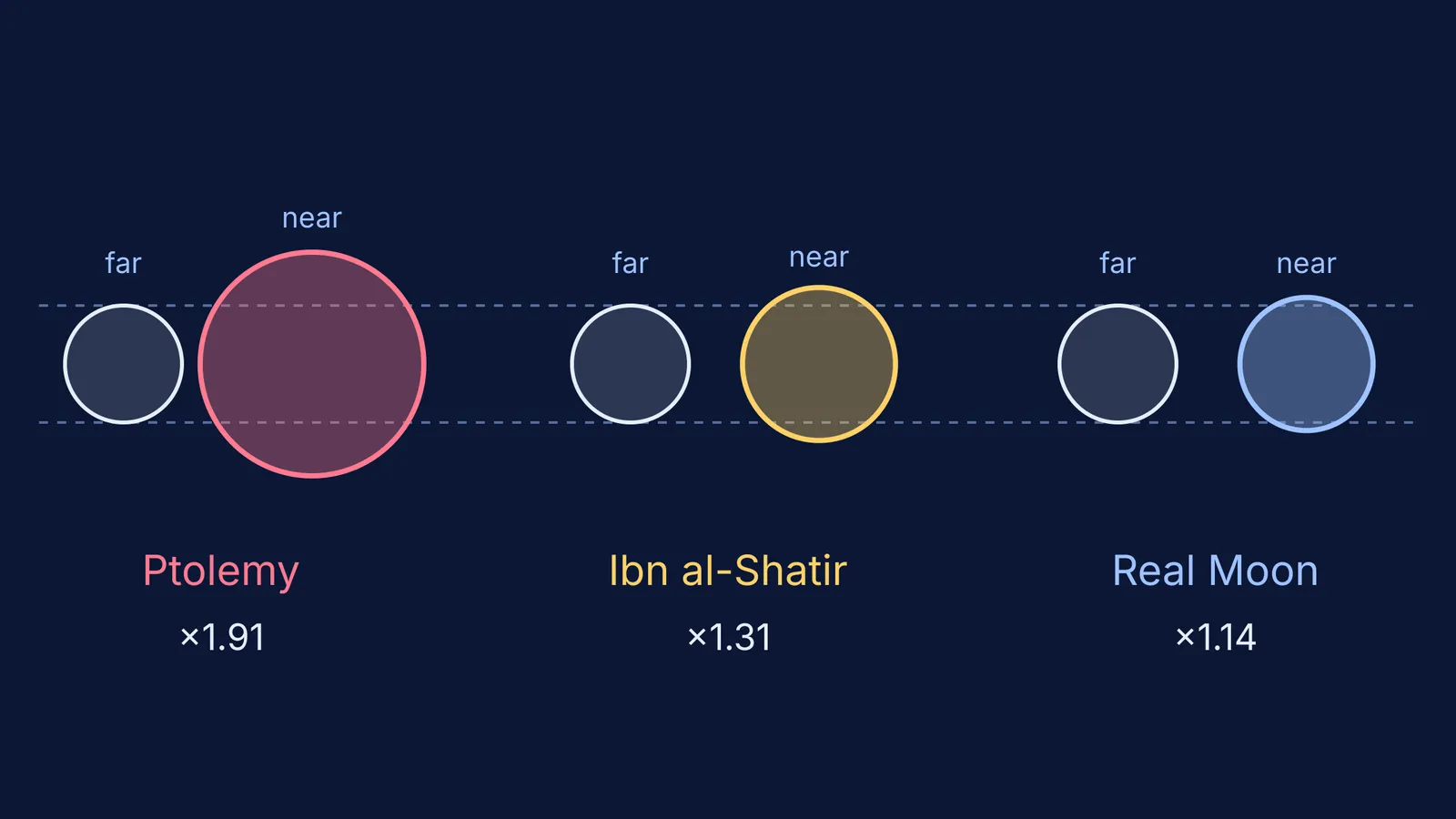
Biggest swing: 68 / 52 = 1.31. Ptolemy's was 64.17 / 33.55 = 1.91 (Krisciunas).
Real Moon: in 2012 almanac data its distance ran from about 56 to 63.7 Earth radii (Krisciunas), a swing of about 1.14.
So Ibn al-Shatir still overstated the change, but far less than Ptolemy. From the model's parameters, Roberts computes that its Moon varies in width between about 29 and 38 arcminutes.
Did Copernicus copy Ibn al-Shatir's model?
The geometry match is not in doubt. Roberts wrote that Ibn al-Shatir's lunar theory, "except for trivial differences in parameters, is identical with that of Copernicus". Copernicus's epicycle radii in De revolutionibus are 6;34,55,12 and 1;25,19,12, against Ibn al-Shatir's 6;35 and 1;25 (Roberts, 1957).
The Stanford Encyclopedia of Philosophy reports that historians Noel Swerdlow and Otto Neugebauer found Copernicus used devices developed by earlier Islamic astronomers, including Nasir al-Din al-Tusi and Ibn al-Shatir. A note to that entry quotes their finding that the lunar model is identical to Ibn al-Shatir's in both the Commentariolus and De revolutionibus, the book Copernicus held on his deathbed in 1543.
How the ideas travelled is still open. Roberts found no evidence that Ibn al-Shatir's books were translated into Latin and allowed that the two men may have reached the same answer independently. The same SEP note records later historians still asking why there is no proof of transmission, while others point to scholars who travelled between the Islamic world and Italy. Same geometry, route unknown. For what Copernicus built on it, see how Copernicus put the Sun at the centre.
What can students take from Ibn al-Shatir today?
Ptolemy's model implied something anyone could check: a Moon that nearly doubles in width. Yet the only ancient or medieval measurements of the Moon's size Krisciunas knows of are by Levi ben Gerson and Ibn al-Shatir (arXiv, 2013). Checking every implication of a model is a habit worth copying. When you finish a physics numerical:
List everything your answer implies, not just the number asked for.
Test one implication against something you know: a limit, a unit, an everyday observation.
If it fails, fix the model, not just the arithmetic.
Keep what works. Ibn al-Shatir kept circles and fixed the distance.
Epicycles on epicycles are hard to picture from words. The Fermi Simulation Lab has interactive simulations for ideas that are easier to see than to read, and the Fermi Concept Library gives every concept in physics and mathematics its own lesson.


