

On this page
Most of us learn the area of a triangle as ½ × base × height. That works well until a question gives you two sides and an angle and no height. The formula ½ab sin C fills that gap, and it takes only three lines to derive from the one you already know.
Why is the area of a triangle ½ab sin C?
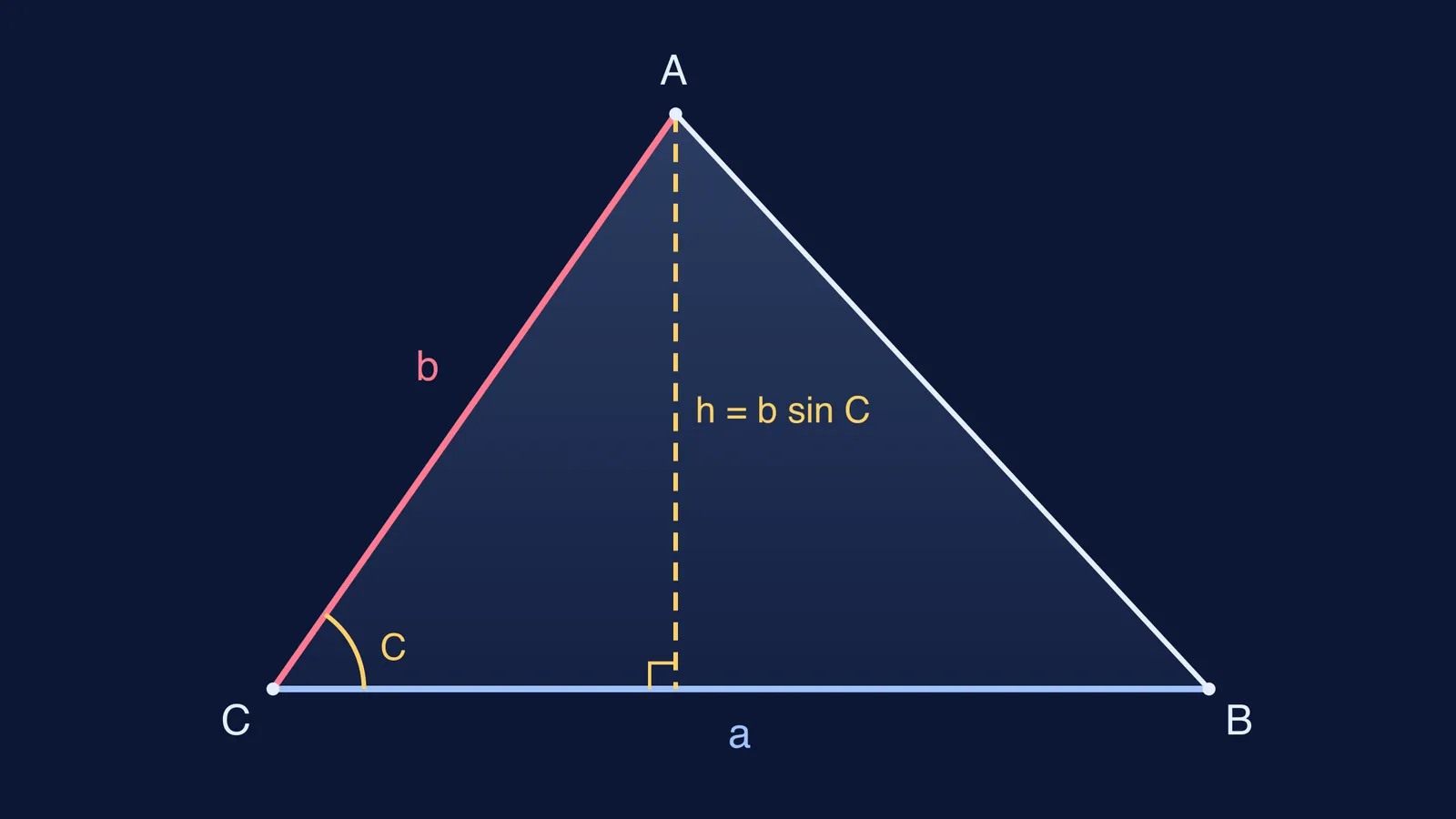
Label the triangle the usual way: side a is opposite angle A, side b is opposite angle B, and C is the angle between sides a and b. Take side a as the base. Drop a perpendicular from the far vertex onto the base; call its length h.
That perpendicular, side b and part of the base make a right triangle. In it, b is the hypotenuse and h is the side opposite angle C. So:
sin C = h / b, which gives h = b sin C.
Area = ½ × base × height = ½ × a × h.
Substitute h: Area = ½ab sin C.
The Wikipedia article on the area of a triangle gives the same derivation, with the height written as a sine of the included angle times the side next to it. It also lists the three equivalent forms: ½ab sin C = ½bc sin A = ½ca sin B. Each one pairs two sides with the angle between them.
Does ½ab sin C work when the angle is obtuse?
Yes. If C is more than 90°, the height lands outside the triangle, on the base extended. The right triangle you use now has the angle 180° − C at C. Its height is b sin(180° − C), and sin(180° − C) = sin C, so the formula does not change. The same Wikipedia article notes that an angle and its supplement have the same sine.
Here is a useful consequence. Take sides 12 cm and 9 cm. With a 30° angle between them, the area is ½ × 12 × 9 × ½ = 27 cm². With a 150° angle between them, the area is also 27 cm², because sin 150° = ½. The triangles differ in shape but share the same height.
Since sin C is at most 1, at C = 90°, two fixed sides enclose the most area when they meet at a right angle: 54 cm² for 12 cm and 9 cm.
How do you use it when two sides and the included angle are given?
Work through it in order.
Check that the angle sits between the two sides you have. If it doesn't, find the included angle first, for example with the angle sum or the sine rule.
Write the formula with the right letters before any numbers go in.
Use exact values for 30°, 45°, 60°, 90°, 120°, 135° and 150°; use a calculator for other angles.
Check the size of your answer: it can never be more than ½ab.
The Maths is Fun page on triangle area works an example with a = 7, b = 10 and C = 25°, and gets an area of about 14.8. Its second example is a field with sides of 150 m and 231 m and an included angle of 123°, and the area comes out at about 14,530 m².
Worked example: a plot of land, checked two ways
A triangular plot has two boundary walls of 40 m and 30 m, meeting at 60°. What is its area?
Area = ½ × 40 × 30 × sin 60° = 600 × (√3/2) = 300√3 m², about 519.6 m².
Now check it without the angle. The cosine rule gives the third side: c² = 40² + 30² − 2 × 40 × 30 × cos 60° = 1600 + 900 − 1200 = 1300, so c = √1300, about 36.06 m. Using Heron's formula for a scalene triangle, the semi-perimeter is about 53.03 m, and the square root of 53.03 × 13.03 × 23.03 × 16.97 is again about 519.6 m². The two methods agree.
Which area formula should you pick?
Let what the question gives you decide:
Base and its perpendicular height: ½ × base × height.
Two sides and the angle between them: ½ab sin C.
All three sides, no angles: Heron's formula.
Coordinates of the vertices: the determinant (coordinate) formula.
Two sides as vectors: half the magnitude of their cross product, which is ½ab sin C written in vector form.
You can also get special-case formulas this way. Put a = b and C = 60°, and ½a² sin 60° becomes (√3/4)a², the area of an equilateral triangle. The same pairing of two sides with their included angle appears in the cosine rule, which you can watch turn into Pythagoras at 90°.
If you keep pairing a side with the wrong angle, the Fermi Problem Library has worked problems with a step-by-step solver that explains the reasoning rather than printing an answer. If sine itself still feels shaky, start with the trigonometry lessons in the Fermi Concept Library.


