

On this page
You have three side lengths, no height and no angle. Heron's formula was built for exactly that. In a scalene triangle no symmetry shortens the arithmetic, but if you factorise before you multiply, you rarely need a calculator.
What is Heron's formula for a triangle with three given sides?
For a triangle with sides a, b and c, the area is √[s(s − a)(s − b)(s − c)], where s = (a + b + c)/2 is the semi-perimeter (Wolfram MathWorld).
It is credited to Hero of Alexandria, who flourished around 60 AD and gave a proof in his *Metrica*, though the historian Thomas Heath suggested Archimedes knew it over two centuries earlier (Wikipedia: Heron's formula). Our profile of Hero of Alexandria and his formula tells that story, and our Class 9 introduction to Heron's formula is the place to start if it is new to you.
How do you find s, s − a, s − b and s − c step by step?
Add the three sides and halve the total. That is s.
Subtract each side from s to get s − a, s − b and s − c.
Check that the three differences add up to s. They always do, because 3s − (a + b + c) = 3s − 2s = s.
Check that all three are positive. If one is zero or negative, the sides break the triangle inequality and no triangle exists.
Do not multiply yet. Write each of the four numbers as a product of primes.
Take one copy of every pair of primes outside the root. Anything unpaired stays inside.
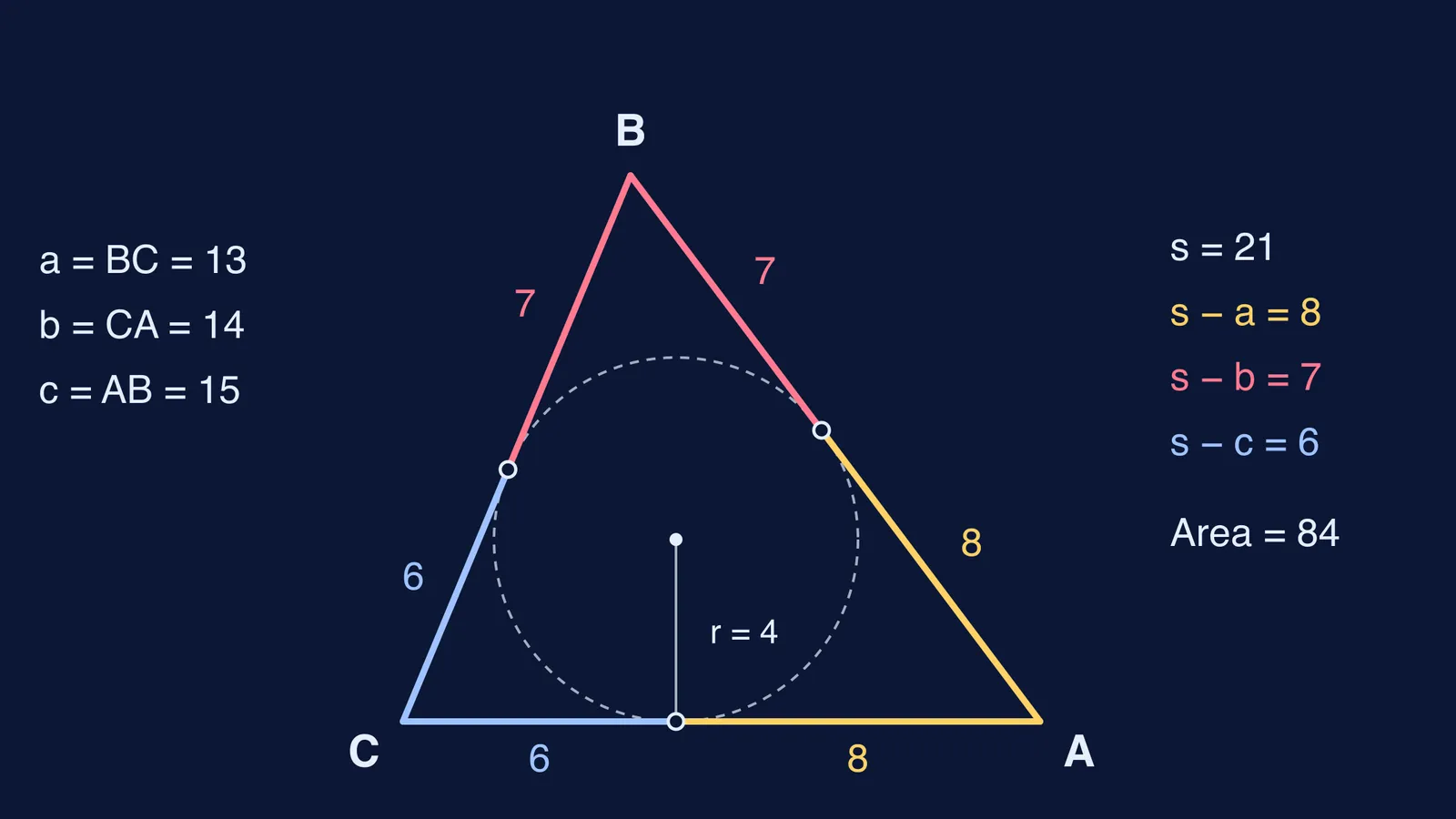
Worked example: what is the area of a triangle with sides 13, 14 and 15 cm?
Take a = 13, b = 14 and c = 15.
s = 42/2 = 21
s − a = 8, s − b = 7, s − c = 6
Check: 8 + 7 + 6 = 21
Under the root you have 21 × 8 × 7 × 6. Factorise instead of multiplying: 21 = 3 × 7, 8 = 2 × 2 × 2, 7 stays 7, and 6 = 2 × 3. Collected, that is 2⁴ × 3² × 7². Every prime appears an even number of times, so the root is 2² × 3 × 7 = 84. The area is 84 cm², with no need to find √7056.
The diagram above shows what the differences mean: the distance from vertex A to where the incircle touches its two sides is exactly s − a, and likewise for B and C (Wikipedia: Incircle and excircles). The same source gives the inradius as r = area/s, so here r = 84/21 = 4 cm, a neat second check.
What if the number under the root is not a perfect square?
Plenty of triangles do not give a whole-number area. Take sides 5, 6 and 7 cm.
s = 18/2 = 9
s − a = 4, s − b = 3, s − c = 2, and 4 + 3 + 2 = 9
9 × 4 × 3 × 2 = (3 × 3) × (2 × 2) × 3 × 2 = 2³ × 3³
Pull out one 2 and one 3; one 2 and one 3 stay inside. The area is 2 × 3 × √6 = 6√6 cm². Leave it in that form unless asked for a decimal. For a refresher on primes, see our comparison of the factor tree and division methods for prime factorisation.
What if the perimeter is odd?
Sides 3, 5 and 7 cm give s = 7.5 and factors 7.5, 4.5, 2.5 and 0.5. To avoid decimals, double all four factors. That multiplies the product by 16, so ¼ comes outside the root. This ¼ version is a standard alternative form of the formula (Wikipedia: Heron's formula). Here it is ¼ √(15 × 9 × 5 × 1) = ¼ √(3³ × 5²) = ¼ × 15√3, so the area is 15√3/4 cm².
What should you check before writing the final answer?
You halved the perimeter.
The three differences add up to s and are all positive.
You factorised before multiplying.
No square factor is left inside the root: write 2√6, not √24.
All sides were in the same unit, and the answer is in square units.
If one step keeps breaking, the Fermi Problem Library has worked problems with a step-by-step solver that explains the reasoning rather than printing an answer, so you can spot where your working differs. For gaps in surds, the Fermi Concept Library gives each concept its own lesson.
Try three on paper now: sides 7, 8, 9 (answer 12√5), sides 9, 10, 17 (answer 36), and sides 6, 8, 10 (answer 24, which you can confirm with ½ × base × height).


