

On this page
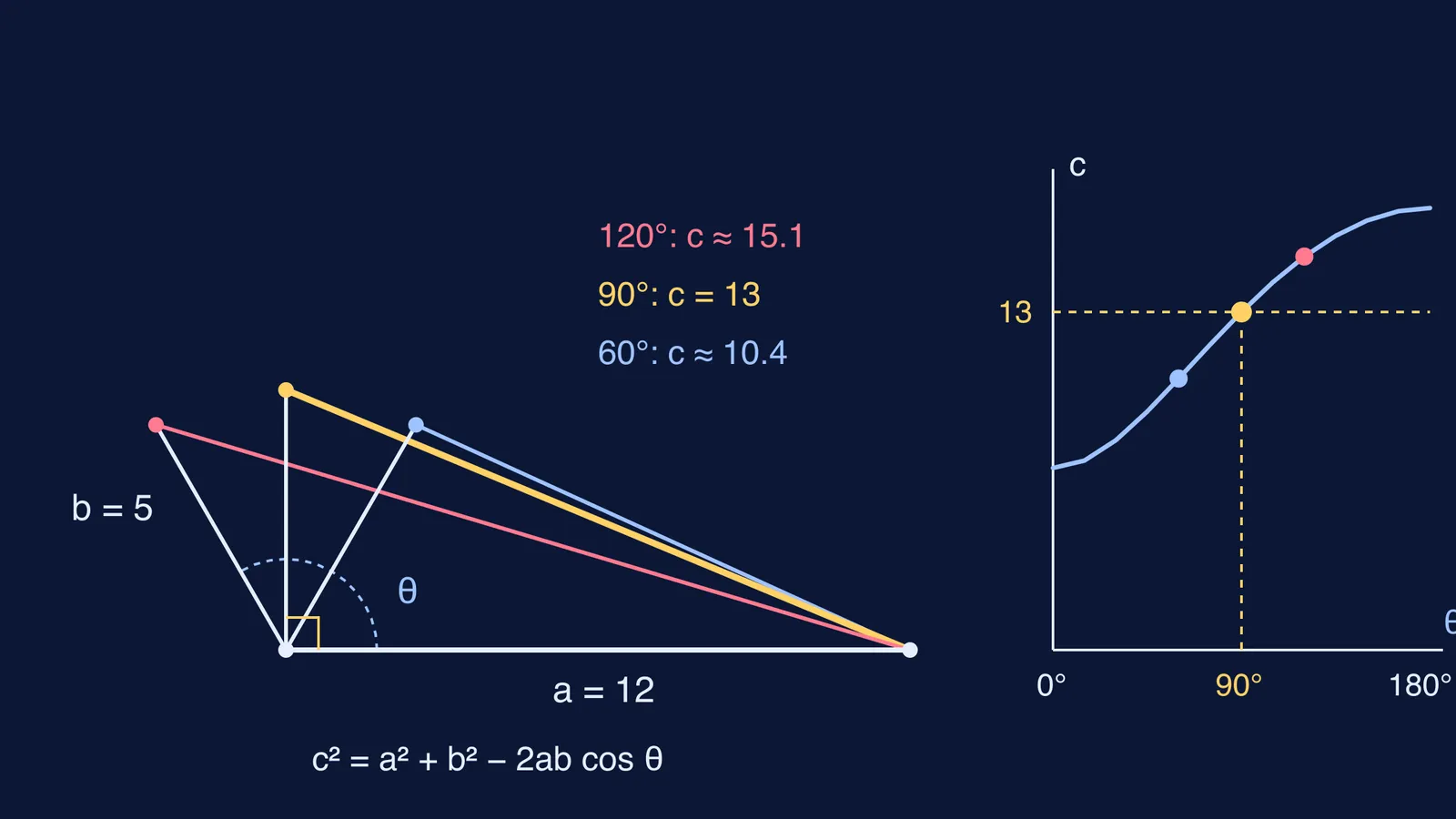
Keep two sides of a triangle fixed at 5 cm and 12 cm, hinge them at one corner, and open the angle between them. Before you measure, write down what you think the third side will be at 60°, 90° and 120°. That guess matters more than the measuring.
What does the cosine rule actually say?
For a triangle with sides a and b meeting at angle θ, the third side c satisfies c² = a² + b² − 2ab cos θ (law of cosines, Wikipedia). The −2ab cos θ term is a correction that measures how far the corner is from a right angle.
Euclid proved a geometric version for obtuse triangles as Proposition 12 of Book II of the Elements, using rectangles instead of cosines (Euclid II.12, Clark University edition), and the acute case as Proposition 13 (Euclid II.13). For how the rule picked up a Persian astronomer's name, read why the law of cosines is called Al-Kashi's theorem.
Why does the cosine rule become Pythagoras at a right angle?
Because cos 90° = 0, the term 2ab cos 90° is zero, and c² = a² + b² is all that remains (law of cosines, Wikipedia). Pythagoras is not a separate rule sitting next to the cosine rule; it is the cosine rule at one particular angle.
If you want to see why a² + b² = c² holds in the first place, try our visual proof of Pythagoras you can rearrange and test.
How does the third side change as the angle opens?
Predict before you calculate. In a study of physics lecture demonstrations, students who only watched understood the concepts no better than students who did not see the demonstration at all, while students who predicted the outcome first showed significantly greater understanding (Crouch, Fagen, Callan and Mazur, American Journal of Physics, 2004). A guess you commit to gives you something to be surprised by.
Answer these on paper first:
At 90°, how long is the third side?
Does it grow by the same amount from 60° to 90° as from 90° to 120°?
What happens when the angle is 0° and when it is 180°?
Worked example: sides 5 and 12
With a = 12 and b = 5, a² + b² = 169 and 2ab = 120, so c² = 169 − 120 cos θ.
0°: cos θ = 1, c² = 49, c = 7. The sides lie on top of each other, so c = 12 − 5.
30°: cos θ ≈ 0.866, c² ≈ 65.1, c ≈ 8.07.
60°: cos θ = 0.5, c² = 109, c ≈ 10.44.
90°: cos θ = 0, c² = 169, c = 13. The familiar 5-12-13 right triangle.
120°: cos θ = −0.5, c² = 229, c ≈ 15.13.
150°: cos θ ≈ −0.866, c² ≈ 272.9, c ≈ 16.52.
180°: cos θ = −1, c² = 289, c = 17. The sides lie in a straight line, so c = 12 + 5.
Notice three things. First, c stays between 7 and 17: the triangle inequality. Second, c² at 60° and 120° sit exactly the same distance from 169 (60 below and 60 above), because cos 120° is the negative of cos 60°. Third, c itself is not symmetric: it is 2.56 short of 13 at 60° but only 2.13 over at 120°. If you predicted equal steps for question 2, that square root is why you were off.
Try it on sides 7, 8 and 12. Since 7² + 8² = 113 and 12² = 144, the angle opposite the 12 side is obtuse, without any calculator.
Where do students go wrong with the cosine rule?
Using the wrong angle. θ must be the angle between a and b, the one opposite c.
Losing the sign for obtuse angles. cos 120° is negative, so the correction term adds to a² + b².
Forgetting the square root at the end.
Reaching for the cosine rule when you are given two sides and an angle that is not between them. That is a sine rule job, and it can have two answers: see the ambiguous case of the sine rule.
If the same slip keeps coming back, the Fermi Problem Library has worked problems with a step-by-step solver that explains the reasoning rather than printing an answer.
A ten-minute test you can run tonight
Draw a 12 cm line and mark one end as the hinge.
With a protractor, draw 5 cm sides from the hinge at 60°, 90° and 120°.
Measure each third side and write it next to your earlier prediction.
Check against the worked example above.
Repeat with your own two sides, predicting the 90° value with Pythagoras first.
A hinge that opens is easier to understand when you can watch it move. The Fermi Simulation Lab has interactive simulations for the ideas that are easier to see than to read, so you can make a prediction and then watch what happens.


