

On this page
You are given two sides and an angle that is not between them. You use the sine rule, find an angle, and move on. Sometimes that is wrong: the same three facts can fit two triangles, or none. This is the ambiguous case, often written SSA (side, side, angle). Here is a quick check that tells you which case you are in.
Why does SSA give more than one triangle?
The sine rule says a/sin A = b/sin B = c/sin C, where each side sits opposite the angle with the same letter (OpenStax Precalculus 2e, section 8.1). When you solve for an angle, you end up with sin B equal to some number.
Sine is positive in both the first and second quadrants, so sin B = 0.7 fits an acute angle and 180° minus it. Your calculator shows only the acute one, the principal value of arcsin. (Revisit the ASTC rule for allied angles and principal values of inverse trigonometric functions if that is hazy.) The real question is whether both values of B fit in a triangle that already contains A.
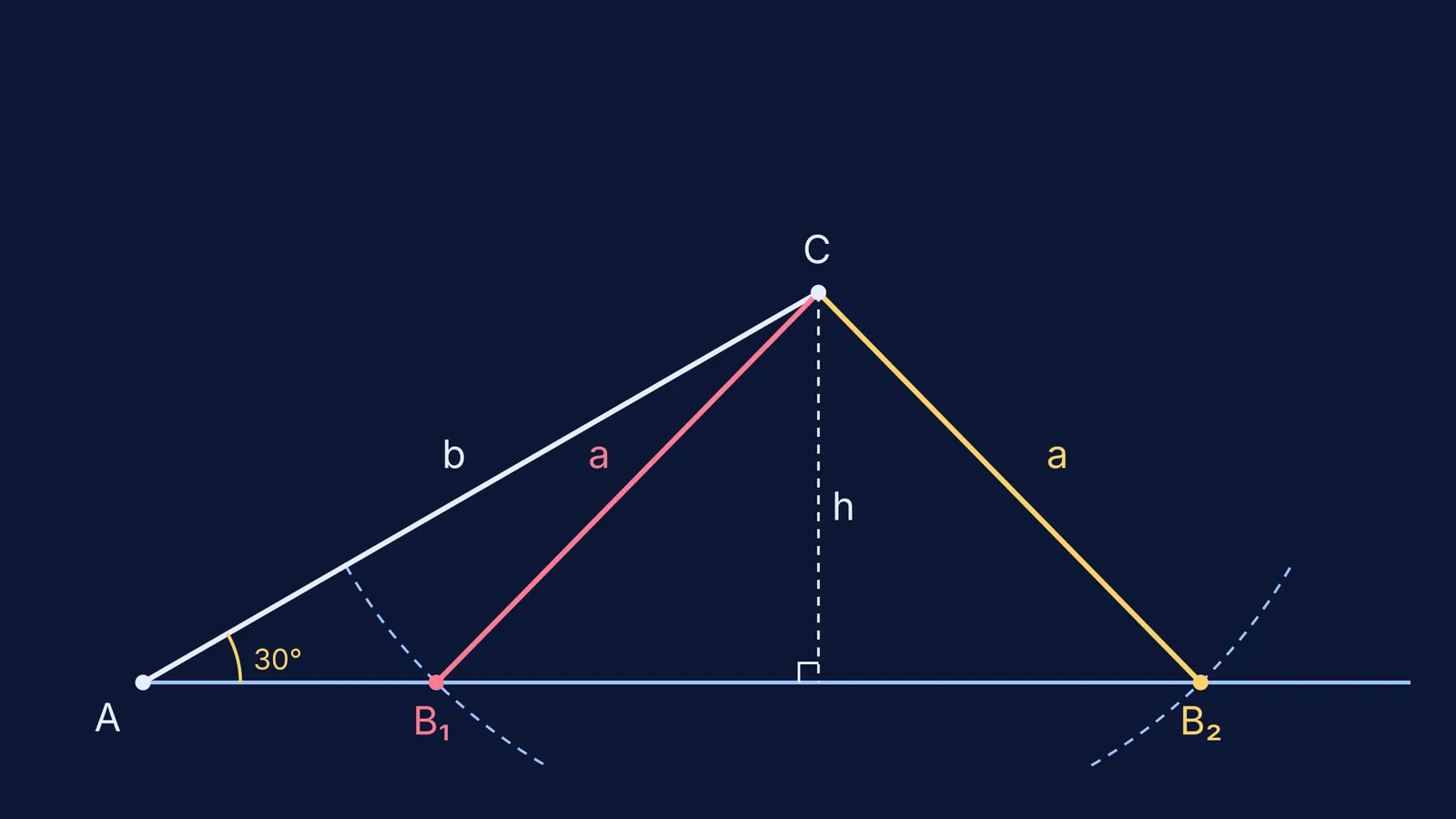
Picture it with a compass. Draw angle A, mark side b along one arm to reach vertex C, then swing an arc of radius a from C. Wherever the arc meets the other arm, you get a triangle.
When are two triangles possible?
Label things this way: A is the given angle, a is the side opposite it, and b is the other given side. The height from C down to the other arm is h = b sin A. The Wikipedia article on the law of sines writes this same altitude as h = c sin α, using its own letters, and lists the conditions for two triangles: the angle is acute, the opposite side is shorter than the other given side, and longer than the altitude.
If A is acute, compare a with h and b:
a < h: no triangle. The arc never reaches the base.
a = h: one right-angled triangle. The arc just touches the base.
h < a < b: two triangles, one with B acute and one with B obtuse.
a ≥ b: one triangle. The second point lies at or behind vertex A, so it does not count.
If A is right or obtuse, there is no ambiguity. A triangle can have only one angle of 90° or more, so you get one triangle if a > b and none if a ≤ b.
A worked example: same angle, four different sides
Take A = 30° and b = 10. Then h = 10 × sin 30° = 5. Now change only a.
a = 4. Since 4 < 5, there is no triangle. The sine rule agrees: sin B = 10 × 0.5 / 4 = 1.25, and no angle has a sine above 1.
a = 5. Since a = h, sin B = 1 and B = 90°. You get one right triangle with C = 60° and c = 5√3 ≈ 8.66.
a = 7. Since 5 < 7 < 10, there are two triangles. sin B = 5/7 ≈ 0.714, so B ≈ 45.6° or B ≈ 134.4°. That gives C ≈ 104.4° with c ≈ 13.56, or C ≈ 15.6° with c ≈ 3.76.
a = 12. Since 12 ≥ 10, there is one triangle. sin B = 5/12, so B ≈ 24.6°. The other value, about 155.4°, plus 30° goes past 180°, so you reject it. That leaves C ≈ 125.4° and c ≈ 19.57.
How can you check the answer with the cosine rule?
Write the cosine rule for the unknown side c as a quadratic: c² - (2b cos A)c + (b² - a²) = 0. The number of positive roots is the number of triangles.
Its discriminant is 4(a² - h²), so there are no real roots when a < h. The product of the roots is b² - a². If h < a < b both roots are positive, giving two triangles. If a > b only one root is positive. For a = 7 above, c = 5√3 ± 2√6, which gives 13.56 and 3.76, matching the sine rule.
What mistakes cost marks here?
Writing down only the calculator's acute angle without asking whether 180° minus it also fits.
Keeping the obtuse value when A plus that value is already 180° or more.
Comparing a with b but forgetting h, which hides the no-triangle and right-triangle cases.
Rounding sin B too early, so an exact 1 becomes 0.999.
To practise, redo the four-case drill with a new angle each day, alongside our practice plan for trigonometric identities and equations. If you get stuck on a solution of triangles problem, the Fermi Problem Library has worked problems with a step-by-step solver that explains the reasoning rather than printing an answer, so you can see where a second triangle came from or why it was rejected.


