

On this page
If you open a high school geometry textbook in France, you will not find the law of cosines listed under that name. Instead, French curricula introduce the formula as the *théorème d'Al-Kashi*. In the 1990s, French educational authorities and textbook authors formally adopted this name in the *Première S* (Grade 11 science) curriculum, replacing older titles like *théorème de Pythagore généralisé* (generalized Pythagorean theorem).
The shift restored credit to the Persian astronomer and mathematician Ghiyath al-Din Jamshid Mas'ud al-Kashi (c. 1380–1429). Working at the Samarqand Observatory under the astronomer-king Ulugh Beg, al-Kashi produced the first explicit trigonometric statement of the law ready for practical numerical calculation. He published it in 1427 in his masterwork *Miftāḥ al-Ḥisāb* (*The Key to Arithmetic*), as documented by the MacTutor History of Mathematics archive.
Why is the law of cosines called the Al-Kashi theorem in France?
For any triangle with side lengths a, b, and c and opposite angle A:
a² = b² + c² − 2bc cos A
When angle A is a right angle (90°), cos 90° = 0, and the formula simplifies directly to the Pythagorean theorem: a² = b² + c². But when angle A is acute or obtuse, the term −2bc cos A provides the exact correction.
French educators adopted al-Kashi's name because he bridged classical geometry and practical triangulation. Astronomers and surveyors in Samarqand needed to compute distances between mountain peaks or stars without drawing massive scale figures on parchment. By embedding trigonometric tables directly into triangle relationships, al-Kashi showed how to calculate an unknown side from two known sides and their included angle in a single algebraic step.
We explored his computational prowess in our look at how Jamshid al-Kashi calculated pi to sixteen digits. That same numerical precision drove his work on trigonometry.
How did Euclid's geometric areas differ from Al-Kashi's trigonometry?
Centuries before al-Kashi, ancient Greek geometers studied oblique triangles. In Book II of the *Elements* (c. 300 BCE), Euclid proved two key propositions:
Proposition 12 (obtuse triangles): The square on the side opposite an obtuse angle exceeds the sum of the squares on the sides containing that angle by twice the rectangle formed by one side and the projection of the other, as translated by David E. Joyce at Clark University.
Proposition 13 (acute triangles): The square on the side opposite an acute angle is less than the sum of the squares on the containing sides by twice the rectangle formed by one side and the internal projection onto it.
Euclid's proofs established relationships between physical geometric areas, as we outlined in our article on Euclid's Elements and proof-based geometry. But Greek geometry lacked negative numbers, angle measures in degrees, and trigonometric ratios. If you knew two side lengths and an angle, Euclid could not tell you the unknown length without constructing auxiliary right triangles and computing proportions by hand.
How did Jamshid al-Kashi turn triangles into calculations?
In Book IV of *Miftāḥ al-Ḥisāb*, titled *On Measurement*, al-Kashi turned geometry into practical computation. As detailed in the scholarly translation by Nuh Aydin, Lakhdar Hammoudi, and Ghada Bakbouk (Springer, 2020), al-Kashi designed the work as a manual for students, surveyors, and astronomers.
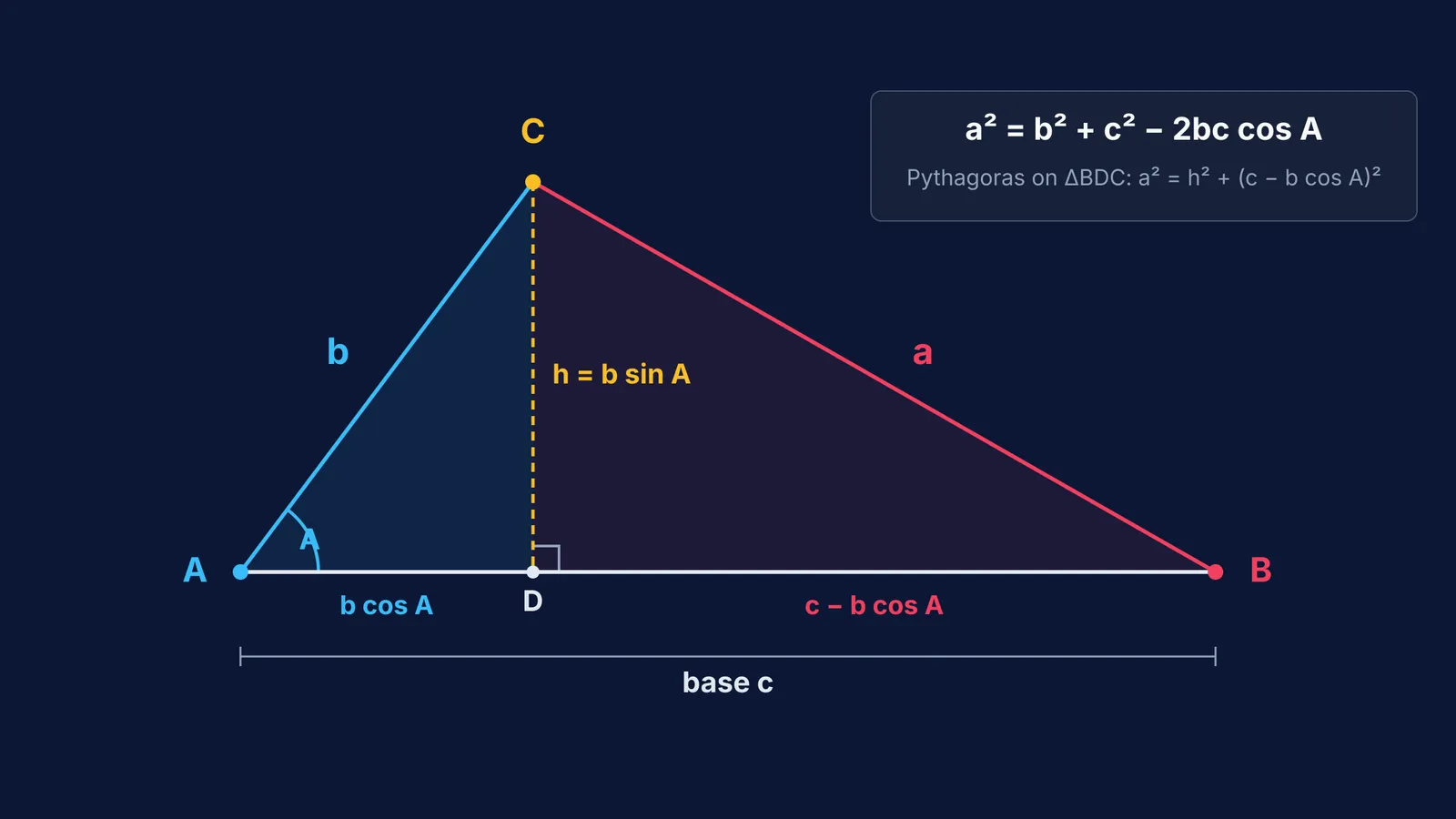
Al-Kashi replaced geometric projections with trigonometric values. By dropping an altitude h from vertex C onto base c:
Base c splits into projection b cos A and remainder c − b cos A.
The altitude equals h = b sin A.
Applying Pythagoras' theorem to the right-hand triangle gives a² = (b sin A)² + (c − b cos A)².
Expanding yields a² = b² sin² A + c² − 2bc cos A + b² cos² A = b² + c² − 2bc cos A.
Because al-Kashi had already tabulated sines to extraordinary precision, this result made solving triangles systematic. Much as Hero of Alexandria's formula found triangle area directly from side lengths, al-Kashi's theorem found unknown sides and angles directly. Later, in 1579, François Viète popularized related forms in France, leading to modern algebraic notation.
When studying triangles or resolving force vectors in physics, keeping these formulas intuitive is essential. In the Fermi Concept Library, every concept in physics, chemistry, biology, mathematics and computing has its own lesson and its place in the map.
How do you apply the theorem in a modern problem?
Consider a triangle where side b = 5 cm, side c = 8 cm, and included angle A = 60°. You need side a. As shown in standard treatments such as Wolfram MathWorld's guide to the law of cosines, solving this triangle can be done either by constructing an altitude or by applying the formula directly.
Method 1: The Euclidean altitude approach
Drop altitude h from C perpendicular to c at D.
Projection AD = b cos 60° = 5 × 0.5 = 2.5 cm.
Altitude h = b sin 60° = 5 × (√3/2) ≈ 4.33 cm.
Remaining base DB = 8 − 2.5 = 5.5 cm.
In right triangle BDC: a² = h² + DB² = (4.33)² + (5.5)² = 18.75 + 30.25 = 49.
Side a = √49 = 7 cm.
Method 2: Al-Kashi's theorem Apply the formula directly:
a² = b² + c² − 2bc cos A a² = 5² + 8² − 2(5)(8) cos 60° a² = 25 + 64 − 40 = 49 a = 7 cm
For an obtuse angle of 120°, cos 120° = −0.5 automatically flips the sign: a² = 25 + 64 − 80(−0.5) = 129, giving a = √129 ≈ 11.36 cm.
When working through geometry and trigonometry problems, choosing whether to use the law of cosines or the law of sines saves valuable time. The Fermi Problem Library provides worked problems with a step-by-step solver that explains the reasoning rather than printing an answer.


