

On this page
Most students memorise (√3/4)a² and then freeze when a question gives the area and asks for the side. If you can rebuild the formula in under a minute, you never need to memorise it, and the reverse questions become easy. Here is the derivation, a check using Heron's formula, and four worked problems.
How do you derive the area of an equilateral triangle formula?
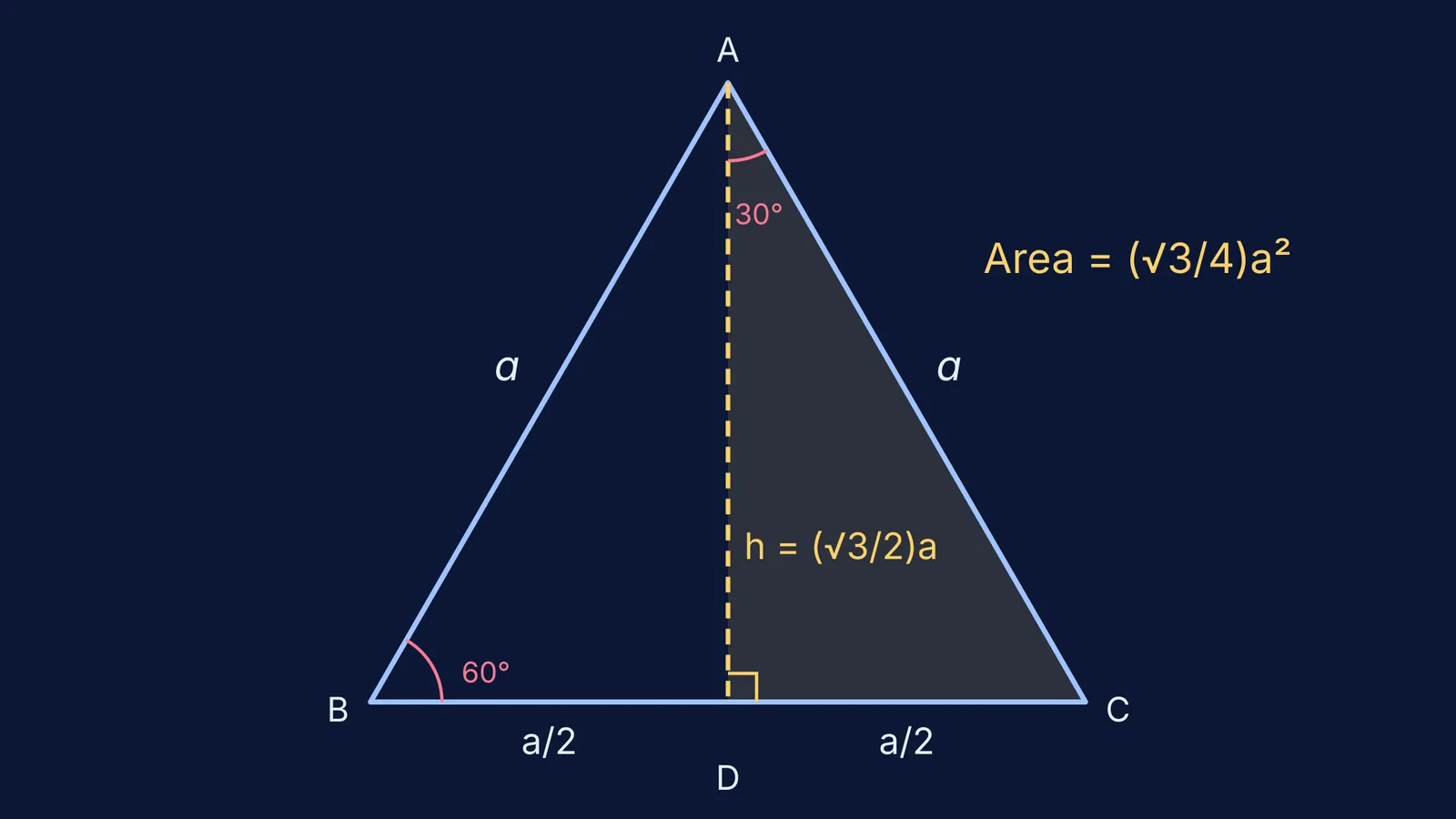
Take an equilateral triangle ABC with every side equal to a. Its area is half of base times height, like any triangle; the only work is finding the height. For why the half is there, read why the area of a triangle is half base times height.
Drop a perpendicular from A to the base BC. Call its foot D. AD is the height h.
D is the midpoint of BC, so BD = a/2 (the next section shows why).
Triangle ABD is right-angled at D. By Pythagoras, h² = a² − (a/2)² = a² − a²/4 = 3a²/4, so h = (√3/2)a.
Area = ½ × base × height = ½ × a × (√3/2)a = (√3/4)a².
Wolfram MathWorld gives the height of an equilateral triangle as a sin 60° = (√3/2)a and its area as (√3/4)a² (MathWorld: Equilateral Triangle). The sin 60° form is the same step seen through trigonometry: in triangle ABD, the angle at B is 60°, so AD/AB = sin 60° = √3/2.
If Pythagoras itself feels shaky, the rearrange-the-squares proof of Pythagoras is worth ten minutes before you go on.
Why does the altitude cut the base exactly in half?
Triangles ABD and ACD share the side AD, both have a right angle at D, and their hypotenuses AB and AC are both a. By RHS congruence, the two triangles are identical, so BD = DC = a/2. The same congruence shows the altitude also splits the 60° angle at A into two 30° angles. That is why every equilateral triangle hides two 30-60-90 triangles, with sides in the ratio 1 : √3 : 2.
Can you check (√3/4)a² with Heron's formula?
Yes, by a completely different route. Heron's formula gives the area of any triangle as √(s(s − a)(s − b)(s − c)), where s is half the perimeter (MathWorld: Heron's Formula).
For an equilateral triangle, s = 3a/2 and each bracket is s − a = a/2. So the area is √((3a/2) × (a/2)³) = √(3a⁴/16) = (√3/4)a². Two methods, one answer.
How do you find the side of an equilateral triangle from its area?
Reverse each step. From A = (√3/4)a², you get a² = 4A/√3, so a = √(4A/√3). Keep the √3 as long as you can; the numbers often come out clean.
Worked examples:
Area 16√3 cm². a² = 4 × 16√3/√3 = 64, so a = 8 cm. Perimeter = 24 cm.
Area 100 cm². a² = 400/√3 ≈ 230.94, so a ≈ 15.20 cm.
Height 6 cm, find the area. a = 2h/√3 = 12/√3 = 4√3 cm. Area = (√3/4) × 48 = 12√3 ≈ 20.78 cm². A shortcut worth deriving yourself: area = h²/√3.
Perimeter 30 cm, find the height. a = 10 cm, so h = 5√3 ≈ 8.66 cm.
When a question gives you one measurement, use this order:
Given the side: use h = (√3/2)a and A = (√3/4)a² directly.
Given the perimeter: divide by 3 to get a, then step 1.
Given the height: a = 2h/√3, then step 1.
Given the area: a = √(4A/√3), then step 1.
The same triangle turns up inside other shapes. A regular hexagon is six equilateral triangles, which is how you get its area in splitting a hexagon into triangles.
What mistakes cost marks here?
Using a, not a/2, as the short leg in Pythagoras. That gives h = 0, a sign something went wrong.
Writing √3/2 a² for the area. That is the height times a, so you forgot the ½.
Forgetting the square root in the reverse direction and reporting a² as the side.
Rounding √3 to 1.7 in the middle of a problem. Keep the surd until the last line.
Dropping units, or writing cm instead of cm² for an area.
If a reverse question keeps going wrong at the same line, the Fermi Problem Library has worked problems with a step-by-step solver that explains the reasoning rather than printing an answer, so you can see which step broke. For background ideas such as congruence, the Fermi Concept Library covers every concept in mathematics, each with its own lesson.
Try it now: derive (√3/4)a² from a blank page, then find the side of a triangle with area 25√3 cm². You should get 10 cm.


