

On this page
Lagrange's theorem says a subgroup's order must divide the group's order. It does not promise that such a subgroup exists. The Sylow theorems go the other way, turning questions about structure into arithmetic you can do in the margin.
They are named after Ludwig Sylow, a Norwegian who taught at a secondary school in Fredrikshald (now Halden) from 1858 and only got a university post in 1898, according to his MacTutor biography. His paper "Théorèmes sur les groupes de substitutions" appeared in Mathematische Annalen in 1872.
What are the Sylow theorems?
Write the order of a finite group G as |G| = p^n m, where p is a prime that does not divide m. A subgroup of order p^n, the largest power of p allowed, is called a Sylow p-subgroup. The three theorems, as stated in the Wikipedia article on the Sylow theorems and in Keith Conrad's notes on their consequences, are:
Existence. G has a Sylow p-subgroup for every prime p dividing |G|.
Conjugacy. Any two Sylow p-subgroups P and Q are conjugate: Q = gPg^-1 for some g in G.
Counting. The number n_p of Sylow p-subgroups divides m, and n_p ≡ 1 (mod p).
Compare our post on Lagrange's theorem and group order: Lagrange rules sizes out, Sylow rules prime-power sizes in.
How do you count Sylow p-subgroups?
The third theorem gives two filters. List the divisors of m, then keep only those that leave remainder 1 when divided by p. Often only 1 survives.
Why does n_p = 1 matter? A conjugate of a Sylow p-subgroup is again one, so if there is only one, it equals all its conjugates. Conrad states this as his Theorem 3.1 in the same notes: the condition n_p = 1 means the Sylow p-subgroup is a normal subgroup.
The filters do not always force 1. In the alternating group A5, of order 60 = 2^2 × 3 × 5, Conrad's notes show that n_3 = 10 and n_5 = 6, both allowed by the rules. The Wikipedia article calls A5 the smallest simple non-cyclic group.
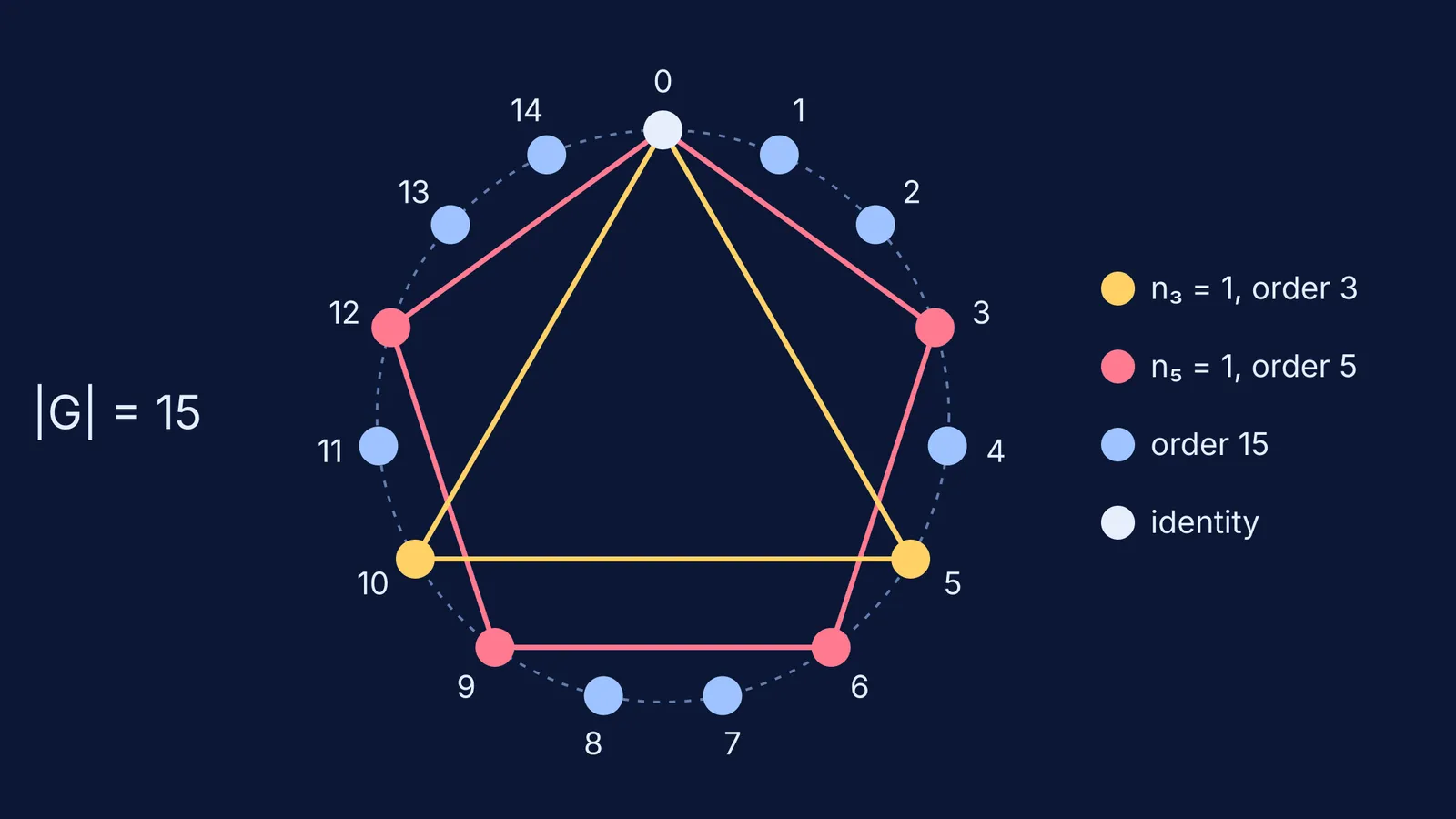
Why is every group of order 15 cyclic?
15 = 3 × 5. For p = 3, n_3 divides 5, so n_3 is 1 or 5. Only 1 leaves remainder 1 when divided by 3. So n_3 = 1.
For p = 5, n_5 divides 3, so n_5 is 1 or 3. Only 1 leaves remainder 1 when divided by 5. So n_5 = 1.
Count elements. The single subgroup of order 3 holds the identity and 2 elements of order 3. The single subgroup of order 5 holds the identity and 4 elements of order 5. Every element of order 3 or 5 generates one of these subgroups, so there are no others.
That accounts for 1 + 2 + 4 = 7 elements. The other 8 have an order that divides 15 but is not 1, 3 or 5. So each has order 15, and any one of them generates the whole group.
So there is only one group of order 15 up to isomorphism, as the Wikipedia article also shows by a different route.
Why is there no simple group of order 20?
A simple group has no normal subgroups except the trivial one and itself. To show that no group of order 20 is simple, you only need one normal subgroup in between.
20 = 2^2 × 5, so take p = 5 and m = 4.
n_5 divides 4, so n_5 is 1, 2 or 4.
Only 1 leaves remainder 1 when divided by 5, so n_5 = 1.
By Conrad's Theorem 3.1, that single subgroup of order 5 is normal. It is neither trivial nor the whole group, so the group is not simple.
Conrad's notes run this computation on a concrete group of order 20, the affine group of Z/5, and find n_5 = 1 there too.
A four-step routine for any order
Factorise |G| into primes.
For each prime p, list the divisors of m and keep those that are 1 mod p.
If any n_p is forced to 1, you have a normal subgroup, so the group is not simple (unless |G| is a power of p, when that subgroup is the whole group).
If no count is forced, count elements: n_p subgroups of prime order p give n_p(p - 1) elements of order p, and the total cannot exceed |G|.
The same habit of counting by symmetry runs through Burnside's lemma for counting colourings and through finite fields built by hand.
If a word like conjugate is what stops you, the Fermi Concept Library covers concepts across mathematics. To check your attempt at orders like 35, 45 or 56, the Fermi Problem Library has a step-by-step solver that explains the reasoning rather than printing an answer.


