

On this page
8 is 2³ and 9 is 3²: two perfect powers, one apart. Walk further along the number line and you never find another such pair. In 1844 Eugène Catalan, of the École polytechnique in Paris, wrote to Crelle's journal that he believed this but could not yet prove it, as Yuri Bilu recounts in his Séminaire Bourbaki survey of the proof. The proof took 158 years.
What does Catalan's conjecture say?
A perfect power is a whole number of the form xᵃ with x and a both at least 2, such as 4, 8, 9, 16, 25, 27 and 32.
Catalan's conjecture states that the equation xᵃ − yᵇ = 1 has no solutions in integers x, y, a, b greater than 1 other than 3² − 2³ = 1 (Bilu, Séminaire Bourbaki no. 909).
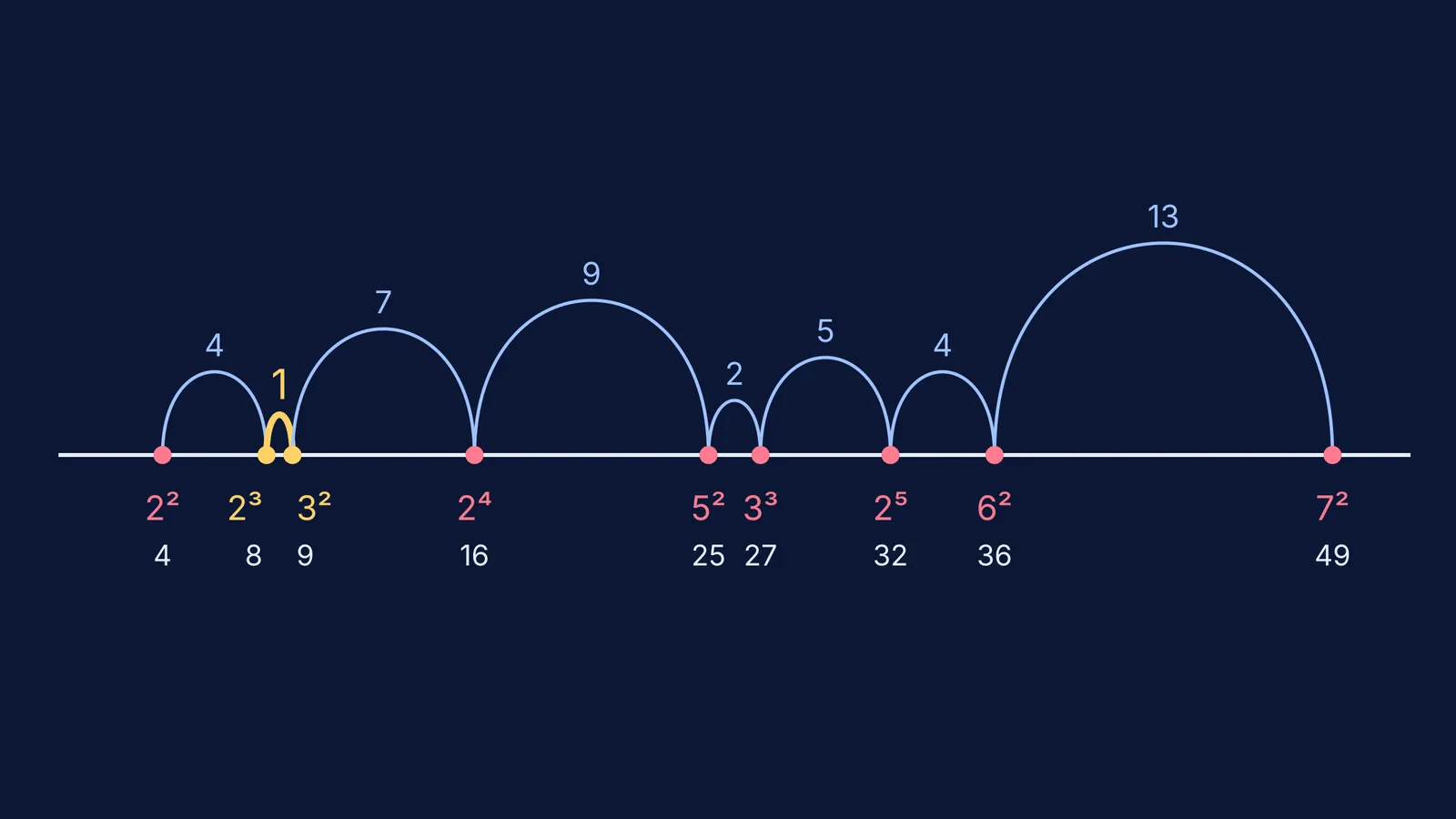
List the perfect powers up to 50 and look at the gaps between neighbours:
4 to 8: gap 4
8 to 9: gap 1
9 to 16: gap 7
16 to 25: gap 9
25 to 27: gap 2
27 to 32: gap 5
32 to 36: gap 4
36 to 49: gap 13
The gaps tend to widen because powers thin out: consecutive squares n² and (n + 1)² are 2n + 1 apart, and cubes are sparser still. Yet small gaps such as 25 to 27 still turn up, so listing alone settles nothing.
Can you prove it by hand for powers of 2 and 3?
Yes, with only remainders and factorising.
Case 1: 3ᵐ − 2ⁿ = 1, with n at least 2.
2ⁿ is divisible by 4, so 3ᵐ leaves remainder 1 on division by 4.
Powers of 3 leave remainders 3, 1, 3, 1, ... so m is even. Write m = 2k.
Then 2ⁿ = (3ᵏ − 1)(3ᵏ + 1): two powers of 2 that differ by 2.
The only such pair is 2 and 4, so k = 1, m = 2 and n = 3. That is 9 − 8 = 1.
Case 2: 2ⁿ − 3ᵐ = 1. Working mod 3 the same way, n is even, so 3ᵐ = (2ᵏ − 1)(2ᵏ + 1), two powers of 3 that differ by 2. They must be 1 and 3, giving 4 − 3 = 1, and 3 is not a perfect power.
Remainder arguments like these also decide which primes are a sum of two squares. If remainders or factorisation feel shaky, the Fermi Concept Library has a lesson for every concept in mathematics.
How did mathematicians close in on it for 158 years?
Bilu's survey gives the main steps:
1844: Catalan's note appears in Crelle's journal.
1850: Victor-Amédée Lebesgue proves that xᵐ − y² = 1 has no solutions in positive integers, so a perfect power is never one more than a square.
1960: J. W. S. Cassels shows that in any solution of xᵖ − y^q = 1 with odd primes p and q, q divides x and p divides y.
1965: Ko Chao proves that x² − yⁿ = 1 has no solutions other than 3² − 2³ = 1.
1976: Robert Tijdeman uses Baker's theory of logarithmic forms to bound the exponents by an explicit constant, reducing the problem to a finite computation (Tijdeman, Acta Arithmetica).
By 2000, any counterexample was known to need exponents p and q between 10⁷ and 10¹⁸.
How did Mihăilescu prove Catalan's conjecture?
Preda Mihăilescu entered the problem in 1999 and had settled it by November 2002, when Bilu presented the proof at the Séminaire Bourbaki; the paper appeared in 2004 (Mihăilescu, Crelle's journal). In outline:
Reduce to xᵖ − y^q = 1 with p and q odd primes: an exponent with no odd prime factor makes a square, which Lebesgue and Ko Chao settled.
Use Cassels' divisibility relations.
Show that any solution forces p^(q−1) ≡ 1 (mod q²) and q^(p−1) ≡ 1 (mod p²), a "double Wieferich pair"; Bilu lists the six such pairs known in 2002, such as (83, 4871).
Use Tijdeman's argument and computations by Mignotte and Roy to show p ≢ 1 (mod q).
Work in the cyclotomic field of a p-th root of unity ζ, where the number (x − ζ)/(1 − ζ) generates an ideal that is a q-th power, and use cyclotomic units to rule out what remains.
Tauno Metsänkylä's Bulletin of the AMS survey sums it up: a deep theorem about cyclotomic fields plays a crucial role in the proof.
For a wider open problem about sums of powers, read our explainer on the abc conjecture.
What should you take from it?
The hand cases above use three moves that recur in olympiad number theory and JEE remainder questions: check remainders, factorise a difference of powers, compare factors. To practise them, try worked problems in the Fermi Problem Library, whose step-by-step solver explains the reasoning rather than printing an answer.


