

On this page
When a sequence settles down, one number describes where it goes: its limit. Many sequences never settle; they bounce between values or wander with no pattern. Limsup and liminf are the two numbers that still describe such a sequence: the highest and lowest values it keeps coming back to.
What are limsup and liminf of a sequence?
There are two equivalent definitions, both given in Wikipedia's article on limit inferior and limit superior.
Subsequential limits. A subsequential limit of (xₙ) is the limit of some subsequence xₙ₁, xₙ₂, … with n₁ < n₂ < …. The limsup is the supremum of the set of subsequential limits, and the liminf is its infimum.
Tail suprema. Drop the first n − 1 terms and look at the tail xₙ, xₙ₊₁, …. Call its supremum Sₙ and its infimum Iₙ. Then limsup xₙ is the limit of Sₙ, and liminf xₙ is the limit of Iₙ, as n → ∞ (MathWorld, supremum limit). As you drop more terms, Sₙ can only fall and Iₙ can only rise, so both limits always exist once you allow +∞ and −∞ (MathWorld, infimum limit).
The two definitions agree, and liminf xₙ ≤ limsup xₙ for every real sequence (Wikipedia).
How do you compute them for (−1)ⁿ(1 + 1/n)?
The first terms are −2, 1.5, −1.333, 1.25, −1.2, 1.167, and so on: odd-numbered terms are −(1 + 1/n) and even-numbered terms are 1 + 1/n.
With subsequences:
The even-numbered terms 1 + 1/n converge to 1.
The odd-numbered terms −(1 + 1/n) converge to −1.
A convergent subsequence has infinitely many odd terms or infinitely many even terms, so its limit is −1 or 1. The set of subsequential limits is exactly {−1, 1}.
So limsup = 1 and liminf = −1.
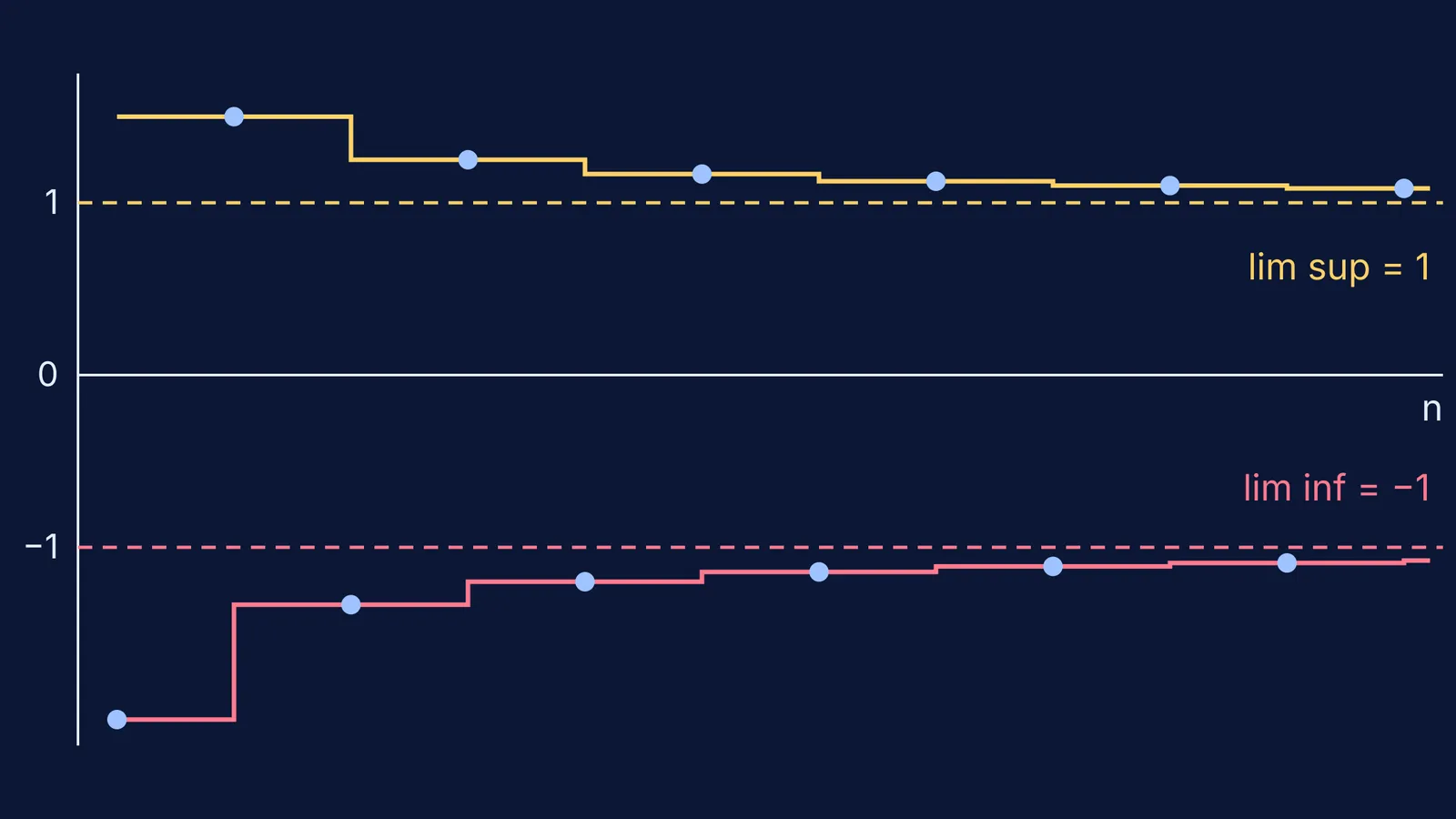
With tails: if n is even, the largest term from position n onwards is xₙ = 1 + 1/n; if n is odd, it is xₙ₊₁ = 1 + 1/(n + 1). Either way Sₙ → 1, and in the same way Iₙ → −1. The diagram at the top draws this: the gold staircase is Sₙ stepping down towards 1, the pink one is Iₙ stepping up towards −1.
What are limsup and liminf of sin n?
Here n is a whole number of radians, so the terms are sin 1, sin 2, sin 3, … ≈ 0.841, 0.909, 0.141, −0.757, −0.959, with no repeating pattern.
The answer is limsup sin n = 1 and liminf sin n = −1 (Wikipedia). MathWorld works the same example: every tail supremum Sₙ equals 1 and every tail infimum equals −1 (MathWorld).
The reason, as Wikipedia notes, is that π is irrational, so the whole numbers 1, 2, 3, … are equidistributed modulo 2π, a consequence of the equidistribution theorem. The angles n therefore land as close as you like to π/2, where sine is 1, and to 3π/2, where sine is −1, again and again.
No term equals 1 exactly: if sin n = 1, then n = π/2 + 2πk for some whole number k, which would make π a fraction. So every tail supremum is 1, yet no term reaches it.
Why does a sequence converge exactly when they agree?
A real sequence converges if and only if limsup xₙ = liminf xₙ and the common value is finite; the limit is then that value. If the two differ, the sequence does not converge (MathWorld).
Why, in two lines:
If they agree at L: every term satisfies Iₙ ≤ xₙ ≤ Sₙ, and both outer sequences tend to L, so xₙ is squeezed to L.
If xₙ → L: every subsequence also tends to L, so L is the only subsequential limit, and its supremum and infimum are both L.
The gap limsup − liminf measures how much a sequence keeps oscillating: 2 for both examples above, 0 for any convergent sequence. Like the Cauchy criterion with its ε–N idea, it lets you test convergence without guessing the limit first.
A four-step method for any sequence
Write out ten terms and look for groups that behave alike: odd and even positions, positions modulo 3, or terms that follow a formula.
Find the limit of each group. These are candidate subsequential limits.
If finitely many groups cover every term and each group has a limit, the largest group limit is the limsup and the smallest is the liminf. If not, as with sin n, work with the tail suprema Sₙ and infima Iₙ instead.
Compare: equal and finite means the sequence converges to that value; different means it oscillates forever.
The same tail-and-supremum thinking returns for sequences of functions in uniform vs pointwise convergence, explained with xⁿ.
If supremum and infimum still feel shaky, the Fermi Concept Library has a lesson on every concept in mathematics. To check your working on a new sequence, the Fermi Problem Library has a step-by-step solver that explains the reasoning rather than printing an answer.


