On this page
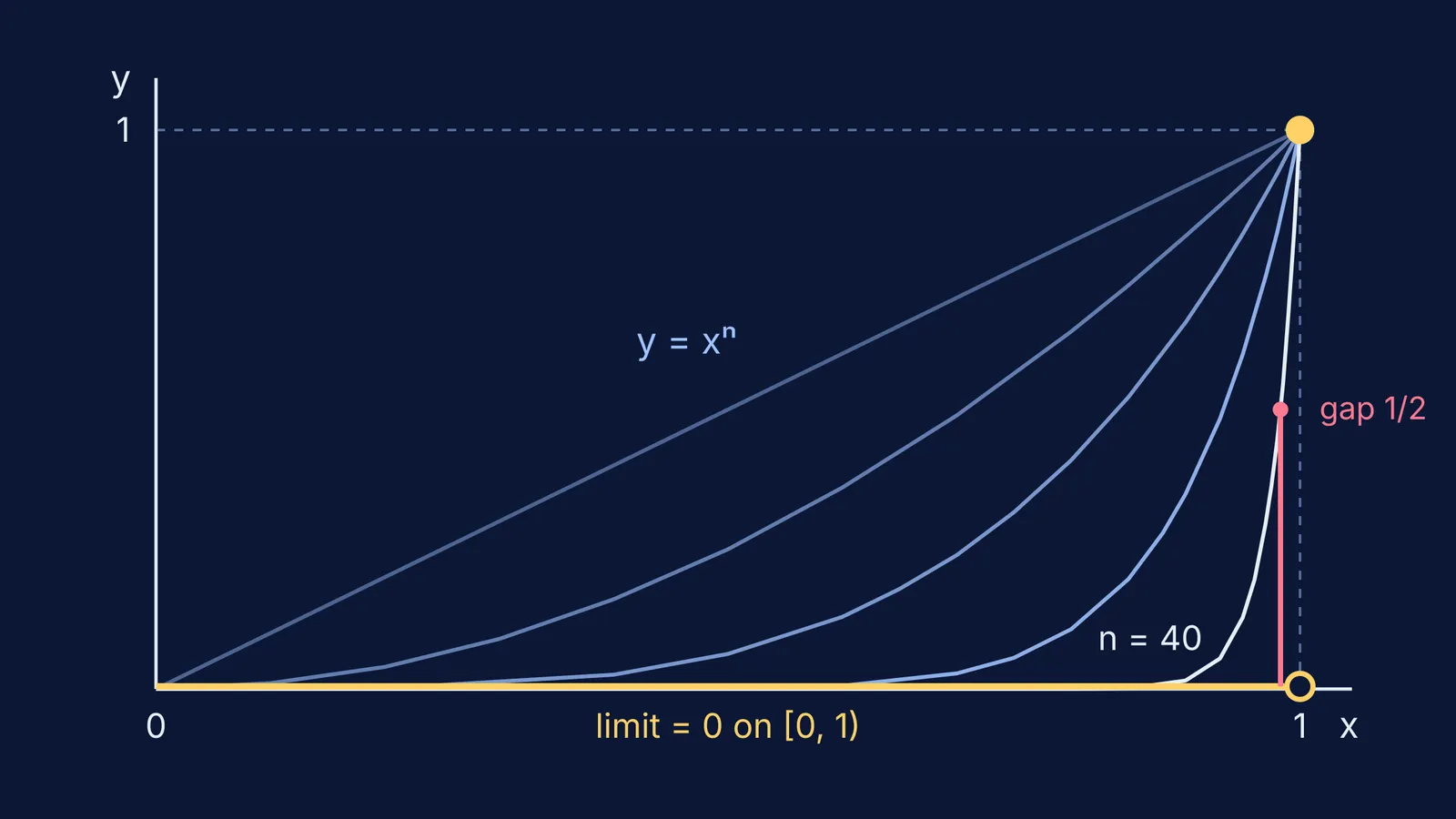
Every curve y = xⁿ on [0, 1] is smooth, yet as n grows the curves settle onto a function with a jump. The difference between pointwise and uniform convergence explains why, and decides when you may swap a limit with an integral.
What is the difference between pointwise and uniform convergence?
Pointwise convergence means that for each fixed x, the numbers fₙ(x) approach f(x) as n grows (Wikipedia: Uniform convergence). Uniform convergence asks for more: for every ε > 0 there is one N that works for all x at once, so that |fₙ(x) − f(x)| < ε for every n ≥ N and every x in the set.
The practical test is the sup norm: fₙ converges uniformly to f exactly when dₙ = sup |fₙ(x) − f(x)|, the largest gap over the whole set, tends to 0 (Wikipedia: Uniform convergence).
Why does xⁿ converge pointwise but not uniformly on [0, 1]?
Fix x in [0, 1). Then xⁿ → 0.
At x = 1, every term is 1, so the limit there is 1.
The pointwise limit is therefore f(x) = 0 for x < 1 and f(1) = 1: a function with a jump.
Now the sup test. For any n, choose x = (1/2)^(1/n). Then xⁿ = 1/2 while f(x) = 0, so the gap is 1/2 however large n is.
Closer to 1 the gap gets as near to 1 as you like, so dₙ = 1 for every n and the convergence is not uniform.
The uniform convergence article uses the same counterexample and shows the sup distance tends to 1. Points near 1 converge ever more slowly, and no single N serves them all. On [0, a] with a < 1, the largest gap is aⁿ, which tends to 0, so there the convergence is uniform.
Why do uniform limits of continuous functions stay continuous?
The uniform limit theorem says that if each fₙ is continuous and fₙ → f uniformly, then f is continuous (Wikipedia: Uniform limit theorem). The proof is the ε/3 argument: go from f(x) to fₖ(x), then to fₖ(y), then to f(y). The outer steps are small because one index k controls the gap everywhere; the middle step is small because fₖ is continuous. With only pointwise convergence, x and y may need different indices, and the chain breaks.
This was not obvious to the people who built calculus. Cauchy published a proof in 1821 that a convergent sum of continuous functions is always continuous, and in 1826 Abel found purported counterexamples among Fourier series (history of uniform convergence). Weierstrass coined the term "gleichmäßig konvergent" (uniformly convergent) in an 1841 paper that was published only in 1894 (same source). As with uniform continuity, where one δ works at every point, "uniform" means one choice serves the whole domain.
How does the Weierstrass M-test prove uniform convergence?
The Weierstrass M-test says that if |fₙ(x)| ≤ Mₙ for every x in the set and ΣMₙ converges, then Σfₙ(x) converges absolutely and uniformly (Wikipedia: Weierstrass M-test). Combined with the uniform limit theorem, a series of continuous functions that passes the test has a continuous sum.
Example: Σ sin(nx)/n². Since |sin(nx)/n²| ≤ 1/n² for every real x, and Σ1/n² converges, the series converges uniformly on the whole real line and its sum is continuous. Absolute convergence also guards against another trap: rearranging a conditionally convergent series can change its sum.
When can you swap a limit and an integral?
If Riemann integrable functions fₙ converge uniformly to f on a closed, bounded interval, then f is Riemann integrable and its integral is the limit of the integrals of fₙ (Wikipedia: Uniform convergence). Pointwise convergence alone is not enough. Take fₙ(x) = 2nx·e^(−nx²) on [0, 1]:
For each fixed x, fₙ(x) → 0, so the pointwise limit is 0 and its integral is 0.
But the integral of fₙ from 0 to 1 is 1 − e^(−n), which tends to 1.
The peak sits at x = 1/√(2n) with height √(2n/e), which grows without bound, so the sup gap blows up.
Uniform convergence is sufficient, not necessary: xⁿ is not uniform on [0, 1], yet its integral 1/(n + 1) tends to 0, matching the limit. The same article notes that the Lebesgue integral gives stronger results needing little more than pointwise convergence; see the Lebesgue integral versus the Riemann integral.
A four-step check for any sequence of functions
Find the pointwise limit f by fixing x.
Compute or bound dₙ = sup |fₙ(x) − f(x)|; the derivative usually finds the maximum.
If dₙ → 0, the convergence is uniform; if points xₙ keep a gap away from 0, it is not.
For a series, try the M-test first.
If a step felt shaky, the Fermi Concept Library gives every concept in mathematics its own lesson and its place in the map. To practise, the Fermi Problem Library has worked problems with a step-by-step solver that explains the reasoning rather than printing an answer.