

On this page
The abc conjecture asks a simple-looking question about sums like 5 + 7 = 12: how do the primes inside a and b limit the primes inside c? It is a central open problem in number theory, yet you can test it with school maths and a calculator.
What does the abc conjecture actually say?
Take three positive whole numbers with a + b = c that share no common prime factor, so they are coprime. The radical of a number, rad(n), is the product of its distinct prime factors, as defined in the Wikipedia entry on the abc conjecture. So rad(72) = 2 × 3 = 6, however many times each prime repeats.
Usually rad(abc) is bigger than c: for 5 + 7 = 12, rad(5 × 7 × 12) = 210. But when a and b are packed with repeated primes, c can win: for 1 + 8 = 9, rad(1 × 8 × 9) = 2 × 3 = 6, which is less than 9.
The abc conjecture, which arose from a 1985 discussion between Joseph Oesterlé and David Masser, says that for every ε > 0 only finitely many coprime triples have c > rad(abc)^(1+ε) (statement and history). In words: c can beat the radical, but it can almost never beat it by a fixed power.
How do you measure the quality of an abc triple?
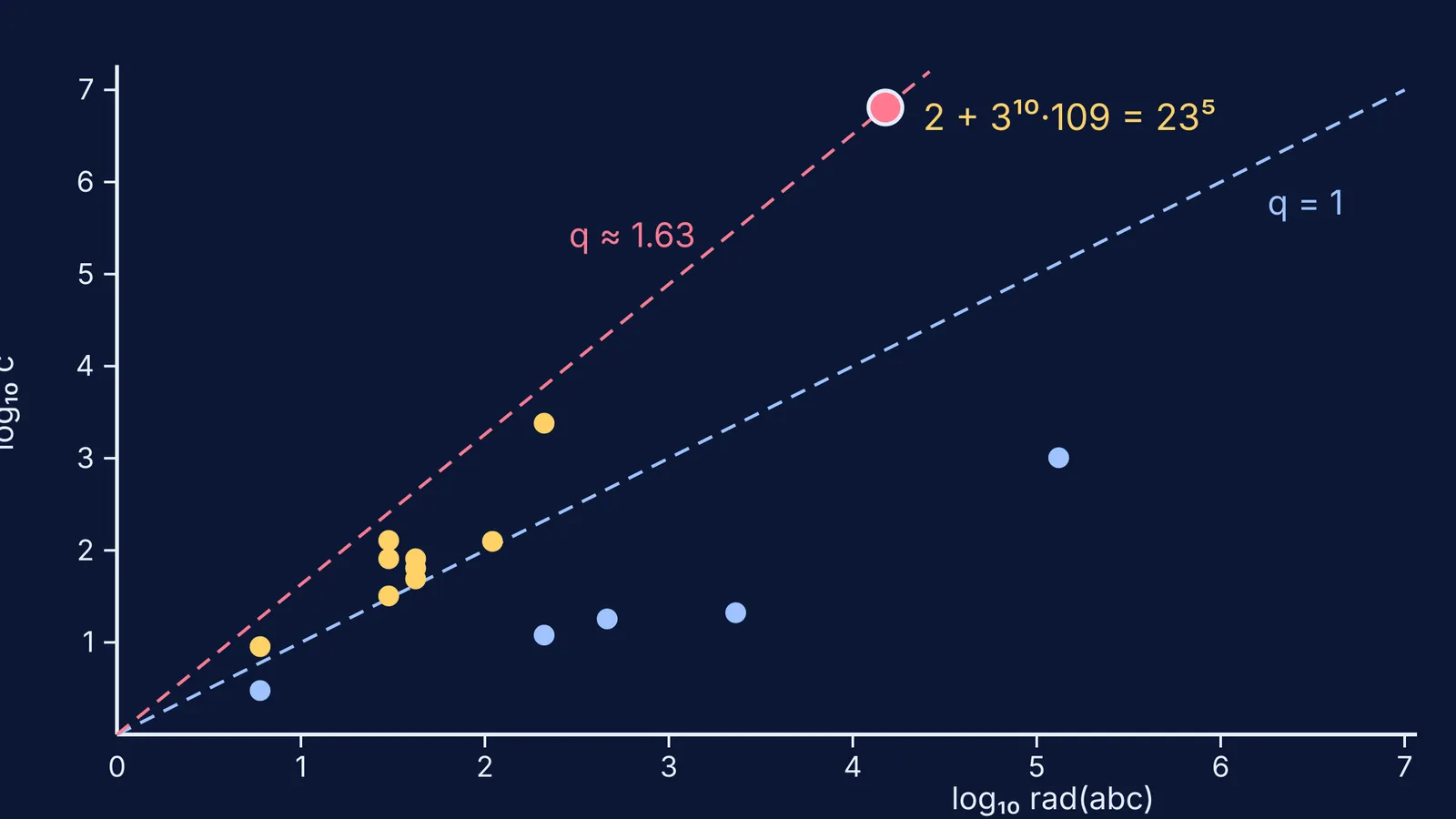
Mathematicians score a triple by its quality, q = log c / log rad(abc), and the conjecture is equivalent to saying only finitely many triples have q > 1 + ε (definition). Any log base gives the same q:
5 + 7 = 12: q = log 12 / log 210 ≈ 0.46. An ordinary triple.
1 + 8 = 9: q = log 9 / log 6 ≈ 1.23. Here c beats the radical.
3 + 125 = 128: rad = 3 × 5 × 2 = 30, so q = log 128 / log 30 ≈ 1.43.
2 + 3¹⁰ × 109 = 23⁵: rad = 2 × 3 × 109 × 23 = 15,042 and c = 6,436,343, so q ≈ 1.63.
The last one is the highest-quality abc triple known: its quality is 1.6299, and it was discovered by Eric Reyssat, according to the table of top triples in the Wikipedia article. Check it by hand: 3¹⁰ = 59,049, times 109 is 6,436,341, and adding 2 gives 6,436,343, which is exactly 23⁵.
What would the abc conjecture prove about Fermat-type equations?
Here is a short argument that shows why the conjecture matters. Suppose xⁿ + yⁿ = zⁿ with x, y, z positive and coprime. Treat it as an abc triple with a = xⁿ, b = yⁿ and c = zⁿ.
The radical ignores powers, so rad(xⁿyⁿzⁿ) = rad(xyz), which is at most xyz.
Since x and y are both smaller than z, xyz < z³.
If every triple had quality below 2, then zⁿ < (z³)² = z⁶, so n would have to be less than 6.
So the unproven statement that q always stays below 2 would rule out Fermat's equation for every n ≥ 6 in three lines; Fermat's Last Theorem "follows easily, at least for n≥6, from an effective form of a weak version of the abc conjecture" (source). Quanta Magazine notes that the conjecture, in certain forms, would give new proofs of both Fermat's Last Theorem and Catalan's conjecture (Quanta Magazine, 2018).
If steps like "the radical ignores powers" or comparing powers of z feel shaky, the Fermi Concept Library covers every concept in mathematics, each with its own lesson and its place in the map.
Did Shinichi Mochizuki prove the abc conjecture?
Shinichi Mochizuki of Kyoto University posted a series of papers on inter-universal Teichmüller theory online in 2012, claiming a proof; the series runs to more than 500 pages (Quanta Magazine).
In 2018 Peter Scholze and Jakob Stix argued that a line of reasoning near the end of the proof of Corollary 3.12, in the third of the four papers, is fundamentally flawed, and Stix called it a "serious, unfixable gap" (same Quanta report).
The papers were published in 2021 in Publications of the Research Institute for Mathematical Sciences, starting with Inter-universal Teichmüller Theory I. Mochizuki, the journal's chief editor, recused himself from the review, and the conjecture "is still regarded as unproven by the mainstream mathematical community" (Wikipedia). The debate continues: in April 2025 Kirti Joshi posted a Final Report on the Mochizuki-Scholze-Stix Controversy to arXiv.
How can you explore abc triples yourself?
Hunting for high-quality triples shows you why they are rare:
Fix a = 1 and pick c as a perfect power, such as 49, 81 or 2401.
Factor b = c − 1 and look for repeated primes.
Compute the radical and q. For 1 + 2400 = 2401, with 2400 = 2⁵ × 3 × 5² and 2401 = 7⁴, the radical is 210 and q ≈ 1.46.
To practise the factorising and the log arithmetic with checked working, the Fermi Problem Library has worked problems with a step-by-step solver that explains the reasoning rather than printing an answer.
Read next: the twin prime conjecture, Bertrand's postulate on primes between n and 2n, and a Fermat question that is fully solved: which primes are a sum of two squares.


