

On this page
Pick any whole number bigger than 1, double it, and a prime always sits strictly between the two. Between 10 and 20 there are four (11, 13, 17, 19); between 50 and 100 there are ten. You can check it with a short list of primes and follow the main idea of a proof with binomial coefficients.
What does Bertrand's postulate say?
Bertrand's postulate states that for every integer n > 1 there is at least one prime p with n < p < 2n, as set out in the Wikipedia article on Bertrand's postulate.
Joseph Bertrand conjectured the result in 1845 and checked it for every integer up to 3,000,000, according to the same article. Pafnuty Chebyshev proved it in 1852, which is why it is also called the Bertrand–Chebyshev theorem. In 1919 Srinivasa Ramanujan published a simpler proof using the Gamma function in the Journal of the Indian Mathematical Society. In 1932 Paul Erdős published a simpler, elementary proof that used binomial coefficients; the proof page calls it one of his earliest mathematical publications.
How can you check it for every n up to 50?
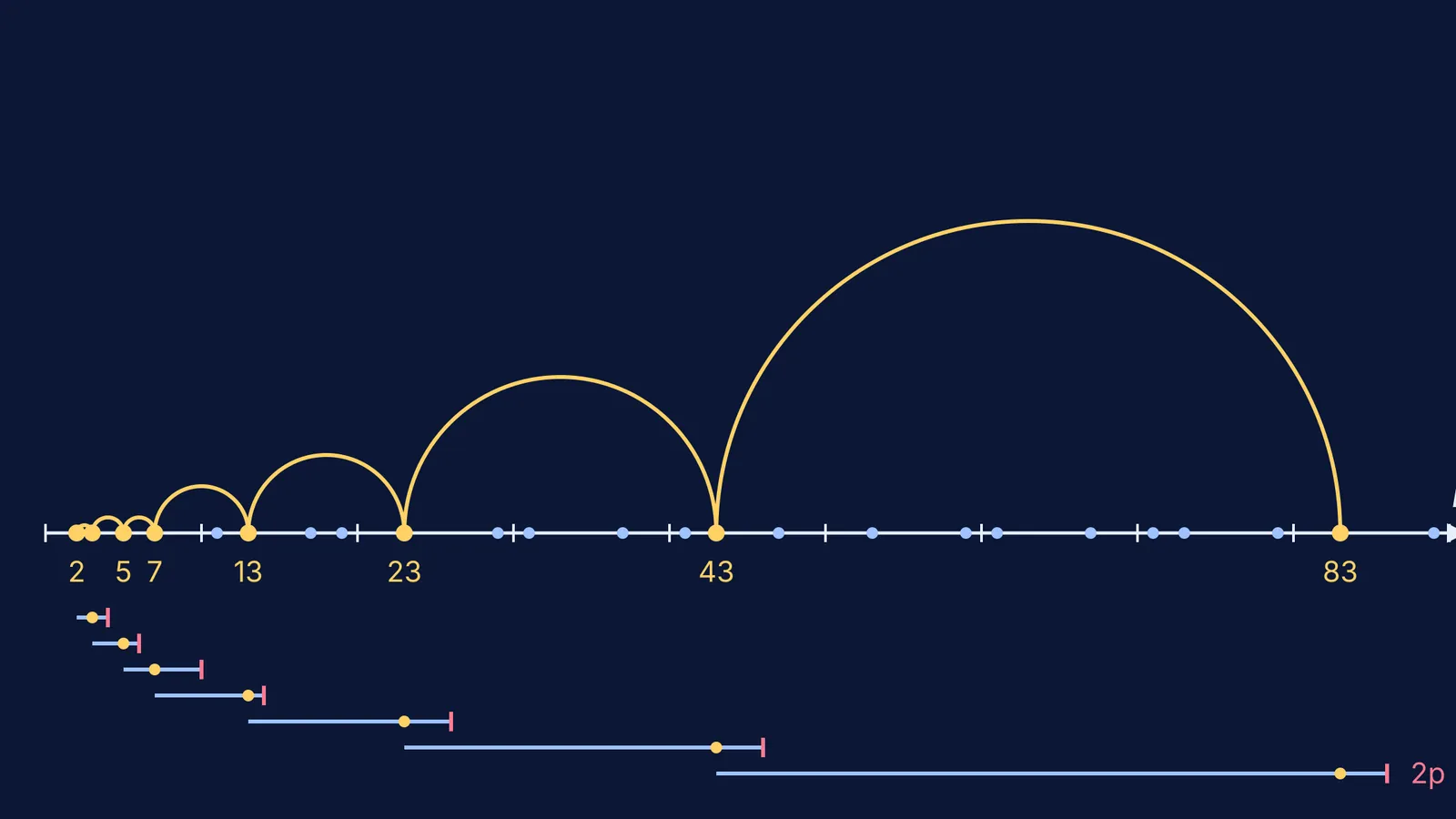
You do not need 49 separate checks. Use a chain of primes in which each prime is less than twice the one before it: 2, 3, 5, 7, 13, 23, 43, 83. The proof write-up uses exactly this kind of list, continued to 163, to settle every n below 128.
Check the chain: 3 < 4, 5 < 6, 7 < 10, 13 < 14, 23 < 26, 43 < 46 and 83 < 86. Every link less than doubles.
For your n, find the largest chain prime p that is at most n. Call the next chain prime q.
Then q > n, because p was the largest chain prime not above n. And q < 2p ≤ 2n. So q lies strictly between n and 2n.
Try n = 12: p = 7, q = 13, and 12 < 13 < 24.
Try n = 50: p = 43, q = 83, and 50 < 83 < 100.
That one chain covers every n from 2 to 82.
How does Erdős's proof use C(2n, n)?
The central binomial coefficient C(2n, n) is the middle entry of row 2n of Pascal's triangle. The proof page builds the argument from four facts about it:
It is large: C(2n, n) ≥ 4^n/(2n), because it is the biggest term in the expansion of (1 + 1)^(2n) = 4^n, whose terms can be grouped into 2n pieces.
Any power of a prime p that divides it is at most 2n.
An odd prime p with 2n/3 < p ≤ n does not divide it at all: the two factors of p in (2n)! cancel the two in n! × n!.
The product of all primes up to x is less than 4^x.
Now suppose no prime lay between n and 2n. Then every prime factor of C(2n, n) would be at most 2n/3, and the last three facts, with a rough count of how many primes there are, force C(2n, n) to be smaller than the first fact allows. The page shows this contradiction holds for every n ≥ 128, and the prime chain handles the rest.
See it with n = 10. C(20, 10) = 184,756 = 2² × 11 × 13 × 17 × 19. The lower bound 4^10/20 = 52,428.8 is indeed smaller. The prime 7 lies between 20/3 and 10 and does not divide it, as the third fact predicts. The primes 11, 13, 17 and 19, the ones between 10 and 20, all appear: they are what the proof is hunting for.
What is still unknown about gaps between primes?
Narrower windows are harder. In 1952 Jitsuro Nagura proved there is always a prime between n and 6n/5 once n ≥ 25, as listed in the Bertrand's postulate article.
Legendre's conjecture asks for a prime between every pair of consecutive squares n² and (n + 1)², and it is still unproved; the Wikipedia article on Legendre's conjecture lists it among Landau's problems of 1912 and reports it holds at least up to n² = 2 × 10^19. Baker, Harman and Pintz proved that for all large x there is a prime between x − x^0.525 and x, but that window is still longer than the gap between consecutive squares near x, which is about 2√x.
Why the difference? The Bertrand's postulate article explains that the prime number theorem predicts roughly n/log n primes between n and 2n, but its error estimates are too coarse to guarantee a prime between consecutive squares. The twin primes conjecture is another gap question that stays open, and if the n = 1 case puzzled you, read why 1 is not a prime number.
If the cancellation step for primes between 2n/3 and n feels slippery, the Fermi Problem Library has worked problems with a step-by-step solver that explains the reasoning rather than printing an answer. For the background on binomial coefficients and primes, each idea has its own lesson in the Fermi Concept Library.


