

On this page
Two primes that differ by 2 are called twin primes: 3 and 5, 11 and 13, 71 and 73. Whether they ever run out is still an open question in number theory, and you can explore it with Class 10 arithmetic.
What is the twin prime conjecture?
The twin prime conjecture states that there are infinitely many pairs of twin primes, as Wolfram MathWorld's entry on the conjecture puts it. MathWorld also notes that nobody knows whether it is true, though it "seems almost certain".
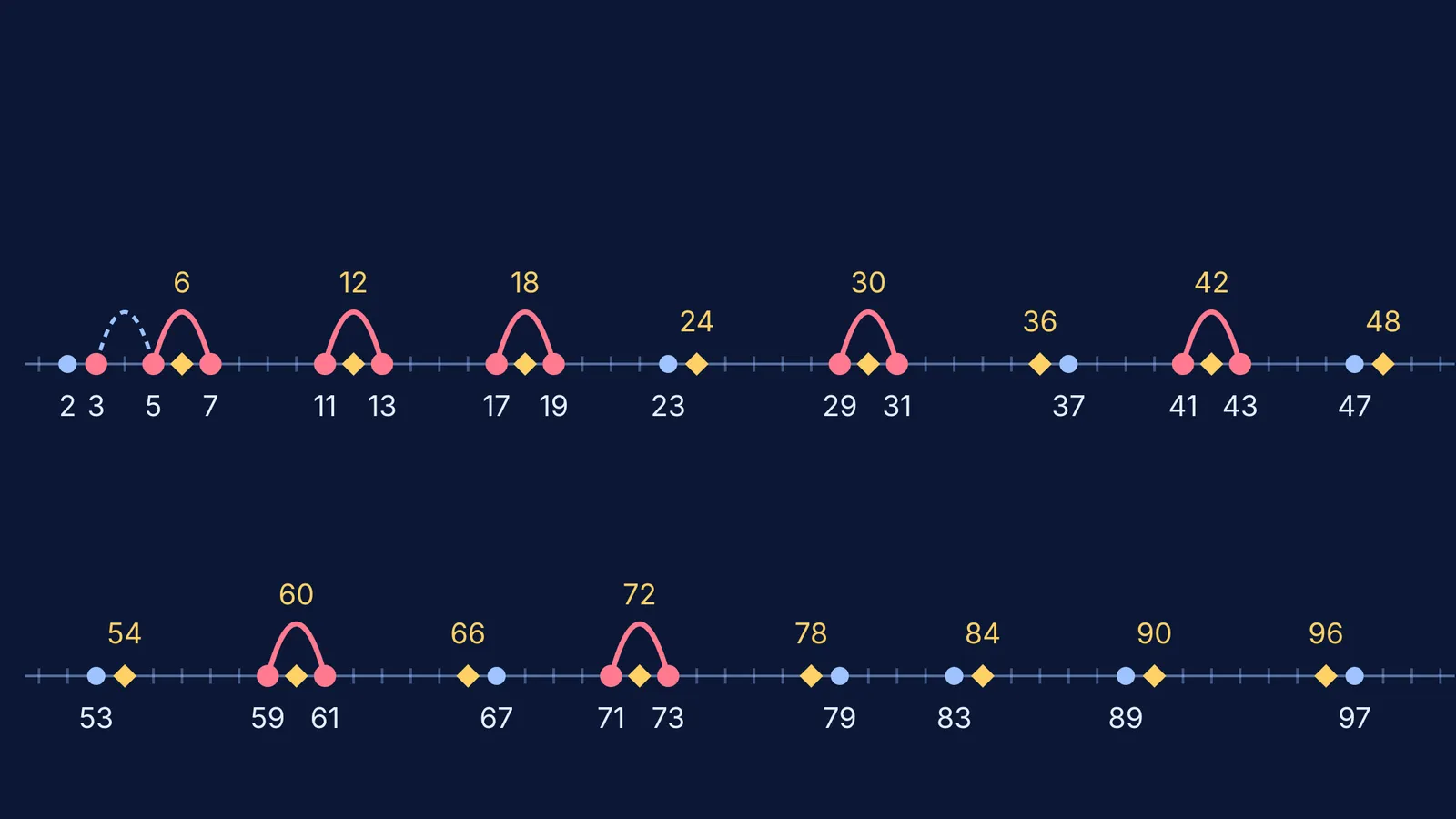
You can list the first pairs yourself. Below 100 there are 8 pairs: (3, 5), (5, 7), (11, 13), (17, 19), (29, 31), (41, 43), (59, 61) and (71, 73). Between 100 and 200 there are 7 more, ending with (197, 199). The largest known pair, listed on PrimePages, was found in September 2016; each number has 388,342 digits.
Why does every twin prime pair surround a multiple of 6?
5 and 7 sit around 6, 11 and 13 around 12, 29 and 31 around 30. Every pair after (3, 5) has a multiple of 6 in the middle. Here is the proof.
Every whole number leaves a remainder of 0, 1, 2, 3, 4 or 5 when divided by 6, so it can be written as 6k, 6k + 1, 6k + 2, 6k + 3, 6k + 4 or 6k + 5.
6k, 6k + 2 and 6k + 4 are even, so the only prime among them is 2.
6k + 3 = 3(2k + 1) is a multiple of 3, so the only prime among them is 3.
Every prime above 3 is therefore 6k + 1 or 6k + 5, which is the same as 6k − 1 for the next k. Two primes above 3 that differ by 2 must be 6k − 1 and 6k + 1, with 6k between them.
The pair (3, 5) is the one exception, because 3 is itself of the form 6k + 3.
The rule works one way only: around 24, 23 is prime but 25 is not. The 6k ± 1 test tells you where to look, not what you will find. Remainder arguments like this one also help explain why primes line up on the diagonals of the Ulam spiral.
What is Brun's constant?
In 1919 Viggo Brun proved that the sum of the reciprocals of twin primes, 1/3 + 1/5 + 1/5 + 1/7 + 1/11 + 1/13 + ..., converges to a finite number (MathWorld, Brun's constant). MathWorld says this "expresses the scarcity of twin primes, even if there are infinitely many of them".
That number is Brun's constant, B₂ ≈ 1.902160583, as listed in OEIS sequence A065421. Those digits come from adding pairs up to very large limits and estimating the rest; OEIS notes the calculation rests on "heuristic considerations about the distribution of twin primes". What is proved is a range: MathWorld gives 1.840503 < B₂ < 2.288490, from Platt and Trudgian (2020).
Worked example: the running total over the 8 pairs below 100 is 0.533, 0.876, 1.044, 1.155, 1.222, 1.270, 1.303, 1.331. Everything beyond 100 adds only about 0.57 more. A finite total does not settle the conjecture: infinitely many terms can still have a finite sum, as in Euler's answer to the Basel problem.
What did Yitang Zhang prove in 2013?
A weaker question is whether any fixed gap occurs infinitely often. Yitang Zhang's paper Bounded gaps between primes, received by the Annals of Mathematics on 17 April 2013, proved that infinitely many pairs of consecutive primes differ by less than 7 × 10⁷, or 70 million.
That sounds far from 2, but going from no bound to some bound was the hard part. MathWorld's twin prime page records that Polymath (2014) cut the bound to 246, and adds that this "does not show that gap 2 occurs infinitely often". The conjecture itself is still open.
How can you explore twin primes yourself?
A short plan, using the MathWorld definition of twin primes:
Write 6k − 1 and 6k + 1 for k = 1 to 33, covering 5 to 199. Strike out multiples of 5, 7, 11 and 13, but not those four primes themselves (that is enough, since the next prime is 17 and 17 × 17 = 289 is above 199). Circle rows where both survive: you should find 14 pairs, plus (3, 5).
Compare the 8 pairs below 100 with the 7 between 100 and 200, then read how many primes lie below a number to see why primes thin out.
Extend the Brun running total to 200. It reaches about 1.429, still far from 1.902.
Explain the 6k ± 1 proof aloud without notes. Where you stall is what to revise.
If remainders feel shaky, the Fermi Concept Library has a lesson for every concept in mathematics, so you can go back a step first. For proofs like this one, the Fermi Problem Library has a step-by-step solver that explains the reasoning rather than printing an answer.


