

On this page
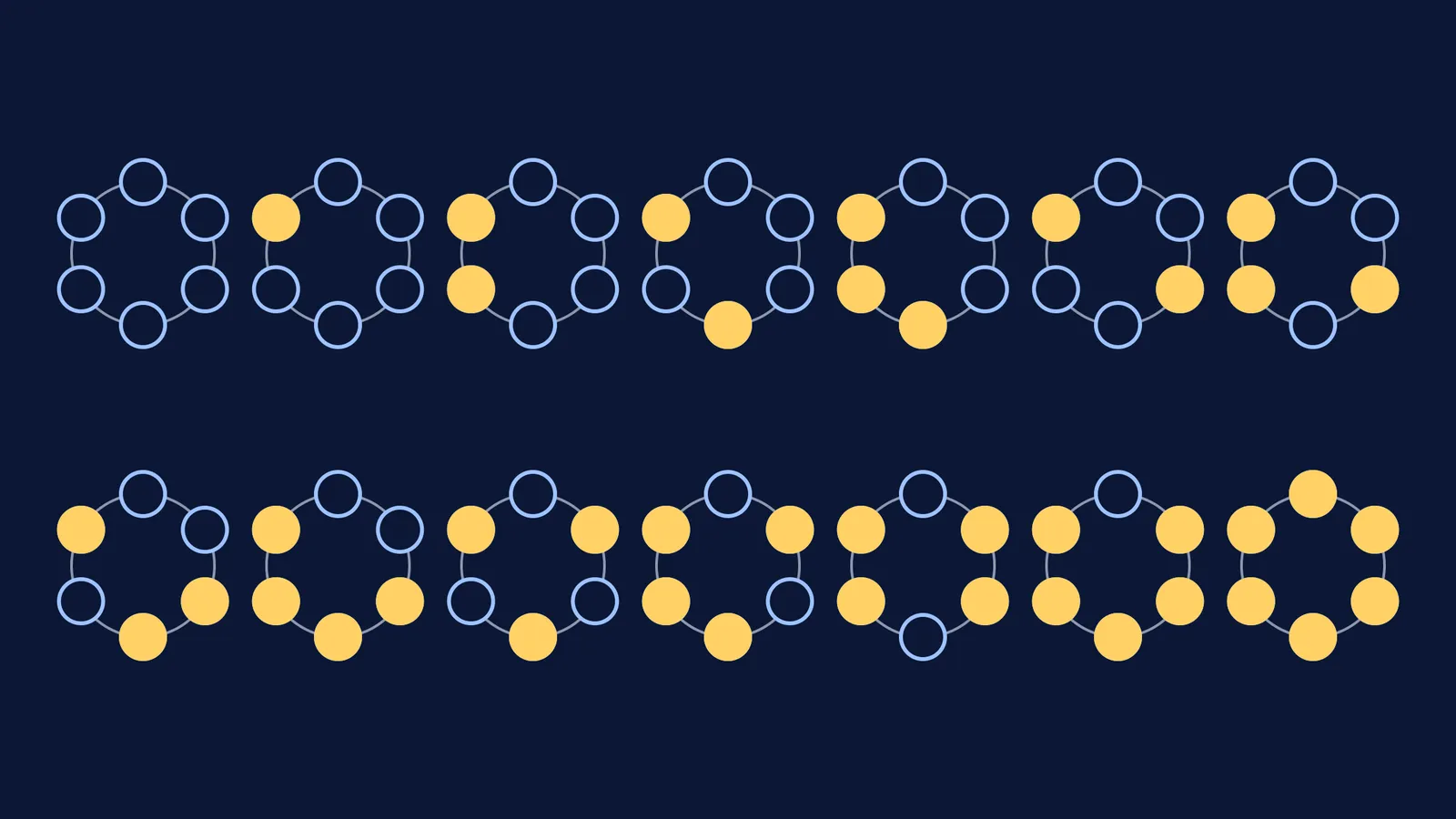
You have six beads on a loop, each black or white. Each bead has 2 choices, so there are 2^6 = 64 ways to colour the six positions. But spin the loop and many of those 64 turn into each other. The real number of different necklaces is 14, the value listed for six beads in the OEIS entry for two-colour necklaces. Dividing 64 by 6 gives 10.67, not even a whole number. Here is the method that works.
What does Burnside's lemma say?
Burnside's lemma says the number of genuinely different patterns equals the average number of colourings left unchanged by each symmetry (Burnside's lemma, Wikipedia). In symbols, if G is the set of symmetries and Fix(g) counts the colourings that g leaves exactly as they were:
Number of different patterns = (1/|G|) × (sum of Fix(g) over every g in G)
Despite the name, the result was discovered by Augustin-Louis Cauchy and Ferdinand Georg Frobenius and became well known after William Burnside quoted it, so it is also called the Cauchy-Frobenius lemma (same source).
Why does dividing by 6 fail? Some colourings look the same after a turn (all black does), so the 64 colourings do not fall into neat groups of six. Averaging the fixed colourings corrects for exactly that.
How many 2-colour necklaces can you make with 6 beads?
The symmetries are the six rotations: by 0, 1, 2, 3, 4 or 5 places. A colouring survives a rotation only if every bead matches the bead that moves onto its spot, so the positions fall into cycles that must share one colour. Rotating by k places splits the six positions into gcd(k, 6) cycles, so it fixes 2^gcd(k, 6) colourings.
Rotate 0 places (do nothing): 6 cycles, 64 colourings fixed.
Rotate 1 place: 1 cycle, 2 fixed (all black, all white).
Rotate 2 places: 2 cycles (positions 1, 3, 5 and 2, 4, 6), 4 fixed.
Rotate 3 places: 3 cycles (the opposite pairs), 8 fixed.
Rotate 4 places: 2 cycles, 4 fixed.
Rotate 5 places: 1 cycle, 2 fixed.
The total is 64 + 2 + 4 + 8 + 4 + 2 = 84, and 84 / 6 = 14 necklaces. That matches the OEIS table A000031, which lists 14 for six beads.
If you may also turn the necklace over, add the six reflections. Three mirror lines pass through two opposite beads: those two stay put and the other four pair up, giving 4 cycles and 16 fixed colourings each. Three pass between beads: 3 pairs, 8 fixed each. Now (84 + 48 + 24) / 12 = 156 / 12 = 13. The OEIS table for bracelets, A000029, also gives 13 for six beads. The necklace that disappears is a mirror-image pair: 001011 and 001101 (reading round the loop) are different under rotation but the same once you can flip.
How many ways can you colour the corners of a square?
Put 2 colours on 4 corners: 2^4 = 16 colourings. The rotations of a square are 0, 90, 180 and 270 degrees.
0 degrees: all 16 fixed.
90 and 270 degrees: the four corners form one cycle, so 2 fixed each.
180 degrees: opposite corners swap, giving 2 cycles and 4 fixed.
So (16 + 2 + 4 + 2) / 4 = 24 / 4 = 6. List them to check: all white, one black, two adjacent black, two opposite black, three black, all black. This is the four-bead necklace, and Wikipedia's worked example gets the same 6.
Adding the four reflections changes nothing here: the two diagonal flips fix 8 colourings each and the two edge flips fix 4 each, so (24 + 24) / 8 = 6.
How do you practise Burnside's lemma?
Try these before reading the answers:
Five beads, 2 colours, rotations only. Every non-zero rotation is a single cycle, so (32 + 2 + 2 + 2 + 2) / 5 = 8, the value OEIS A000031 lists for five beads.
Six beads, 3 colours, rotations only: (729 + 3 + 9 + 27 + 9 + 3) / 6 = 780 / 6 = 130.
Faces of a cube in 3 colours, using the 24 rotations of a cube. The Wikipedia example works it through to 57.
Symmetry counting also sits behind counting the isomers of a trisubstituted benzene. For more counting, read bijection counting arguments and how to prepare permutations and combinations for JEE Advanced.
When your own count does not come out to a whole number, a step has gone wrong, usually a missed cycle. The Fermi Problem Library has a step-by-step solver that explains the reasoning rather than printing an answer, so you can compare its steps with yours. If the cycle idea itself feels shaky, look it up in the Fermi Concept Library before your next attempt.


