On this page
Permutations and combinations get one short syllabus line, but the real skill is deciding exactly what you are counting.
JEE (Advanced) 2027 will be held on 23 May 2027 (Sunday), with IIT Delhi as the organising institute (JEE (Advanced) official site). To be eligible, you must be among the top 2,50,000 candidates in the B.E./B.Tech paper of JEE (Main) 2027 (eligibility criteria). The 2027 syllabus is not yet published, so this guide follows 2026. For the basics, start with our permutations and combinations guide for JEE Main and the Class 11 chapter guide.
What does the JEE Advanced syllabus say about permutations and combinations?
The official JEE (Advanced) 2026 syllabus lists "permutations and combinations" in its Algebra section, and its Probability section adds "computation of probability of events using permutations and combinations". It notes the 2026 syllabus is unchanged from 2025.
The JEE (Main) 2027 syllabus covers the same unit but ends it with the words "Simple applications". The Advanced syllabus has no such qualifier and explicitly ties counting to probability. Neither lists extra counting topics for Advanced: the difference is depth.
JEE (Advanced) 2026 had two compulsory papers of three hours each (2026 Information Brochure). Its brochure said the marking scheme would be given in the instructions at the time of the exam; our post on how partial marking works for multiple-correct questions explains why checking every option matters.
How do you model a counting problem before solving it?
Wrong answers usually come from a wrong model. Before solving, ask:
Are the objects identical or distinct?
Are the boxes (people, groups, positions) identical or distinct?
Can a box be empty?
Is there an upper cap on any box?
Then pick the tool: inclusion-exclusion for "at least" and "no two adjacent", and division by symmetry only when every case is counted equally often.
Worked examples: what do Advanced-level problems look like?
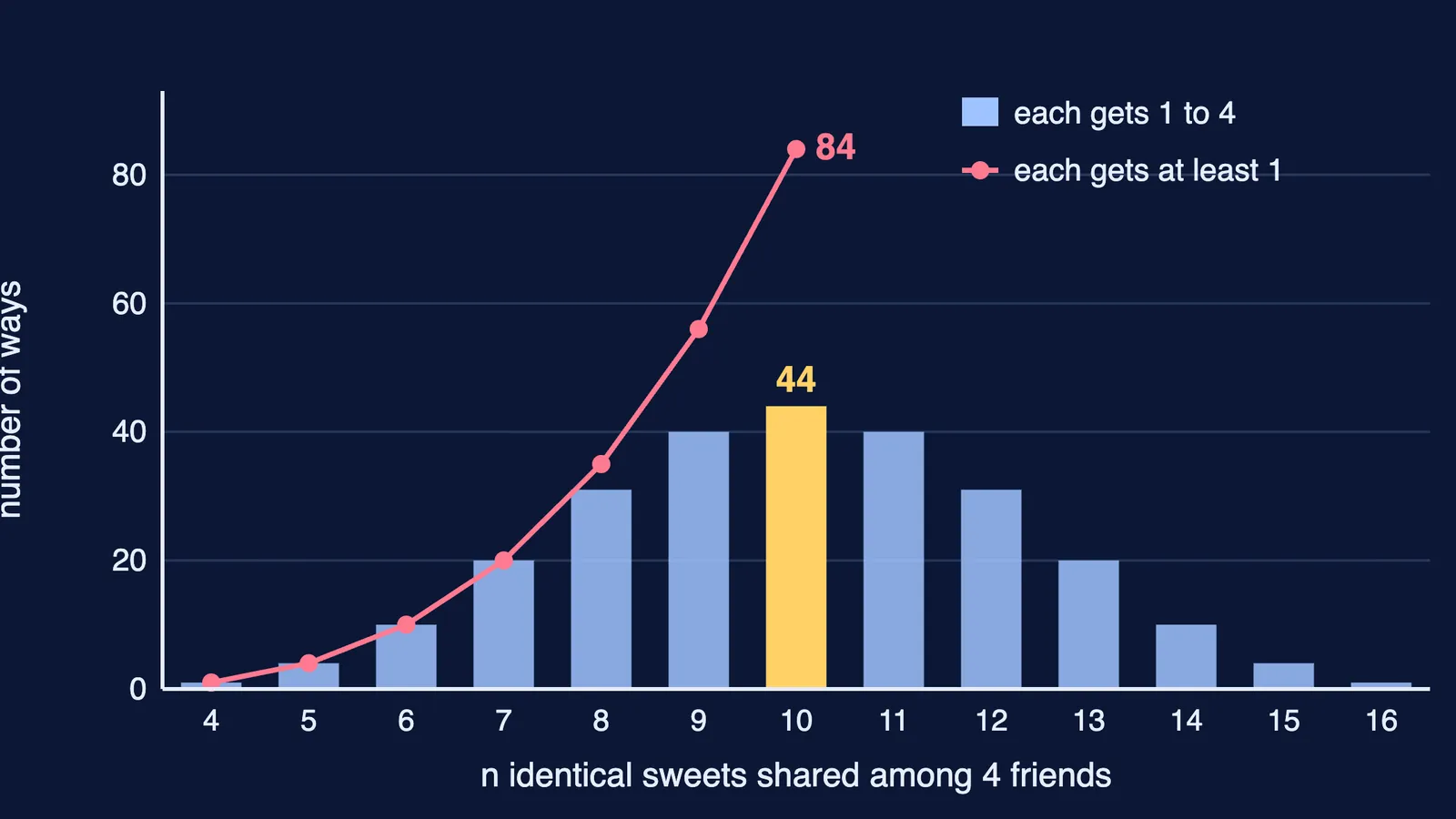
Example 1: a distribution with a cap. Ten identical sweets are shared among four friends, each getting 1 to 4. How many ways?
Give everyone 1. Six remain, with extra shares y₁ + y₂ + y₃ + y₄ = 6, each from 0 to 3. Without the cap, stars and bars gives C(9, 3) = 84. If one friend gets 4 or more extra, take 4 away: the rest sum to 2 in C(5, 3) = 10 ways, for each of 4 friends, so 40. Two friends cannot both break the cap (8 > 6). Answer: 84 − 40 = 44.
Check the limits: 4 or 16 sweets give exactly one way, and replacing each share x by 5 − x makes the counts symmetric about 10.
Example 2: labelled versus unlabelled groups. Eight different tasks go to three interns, each getting at least one. All assignments: 3⁸ = 6561. Remove those leaving an intern out, 3 × 2⁸ = 768, and add back those leaving two out, 3: 5796.
If the groups are unnamed teams, divide by 3! to get 966. This is safe because no team is empty, so each split is counted exactly 6 times. With empty teams allowed, 6561 ÷ 6 is not a whole number: the shortcut has broken.
Example 3: multiple-correct. Tiles A, A, B, B, C, D, E are arranged in a row. Which are correct?
There are 1260 arrangements.
In 360 arrangements the two A's are adjacent.
In 540 arrangements no two identical tiles are adjacent.
The probability that both end tiles are A is 1/21.
Total: 7!/(2! × 2!) = 1260, so (1) is correct. Glue the A's: 6!/2! = 360, so (2) is correct. For (3), the B's are adjacent in 360 arrangements and both pairs in 5! = 120, giving 1260 − 360 − 360 + 120 = 660; 540 is the forgot-to-add-back trap. For (4), A at both ends leaves 5!/2! = 60 arrangements, and 60/1260 = 1/21. Correct: 1, 2 and 4.
How should you practise permutations and combinations for JEE Advanced?
A three-week plan:
Week 1: one set each on arrangements, selections and distributions, answering the four questions before every solution.
Week 2: mixed sets and counting-based probability, with the small-case test on any answer you doubt.
Week 3: timed multiple-correct and numerical-answer sets. Log each mistake as an overcount, a missed case or a wrong division, and redo those a week later.
Count came out double? The Fermi Problem Library has worked problems with a step-by-step solver that explains the reasoning rather than printing an answer.
Practice questions to try
In how many ways can you choose 4 numbers from 1 to 15 so that no two are consecutive?
Eight identical balls go into 3 distinct boxes, empty allowed, none holding more than 5. How many ways?
A 6-digit code (leading zeros allowed) uses exactly two different digits, each appearing three times. How many codes?
Answers: (1) C(12, 4) = 495; (2) C(10, 2) − 3 × C(4, 2) = 27; (3) C(10, 2) × C(6, 3) = 900.