

On this page
Pick two divisors of 60 and ask whether one divides the other. Sometimes it does (3 and 12), sometimes neither does (4 and 6). That makes divisibility a partial order rather than a ranking, and the setting for a result you can check by hand.
What are chains and antichains in a partial order?
A partial order is a relation that is reflexive, antisymmetric and transitive. Divisibility on positive whole numbers is one.
Using the definitions in the Wikipedia article on Dilworth's theorem, a chain is a set of elements every two of which are comparable. An antichain is a set of elements no two of which are comparable.
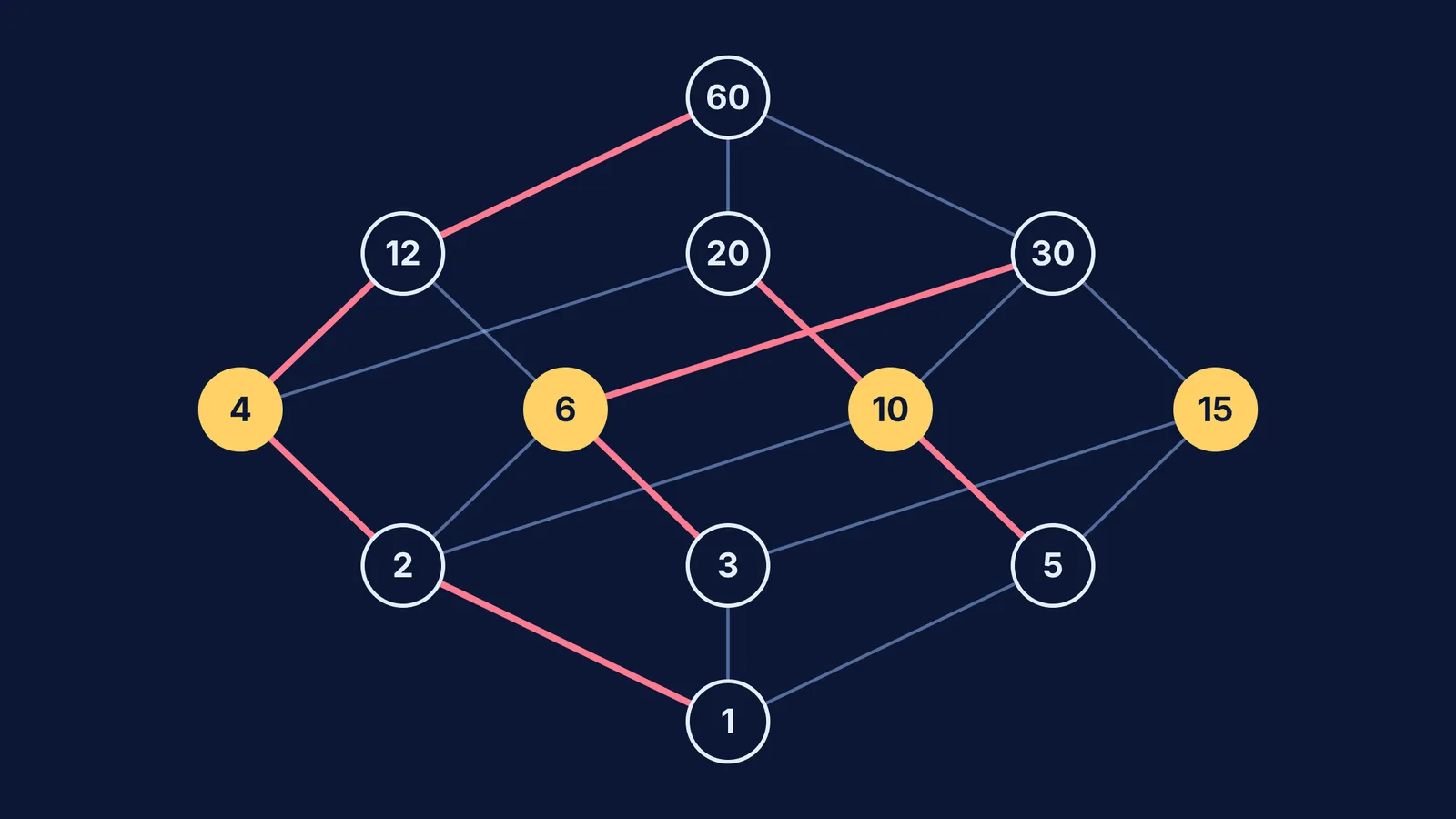
Among the divisors of 60, {1, 2, 4, 12, 60} is a chain, because each number divides the next. {4, 6, 10, 15} is an antichain: 4 divides none of 6, 10 and 15; 6 divides neither 10 nor 15; and 10 does not divide 15.
What is Dilworth's theorem for partial orders?
Dilworth's theorem says that in any finite partially ordered set, the largest antichain has the same size as the smallest partition of the set into chains (Wikipedia). R. P. Dilworth published it in 1950 as "A Decomposition Theorem for Partially Ordered Sets" in the Annals of Mathematics. This common number is called the width of the order.
Half of the theorem is easy. Two elements in the same chain are comparable, so a chain holds at most one element of any antichain, and an antichain of size k forces at least k chains. The real content is the other half: you never need more.
The same Wikipedia page notes that the theorem is equivalent to Kőnig's theorem on bipartite matching and to Hall's marriage theorem.
How do you find the width of the divisors of 60?
Since 60 = 2² × 3 × 5, it has (2+1)(1+1)(1+1) = 12 divisors: 1, 2, 3, 4, 5, 6, 10, 12, 15, 20, 30 and 60.
Sort into levels. Count prime factors with repeats. Level 0: 1. Level 1: 2, 3, 5. Level 2: 4, 6, 10, 15. Level 3: 12, 20, 30. Level 4: 60. A proper multiple has more prime factors, so each level is an antichain. The biggest has 4 elements.
Cover with that many chains. Try 1, 2, 4, 12, 60; then 3, 6, 30; then 5, 10, 20; then 15 on its own. Check each link divides the next and every divisor appears once.
Conclude. Four chains cover everything, so no antichain has five elements (two would share a chain). An antichain of four exists, so three chains cannot do it. The width is 4.
How is Mirsky's theorem the dual of Dilworth's?
Swap the roles. Leon Mirsky showed in a 1971 note in the American Mathematical Monthly that the height of a finite poset, the size of its longest chain, equals the fewest antichains needed to partition it.
The proof on Wikipedia's Mirsky's theorem page is short. Label each element with the size of the longest chain ending at it. Equal labels form an antichain, and there are exactly as many labels as the longest chain is long. For 60, the chain 1, 2, 4, 12, 60 has 5 elements, and the five levels above are the 5 antichains.
What does Sperner's theorem say about subsets?
Now order all subsets of an n-element set by inclusion. Emanuel Sperner's 1928 paper in Mathematische Zeitschrift settled the width of this order. As the Wikipedia article on Sperner families states it, a family of subsets in which none contains another has at most C(n, ⌊n/2⌋) members, and the middle layer reaches that bound.
Divisors connect straight back. The divisors of 30 = 2 × 3 × 5 behave exactly like the subsets of {2, 3, 5}, so their width is C(3, 1) = 3, from {2, 3, 5} or {6, 10, 15}.
How should you practise this?
Draw the divisors in levels, as in the picture above.
Take the widest level as your antichain.
Build exactly that many chains from the bottom.
If they cover everything, both answers are proved.
Try the divisors of 72 = 2³ × 3². You should find width 3 (1, 2, 4, 8, 24, 72; then 3, 6, 12, 36; then 9, 18) and height 6. Then try 210 = 2 × 3 × 5 × 7, where Sperner predicts width C(4, 2) = 6.
If turning a cover like this into a written proof is where you get stuck, the Fermi Problem Library has a step-by-step solver that explains the reasoning rather than printing an answer. For a refresher on relations, see the Fermi Concept Library.
A pigeonhole step like the one above also drives why six people always contain three friends or three strangers, and bijection counting arguments are the natural next read.


