

On this page
Pick any six people at a wedding or in your hostel corridor. However they know each other, you can always find three who all know one another or three who are all strangers. Mathematicians write this as R(3, 3) = 6, and the proof needs only the pigeonhole principle.
How do you turn a party into a colouring problem?
Draw each person as a dot and join every pair with a line. Colour a line blue if the two people know each other and red if they do not. Three mutual friends is now a blue triangle; three mutual strangers is a red triangle.
The theorem on friends and strangers says that in any party of six people, at least three are mutual acquaintances or mutual strangers (Wikipedia: Theorem on friends and strangers).
The Ramsey number R(3, 3) is the smallest number of dots for which every red-blue colouring of all the lines must contain a one-colour triangle, and it equals 6 (Wikipedia: Ramsey's theorem).
Why do six people always contain three friends or three strangers?
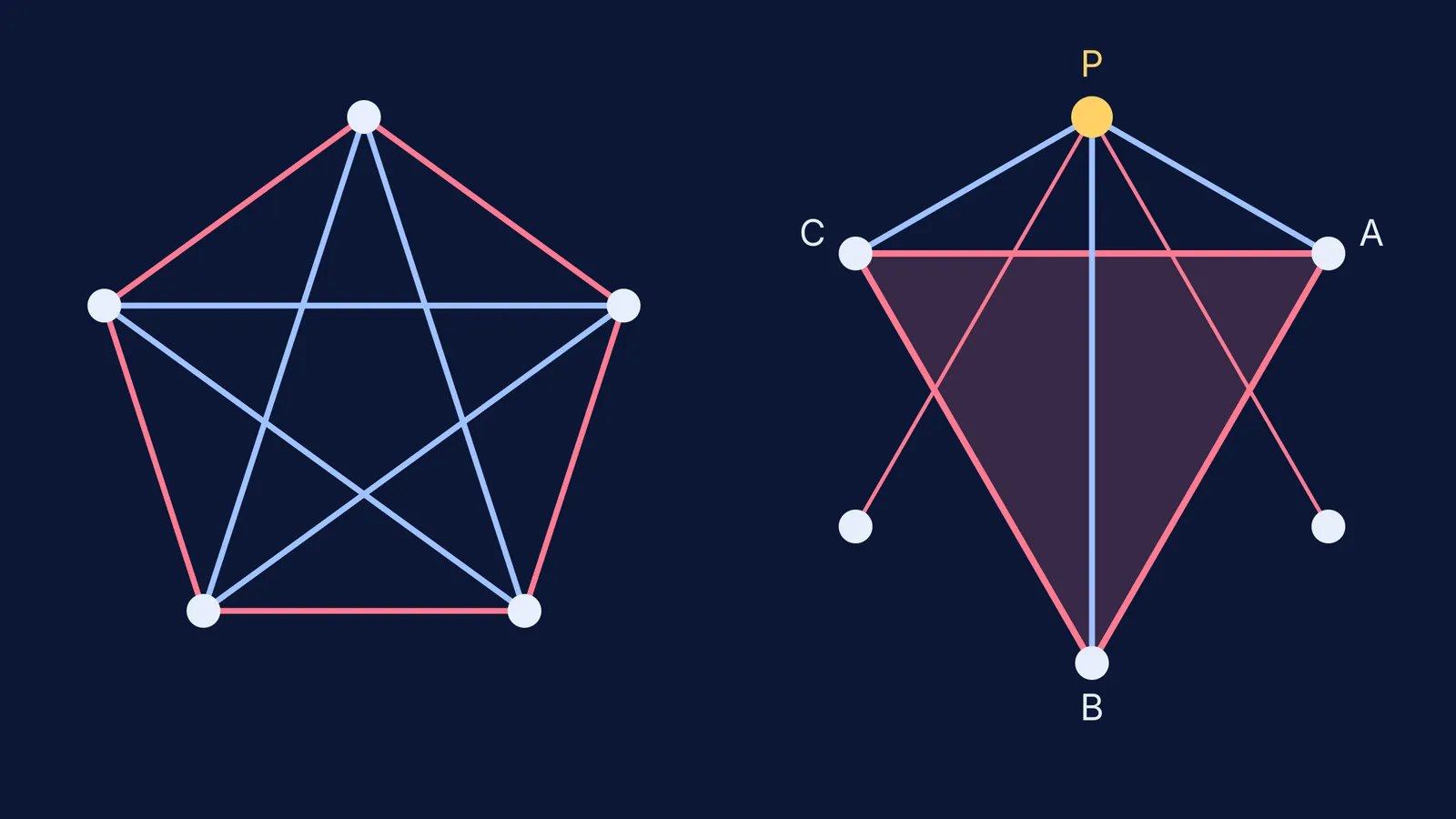
Pick one person, P. P has five lines, one to each of the others.
Five lines, two colours: at least three share a colour, because two lines of each colour cover only four. Say those three are blue and go to A, B and C. If they are red, swap the colours below.
Look at the three lines AB, BC and CA. If any one is blue, say AB, then P, A and B form a blue triangle.
If none of them is blue, all three are red, and A, B and C form a red triangle.
Either way a one-colour triangle appears, so six people are always enough.
Why are five people not enough?
Showing that six works is half the job; you must also show that five can fail. Place five people at the corners of a regular pentagon. Colour the five sides red and the five diagonals, the star inside, blue.
The red lines form one loop through all five corners, and a loop of five contains no triangle. The blue star is also a single loop of five (corner 1 to 3 to 5 to 2 to 4 and back), so it has no triangle either. The friends and strangers article uses this same pentagon-and-star colouring to conclude that six is the smallest number that works (Wikipedia).
So R(3, 3) is at most 6 by the pigeonhole proof and more than 5 by the pentagon: exactly 6.
Where does Ramsey theory go from here?
The general result comes from Frank Ramsey's 1930 paper "On a Problem of Formal Logic" in the Proceedings of the London Mathematical Society (doi:10.1112/plms/s2-30.1.264). In plain words: for any group sizes you name, a large enough party always contains that many mutual friends or that many mutual strangers.
The numbers soon get hard. To force four mutual friends or four mutual strangers you need 18 people: R(4, 4) = 18 (Wikipedia: Ramsey's theorem). For five, nobody knows the answer: R(5, 5) lies between 43, from Geoffrey Exoo in 1989, and 46, from Vigleik Angeltveit and Brendan McKay in 2024 (Wikipedia: Ramsey's theorem). Stanisław Radziszowski's survey Small Ramsey Numbers, first published in 1994 and still revised, tracks the known values (Electronic Journal of Combinatorics, DS1).
How can you practise the argument?
Try this extension before reading the solution: among any 10 people, show there are 4 mutual friends or 3 mutual strangers.
Pick a person P. P has 9 lines.
If P has at least 4 strangers, look at those 4. If any two of them are strangers, they and P are 3 mutual strangers. If no two are, those 4 are mutual friends.
Otherwise P has at most 3 strangers, so at least 6 friends. Among those 6, the result above gives 3 mutual friends (add P to get 4) or 3 mutual strangers.
Same move as before: pick one person, split their lines by colour, and push the problem into a smaller group you already understand.
Before you call a Ramsey-style proof finished, check:
Did you prove both halves: n people always work and n - 1 can fail?
Did you write "at least", not "exactly"?
Did you handle the other colour, or say why it is symmetric?
Did you check your counterexample triangle by triangle? Five dots have 10 triangles, so list them.
If turning a word problem into dots and lines is where you get stuck, the Fermi Problem Library has worked problems with a step-by-step solver that explains the reasoning rather than printing an answer. To revise the pigeonhole principle on its own, the Fermi Concept Library gives each concept its own lesson.
For more olympiad counting tools, read how to count using a bijection and linearity of expectation with indicator variables, or try Schur's inequality and its olympiad uses.


