On this page
Conic Sections is Chapter 10 of the NCERT Class 11 Mathematics textbook (2026-27 reprint). The CBSE Mathematics syllabus for 2026-27 lists sections of a cone, degenerate cases, the circle, and the standard equations of the parabola, ellipse and hyperbola. For the chapter plan, read our Conic Sections Class 11 guide with solved examples.
Not in this chapter: tangents, asymptotes, and parabolas, ellipses or hyperbolas with shifted centres or tilted axes.
How does a plane cut a cone into a conic section?
Double-napped right circular cone: the surface traced when a line m turns around a fixed line l it crosses, keeping a fixed angle α.
Vertex, axis and generator: the crossing point V is the vertex, l is the axis and the turning line m is a generator. Don't confuse with: the vertex of a conic, which lies on the curve.
Nappe: either half of the cone on each side of V.
Conic section: where a plane meets the cone.
Angle β: the angle between the cutting plane and the cone's axis. If the plane misses the vertex, β = 90° gives a circle, α < β < 90° an ellipse, β = α a parabola, and 0 ≤ β < α a hyperbola (the plane cuts both nappes).
Degenerate conic: what a plane through the vertex gives: a point (α < β ≤ 90°), a straight line (β = α) or a pair of intersecting lines (0 ≤ β < α).
Circle: key terms
Circle: the set of all points in a plane at a fixed distance, the radius r, from a fixed point, the centre (h, k).
Equation of a circle: (x − h)² + (y − k)² = r², from the distance formula; x² + y² = r² when centred at the origin.
Completing the square: rewriting an expanded equation in centre-radius form. Example: x² + y² − 6x + 4y − 12 = 0 becomes (x − 3)² + (y + 2)² = 25, so centre (3, −2) and radius 5.
What are the focus, directrix and latus rectum of a parabola?
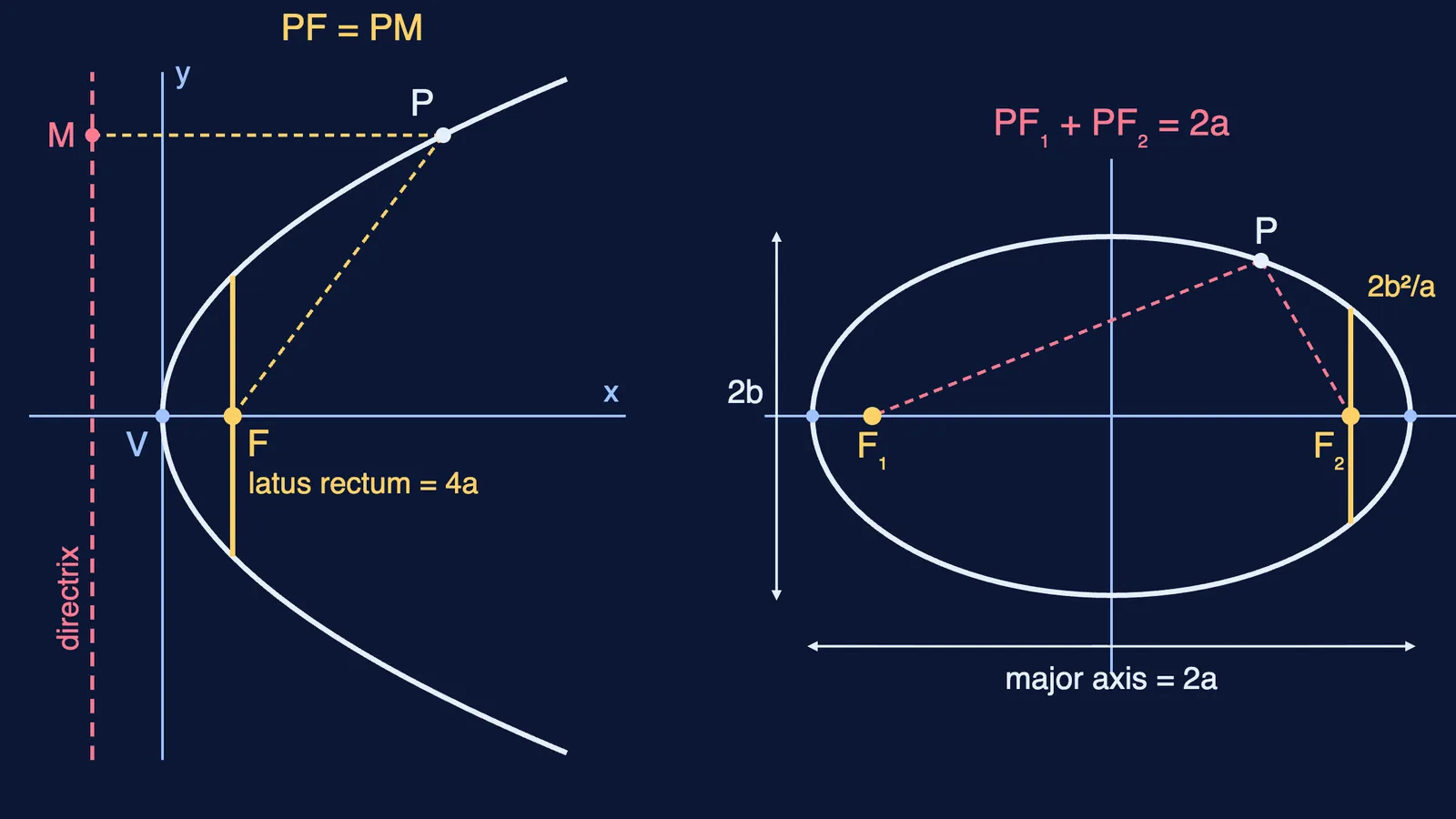
Parabola: every point of a plane whose distance to a fixed point matches its distance to a fixed line that misses that point.
Focus and directrix: the fixed point and the fixed line.
Axis and vertex: the axis is the line through the focus perpendicular to the directrix; the vertex is where the parabola meets it. Don't confuse with: the directrix.
Standard equations: y² = 4ax, y² = −4ax, x² = 4ay, x² = −4ay (a > 0), vertex at the origin. A y² term means the axis is the x-axis; the other term's sign shows which way it opens. Example: x² = −12y opens downwards, focus (0, −3), directrix y = 3.
Latus rectum of a parabola: the segment through the focus, perpendicular to the axis, ending on the parabola; length 4a. Example: y² = 20x has a = 5, focus (5, 0), directrix x = −5, latus rectum 20.
Degenerate parabola: if the focus lies on the directrix, the points equidistant from both form a straight line.
Ellipse: key terms
Ellipse: every point of a plane whose distances to two fixed points add up to the same constant, 2a, which exceeds the gap between them: PF₁ + PF₂ = 2a.
Foci and centre: the two fixed points, and the midpoint between them.
Major and minor axis: the major axis (length 2a) runs through the foci; the minor axis (length 2b) passes through the centre perpendicular to it.
Vertices and c: the vertices are the ends of the major axis; 2c is the distance between the foci, and c² = a² − b².
Standard equations: x²/a² + y²/b² = 1 (major axis along the x-axis) and x²/b² + y²/a² = 1 (along the y-axis), with a > b. The larger denominator shows the major axis: x²/36 + y²/100 = 1 has it on the y-axis.
Eccentricity: e = c/a; for an ellipse c < a, so e < 1.
Latus rectum of an ellipse: the segment through a focus, perpendicular to the major axis, ending on the ellipse; length 2b²/a. Example: x²/100 + y²/36 = 1 has a = 10, b = 6, c = 8, foci (±8, 0), e = 4/5, latus rectum 36/5.
How is a hyperbola different from an ellipse?
Hyperbola: every point of a plane whose distances to two fixed points (the foci) differ by the same constant, farther minus nearer: |PF₁ − PF₂| = 2a.
Transverse axis: the line through the foci; the vertices sit on it, 2a apart. Don't confuse with: an ellipse's major axis.
Conjugate axis: the line through the centre perpendicular to the transverse axis; its length is 2b.
Relation for c: b is defined by b² = c² − a², so c² = a² + b². Don't confuse with: c² = a² − b² for an ellipse.
Standard equations: x²/a² − y²/b² = 1 and y²/a² − x²/b² = 1; the positive term shows the transverse axis.
Eccentricity of a hyperbola: e = c/a, and since c > a, e > 1.
Latus rectum of a hyperbola: the segment through a focus, perpendicular to the transverse axis, ending on the hyperbola; length 2b²/a. Example: x²/36 − y²/64 = 1 has a = 6, b = 8, c = 10, foci (±10, 0), e = 5/3, latus rectum 64/3.
Equilateral hyperbola: one with a = b. Example: x² − y² = 4 has a = b = 2, c = 2√2, e = √2.
How to learn these terms
Learn the four definitions as a family: one point (circle), a point and a line (parabola), a constant sum (ellipse), a constant difference (hyperbola).
Pair the look-alikes: major and transverse axis, c² = a² − b² and c² = a² + b², e < 1 and e > 1.
Sketch each standard equation, marking focus, vertex and latus rectum.
Revise the Conic sections Class 11 formulas, then test yourself with the Conic sections assertion-reason questions.
If completing the square feels shaky, the Fermi Concept Library gives every mathematics concept its own lesson and shows where it sits in the map.