On this page
Cut a triangle into small triangles and label every corner point 1, 2 or 3 under two simple rules. However you do it, some small triangle gets all three labels. Sperner proved this in 1928 (Sperner, Abhandlungen Hamburg).
What is Sperner's lemma?
Francis Su states the rules in Rental Harmony: Sperner's Lemma in Fair Division (American Mathematical Monthly, 1999):
The three main corners get three different labels.
A point on an edge takes the label of one of that edge's two corners, so the edge from 1 to 3 uses only 1s and 3s.
Points inside can take any label.
Sperner's lemma: any such labelling contains an odd number of small triangles labelled 1, 2 and 3, so there is always at least one (Su, 1999). It holds in every dimension: a tetrahedron cut into small tetrahedra and labelled 1 to 4 by the same rules always contains a fully labelled one.
How does the door-counting proof work?
Su calls the big triangle a house, each small triangle a room, and each edge with ends labelled 1 and 2 a door.
Outside doors: only the bottom edge, from corner 1 to corner 2, can hold doors. Walking along it, the label switches an odd number of times, so there is an odd number of outside doors.
Doors per room: a 1-2-3 room has exactly one door; a 1-1-2 or 1-2-2 room has two; any other room has none.
The walk: enter by an outside door. Each room either is fully labelled (stop) or has one other door to leave by, and you never revisit a room. Walks that come back out use outside doors in pairs, and there is an odd number of them, so some walk ends inside. Fully labelled rooms no walk reaches pair up among themselves, so the total is odd.
The same odd-versus-pairs reasoning explains why the 15 puzzle with 14 and 15 swapped can't be solved.
A worked colouring you can check by hand
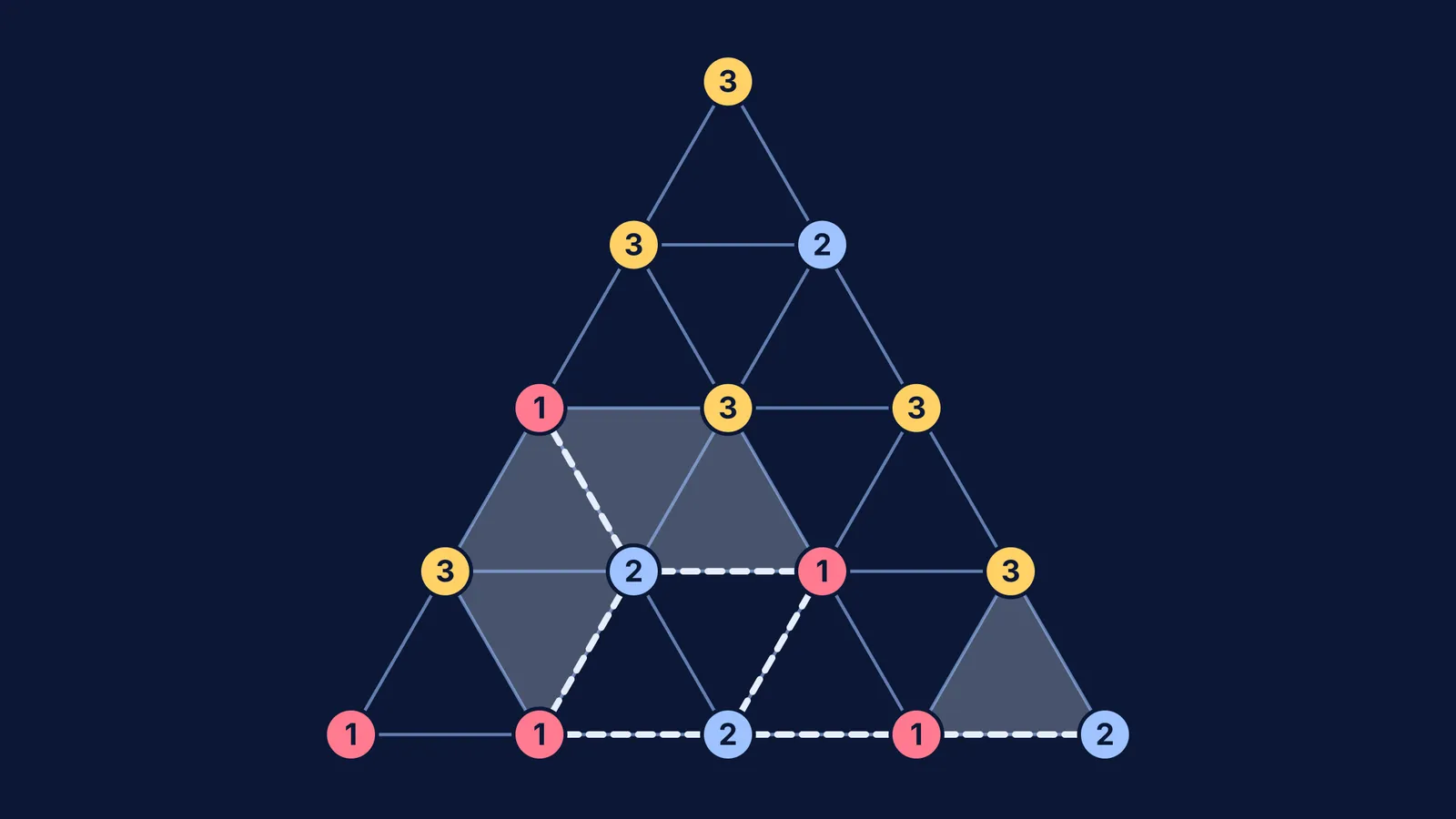
Cut each side into 4 equal parts: 16 small triangles and 15 points. Reading each row left to right, from the bottom (the picture above shows it):
Bottom row, corner 1 to corner 2: 1, 1, 2, 1, 2
Second row: 3, 2, 1, 3
Third row: 1, 3, 3
Fourth row: 3, 2
Top corner: 3
The left edge, bottom to top, reads 1, 3, 1, 3, 3; the right edge reads 2, 3, 3, 2, 3; the bottom row has only 1s and 2s. The rules hold.
Now follow Su's walk. The bottom row switches label three times, so it has 3 outside doors.
The rightmost door opens straight into a 1-2-3 room.
The leftmost door leads through a 1-2-2 room into a 1-3-2 room.
The middle door passes through two two-door rooms and ends in a 2-1-3 room.
Two more fully labelled rooms on the left share a door, so they form a pair.
That makes 5 fully labelled triangles, an odd number. Check: doors counted room by room give 5 × 1 + 3 × 2 = 11, which is twice the 4 inside doors plus the 3 outside doors.
How does Sperner's lemma prove Brouwer's fixed point theorem?
Brouwer's fixed point theorem says every continuous map from a triangle to itself leaves some point where it was. Su notes that Sperner's lemma gives a short, elementary proof of it (Su, 1999). The sketch:
Describe each point by three weights that add to 1, one per corner. Call the map f.
Label a point i if its i-th weight is positive and f does not increase it. Such an i always exists, because both sets of weights add to 1.
This is a Sperner labelling: a corner can only get its own label, and an edge point only one of its edge's two labels.
So every finer grid has a fully labelled small triangle. These close in on a point where, because f is continuous, no weight increases. The weights add to 1, so none decreases either: f fixes that point.
Brouwer only promises a fixed point exists. The contraction mapping theorem, shown with cos x settling at 0.739, asks more of the map and gives uniqueness and a way to reach the point.
How can three flatmates split rent with Sperner's lemma?
Su's paper starts from a friend's question: can rent always be split so each housemate prefers a different room? His Rental Harmony Theorem says yes, if each person finds some room acceptable at any split, everyone prefers a free room to a paid one, and preferences behave sensibly at limits (Su, 1999). For three friends sharing a flat:
Every split of the rent into three prices is a point of a triangle, since the prices add up to the total.
Draw a fine grid on it and give each point an owner, one per friend in every small triangle.
At each point, ask its owner which room they would choose at those prices, and write that room's number there.
Find a small triangle whose three owners picked three different rooms. Its prices are close to a split nobody envies; a finer grid gets closer.
Su shows such a triangle always exists, and his proofs turn into step-by-step procedures. For something you can cut, compare how to divide a cake fairly among three people.
If triangulations or weighted coordinates are new, the Fermi Concept Library gives every mathematics concept its own lesson and its place in the map. When a proof step stalls, the Fermi Problem Library has worked problems with a step-by-step solver that explains the reasoning.