On this page
If a NEET-UG question asks why breastfeeding can delay pregnancy, the textbook answer is one line. The biology behind it is a chain of hormones, and knowing the chain helps you handle the tricky options. Here is that chain, why NCERT stops at six months, and why the method fails more often than students expect.
How does breastfeeding prevent pregnancy?
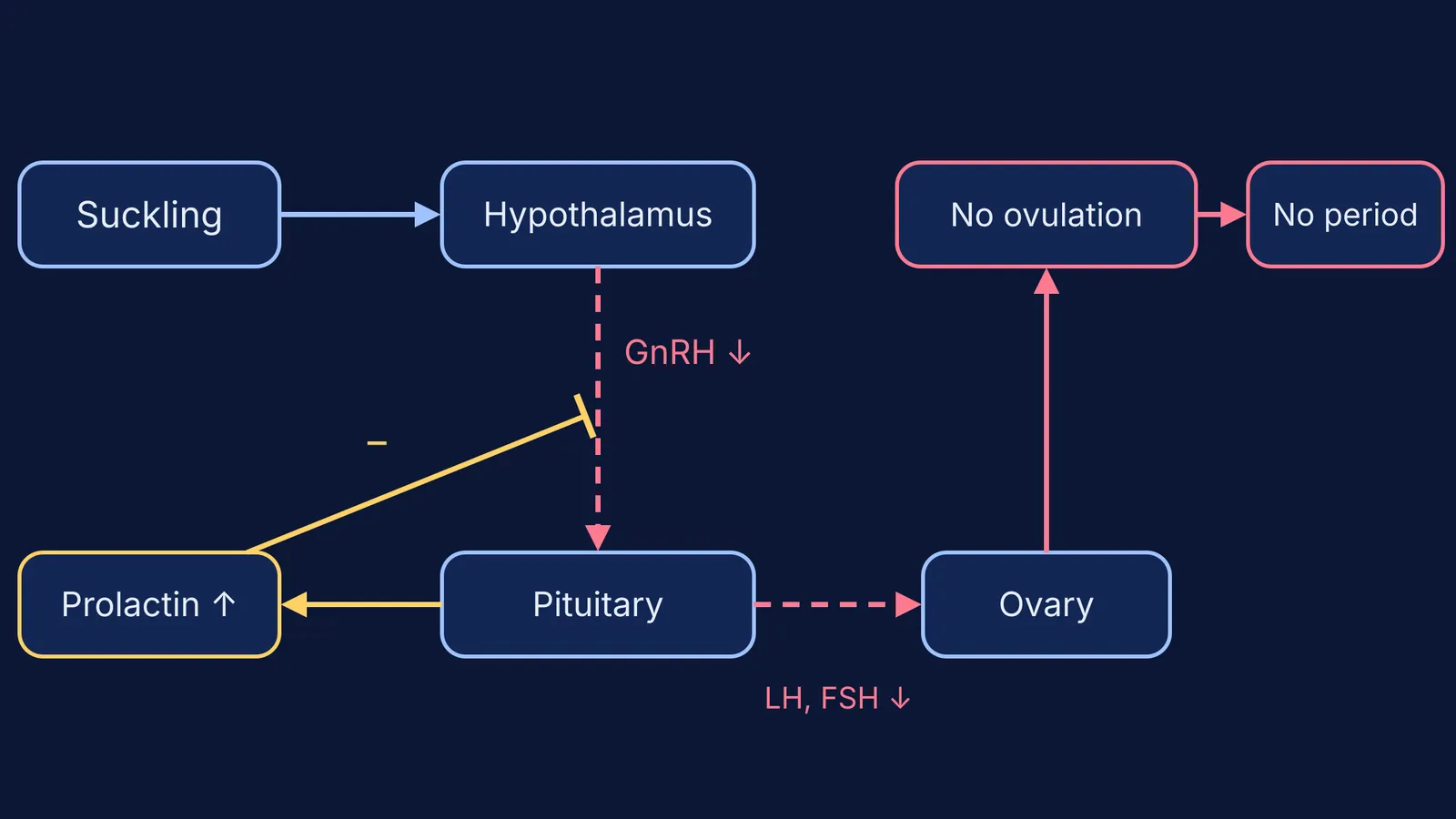
The trigger is the baby's suckling, not the milk itself. A review by Alan McNeilly in Reproduction, Fertility and Development calls suckling "the only truly physiological signal that suppresses fertility in normally nourished, healthy women". The chain runs like this:
Suckling sends a nerve signal from the nipple to the hypothalamus in the brain.
The pituitary releases prolactin; a classic study measured prolactin release during nursing in mothers who had recently given birth (Noel and colleagues, Journal of Clinical Endocrinology and Metabolism, 1974).
In early lactation, the pulses of gonadotrophin-releasing hormone (GnRH) from the hypothalamus are almost completely switched off, according to McNeilly's review.
Without GnRH pulses, the pituitary releases little LH and FSH, so follicles do not mature and no egg is released.
No ovulation means no corpus luteum and no period. That missing period is the "amenorrhoea" in the name.
The diagram at the top shows this pathway. The arrow from prolactin to GnRH is the version usually taught, and it has support in animals: in mice, high prolactin stopped ovarian cycles, and giving kisspeptin restored hormone release and cycling (Sonigo and colleagues, Journal of Clinical Investigation, 2012).
Why does NCERT say the method works only for six months?
The Class 12 NCERT chapter Reproductive Health says lactational amenorrhoea is based on the fact that ovulation and the cycle do not occur during intense lactation after childbirth. The same page says the method "has been reported to be effective only upto a maximum period of six months following parturition". NCERT lists it under natural methods, with almost no side effects but high chances of failure.
The six-month limit comes from how the method is defined. The WHO and Johns Hopkins Family Planning: A Global Handbook for Providers says all three conditions must hold:
The mother's monthly bleeding has not returned.
The baby is fully or nearly fully breastfed, and fed often, day and night.
The baby is less than 6 months old.
The handbook notes that breast milk alone can fully nourish a baby for the first six months. After that, other foods come in, feeds thin out and the suckling signal weakens. The handbook also gives the numbers: when used correctly, fewer than 1 pregnancy per 100 women in the first 6 months after childbirth; as commonly used, about 2 per 100.
Why is lactational amenorrhoea unreliable?
The method works only while the suckling signal stays strong, and that varies. McNeilly's review links differences in how long lactational amenorrhoea lasts to the strength of the suckling stimulus, "a unique situation between each mother and baby".
Hormones can stir before a period shows. In a study of 20 fully breastfeeding women by Tay, Glasier and McNeilly in Human Reproduction (1992), LH pulses were present in 9 of the 11 women sampled at 8 weeks after birth, while their periods were still absent.
Periods also come back sooner than many families expect. A Cochrane review by Van der Wijden and Manion (2015) found that by six months, between 11.1% and 39.4% of women in the included studies had started menstruating again.
So the method slips when feeds get spaced out, when other milk or food replaces some feeds, or after six months. This article explains the biology; it is not medical advice. Any family choosing contraception after a birth should talk to a doctor, ANM or ASHA worker, and NCERT says the choice should be made with qualified medical professionals.
How do you answer a NEET-UG question on lactational amenorrhoea?
Use this five-link recall chain and check every option against it:
Suckling sends a nerve signal to the hypothalamus.
Prolactin goes up.
GnRH pulses go down.
LH and FSH go down, so there is no ovulation.
No ovulation, so no menstruation.
Then run the trap checklist:
"Effective for a year": wrong; NCERT says a maximum of six months.
"Uses medicines or devices": wrong; it is a natural method.
"Low chance of failure": wrong in NCERT's framing; chances of failure are high.
"Prolactin triggers ovulation": reversed; it is linked to suppressing it.
"Works once periods return": wrong; a returned period ends the method.
If you keep mixing up which pituitary hormone does what, the Fermi Concept Library gives each concept in biology its own lesson and shows its place in the map, so you can trace prolactin, GnRH and LH side by side. For the rest of this chapter, see how NCERT's six tests of an ideal contraceptive score each method, how emergency contraceptive pills work within 72 hours, and the common reproductive health mistakes in NEET Biology.