On this page
Every slip below is checked against NCERT's Class 12 Biology text, Chapter 3, Reproductive Health (NCERT chapter lebo103, Reprint 2026-27), which the NMC's NEET (UG) 2026 syllabus lists under Unit 6, Reproduction. Each has the wrong belief, why it tempts, NCERT's version, our own check and a habit. For the whole chapter first, read our reproductive health guide for NEET. This is a study summary, not medical advice.
Which group does each method belong to?
"Withdrawal is a barrier method, since it keeps semen out."
Why it tempts: the goal sounds like a condom's goal, so the two get filed together.
What NCERT says (3.2): withdrawal, or coitus interruptus, sits with the natural or traditional methods, beside periodic abstinence and lactational amenorrhea. Barrier methods use a physical barrier: condoms, diaphragms, cervical caps and vaults. Natural methods use no device or medicine.
Check: true or false? "Coitus interruptus and the cervical cap both keep semen away from the cervix, so NCERT files them in one group." (False: coitus interruptus is a natural method; the cap is a barrier.)
Habit: group a method by what it uses, not by what it is trying to stop.
"An implant goes under the skin, so it counts as a surgical method."
Why it tempts: it sits under the skin, which sounds like an operation, and sterilisation is the operative method students know.
What NCERT says (3.2): implants are their own category. They carry progestogens alone or with estrogen, act much like pills and last far longer. Surgical methods, vasectomy and tubectomy, block gamete transport and are poorly reversible.
Check: of an implant and a vasectomy, which one blocks gamete transport, and which works the way a pill does? (Vasectomy; implant.)
Habit: ask "hormone or cut tube?" before you pick a category.
Where and how does each method act?
"Pills work only by stopping ovulation."
Why it tempts: stopping ovulation is the action students learn first, so the list ends there.
What NCERT says (3.2): pills inhibit ovulation, inhibit implantation, and alter the cervical mucus, which keeps sperms out or slows them down. That is three effects, not one.
Check: an option reads "Oral pills have no effect on sperm entering the female tract." True or false? (False: the change in cervical mucus retards sperm entry.)
Habit: for every hormonal method, write all three effects, not the first one you remember.
"A non-medicated IUD releases nothing, so it does nothing."
Why it tempts: "non-medicated" (the Lippes loop is NCERT's example) sounds like "inactive", and copper gets all the credit.
What NCERT says (3.2): IUDs as a group increase the phagocytosis of sperms in the uterus. The Cu ions of copper-releasing IUDs also suppress sperm motility and fertilising capacity, and hormone-releasing ones also turn the uterus against implantation and the cervix against sperms.
Check: a Lippes loop releases neither copper nor hormones. Which IUD action in NCERT still applies to it? (Raised phagocytosis of sperms inside the uterus.)
Habit: give IUDs one shared action, then add what each type adds on top.
Contraception, MTP or ART: which step is which?
"Emergency contraception is simply an early MTP."
Why it tempts: both happen after unprotected intercourse, so they blur into one idea.
What NCERT says (3.2, 3.3): emergency contraceptives, given within 72 hours of coitus, are progestogens, progestogen-estrogen combinations or IUDs, used to avoid a possible pregnancy. MTP is the intentional ending of a pregnancy before full term, in its own section.
Check: one of the two is described as preventing a pregnancy that may follow; the other ends a pregnancy already under way. Which is which? (Emergency contraception; MTP.)
Habit: ask "is there a pregnancy yet?" before naming the method.
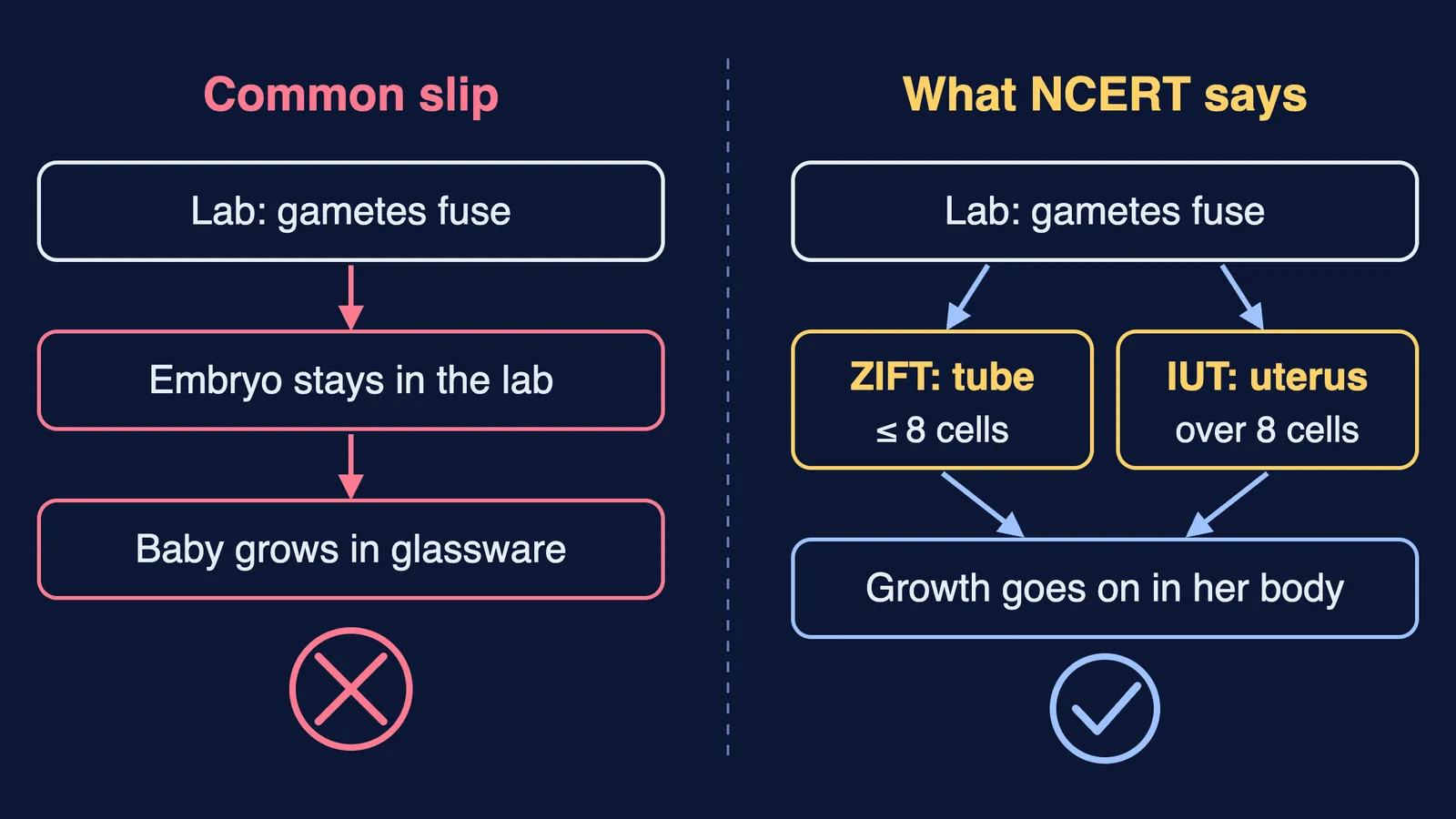
"A test tube baby grows in the laboratory."
Why it tempts: the popular name puts the whole process in glassware.
What NCERT says (3.5): the laboratory step is forming the zygote from ova and sperms, in conditions close to the body's. Then comes transfer: a zygote or early embryo of 8 or fewer blastomeres goes to the fallopian tube (ZIFT), one of more than 8 goes to the uterus (IUT), and development is completed in the body.
Check: in IVF-ET followed by IUT, where does each of these happen: zygote formation, then the embryo's further development? (Laboratory; uterus.)
Habit: in ART, mark where each step happens before you read the options.
What does "reproductive health" cover?
"Reproductive health just means normal reproductive organs."
Why it tempts: the word "health" makes students think only of the body.
What NCERT says (chapter opening): following WHO, it means total well-being in every part of reproduction, physical, emotional, behavioural and social. Organs that work normally are only one part.
Check: name the four aspects in the WHO meaning NCERT uses, and say which one alone the slip keeps. (Physical, emotional, behavioural, social; physical.)
Habit: when you see "reproductive health", count four aspects.
"Contraceptives are a regular requirement for reproductive health."
Why it tempts: they sit at the centre of the chapter and help check population growth, so they feel essential to health.
What NCERT says (3.2): they are not regular requirements for keeping reproductive health. They act against a natural event, conception, and are used to prevent, delay or space pregnancy. NCERT also lists possible ill-effects, such as nausea, abdominal pain and irregular bleeding, which it calls not very significant but not to be ignored.
Check: find the false half: "Contraceptives help check population growth, so NCERT treats them as a routine need for reproductive health." (The second half.)
Habit: separate "useful for a goal" from "needed for health".
A 60-second self-check before you mark
To see each method lined up against the step it blocks, our explainer on how each contraceptive method works lays them out in order.
Which of these eight slips would catch you today? Fermi's AI tutor works out what you already know and builds a plan for the session.