

On this page
The eight slips below are checked against NCERT Class 11 Biology Chapter 3 (Reprint 2026-27). The NMC's NEET (UG) 2026 syllabus places plant groups in Unit 1, Diversity in Living World. For the group-by-group basics, see our Plant kingdom for NEET guide.
Which generation are you looking at?
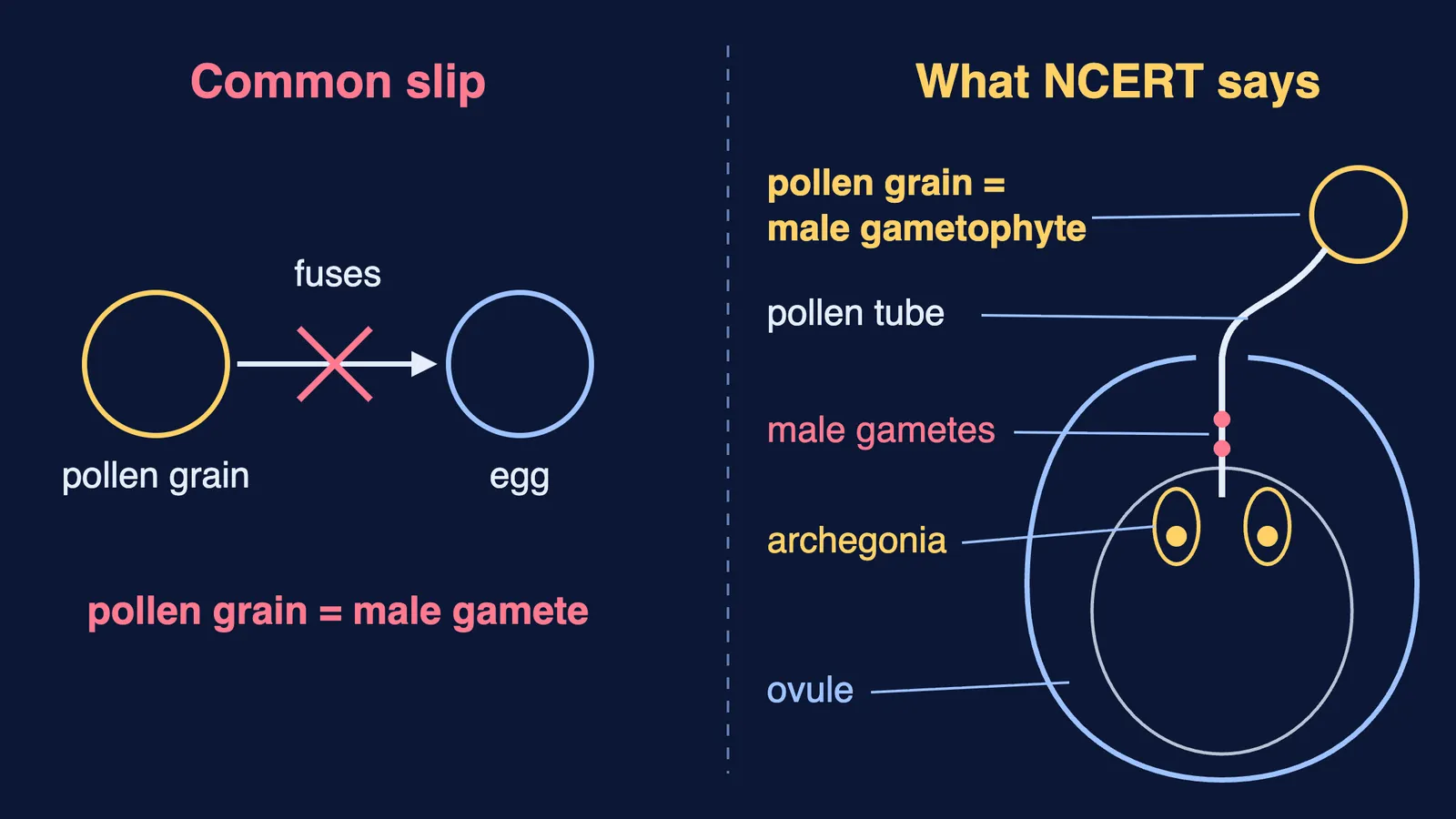
"In a pine, the pollen grain fuses with the egg."
Why it tempts: pollen is the "male" part everyone has heard of, so it gets treated as the male cell itself.
What NCERT says (3.4): microspores grow into a male gametophyte that is cut down to a small number of cells, and that reduced gametophyte is the pollen grain. Air carries it to the ovule, its pollen tube grows towards the archegonia and releases the male gametes near their mouth.
Check: correct this line from a classmate's notes: "In Pinus, pollen grains enter the archegonium and fertilise the egg." (The pollen tube takes the male gametes towards the archegonia; one male gamete fuses with the egg.)
Habit: say "grain, tube, gametes" as three separate things.
"A fern leaf is haploid because the spores on it are haploid."
Why it tempts: the product's ploidy gets copied onto its maker.
What NCERT says (3.3): the fern plant with true root, stem and leaves is the sporophyte. It grows from the zygote, and inside its sporangia, spore mother cells divide by meiosis into spores. NCERT calls meiosis reduction division (3.2), so the leaf that bears the sporangia has twice the chromosomes of each spore.
Check: a spore shed from a fern leaf has 22 chromosomes. How many does a cell of that leaf have, and a spore mother cell just before meiosis? (44 and 44.)
Habit: mark n or 2n on the parent before you mark it on the spore.
"The fern prothallus lives on the fern plant, just as the moss capsule lives on the moss."
Why it tempts: in bryophytes the small generation rides on the big one, and students stretch that to every group.
What NCERT says: the bryophyte sporophyte stays attached and draws its food from the gametophyte (3.2). The pteridophyte prothallus is small but multicellular, free-living and mostly photosynthetic (3.3). In gymnosperms neither gametophyte lives free; both stay inside sporangia on the sporophyte (3.4).
Check: sort into "lives free" or "stays attached to the other generation": a moss seta with its capsule, a fern prothallus, the female gametophyte of a pine. (Lives free: only the prothallus.)
Habit: ask separately which phase is larger and which lives alone.
Which label belongs to which group or system?
"Mosses were the first land plants with xylem and phloem."
Why it tempts: the chapter gives mosses a "first" too, and two firsts merge in memory.
What NCERT says: mosses and lichens are named as the earliest settlers on bare rock (3.2). Pteridophytes are, in evolution, the first land plants to have xylem and phloem (3.3).
Check: match each first to its group: first to settle on bare rock; first land plants with vascular tissue. (Mosses with lichens; pteridophytes.)
Habit: store every "first" with its full phrase, never the word alone.
"Bentham and Hooker's classification is a phylogenetic, evolution-based system."
Why it tempts: "natural" sounds like "how nature evolved".
What NCERT says (chapter introduction): natural systems group plants by natural affinities, using internal features such as anatomy, embryology and phytochemistry as well as external ones; Bentham and Hooker gave one for flowering plants. Phylogenetic systems, accepted at present, rest on evolutionary relationships and assume each taxon's members descend from one ancestor.
Check: a scheme sorts plants using leaf anatomy and embryo development but makes no claim about ancestry. Natural or phylogenetic? (Natural.)
Habit: tie "phylogenetic" to "common ancestor" and "natural" to "many features".
Which pigments and counts get swapped?
"Red algae have no chlorophyll; their red pigment does the job."
Why it tempts: the colour hides the green, so students assume the green is missing.
What NCERT says: all algae bear chlorophyll (3.1). Red algae look red because r-phycoerythrin predominates (3.1.3), and Table 3.1 lists chlorophyll a and d alongside it.
Check: a deep-red seaweed: does its colour rule chlorophyll out, and which two chlorophylls does Table 3.1 give it? (No; a and d.)
Habit: read colour as "which extra pigment wins", not "which pigments exist".
"Brown algae have 2 to 8 equal, apical flagella; green algae have 2 unequal, lateral ones."
Why it tempts: the "2" and the "2-8" sit side by side in Table 3.1 and swap rows.
What NCERT says (Table 3.1): green algae have 2 to 8 flagella, equal and apical; brown algae have 2, unequal and lateral; red algae have none.
Check: two classmates each write "2 flagella", one for a green alga and one for a brown alga. Which two words must each add so the answers cannot be swapped? (Green: equal, apical. Brown: unequal, lateral.)
Habit: learn flagella as a triple: number, equal or not, and where attached.
"A gymnosperm female gametophyte holds a single archegonium, since an archegonium holds one egg."
Why it tempts: the bryophyte fact "one archegonium, one egg" gets copied up to the whole gametophyte.
What NCERT says: the flask-shaped bryophyte archegonium makes just one egg (3.2). In gymnosperms, the megaspore mother cell divides by meiosis into four megaspores, one of which grows into a multicellular female gametophyte bearing two or more archegonia (3.4).
Check: true or false: a pine female gametophyte drawn with three archegonia must be a mistake. (False; NCERT allows two or more.)
Habit: ask "per archegonium or per gametophyte?" before you write any count.
A 60-second self-check before you mark
Pollen grain: male gametophyte, not a gamete?
Spore-maker: 2n, even though its spores are n?
Prothallus: free-living, unlike the moss sporophyte?
First on rock: mosses with lichens; first with xylem and phloem: pteridophytes?
Natural system: many features; phylogenetic: common ancestry?
Red algae: chlorophyll a and d, coloured by r-phycoerythrin?
Flagella: 2 to 8 equal ones at the tip in green, 2 unequal side ones in brown, none in red?
Pine female gametophyte: two or more archegonia?
For the algae features side by side, see how green, brown and red algae compare.
Not sure which of these slips are yours? Fermi's AI tutor works out what you already know and builds a plan for the session.


