

On this page
In the NEET (UG) 2026 syllabus, this chapter falls in Unit 9, Biotechnology and Its Applications, as "Principles and process of Biotechnology". Each correction cites NCERT Class 12 Biology, Chapter 9, Biotechnology: Principles and Processes (Reprint 2026-27) with its section number, and every check is our own. For the chapter as a whole, start with our biotechnology principles guide for NEET.
Try each check before reading the bracketed answer.
Which enzyme cuts where?
"Restriction enzymes chew DNA in from the ends."
Why it happens: "nuclease" gets remembered, but the prefix does not. What NCERT says (9.2.1): nucleases come in two kinds; exonucleases take nucleotides off the ends, while endonucleases cut at set positions inside the DNA, and restriction enzymes are endonucleases. Check: sort two jobs. (a) Taking nucleotides off the free end of a strand. (b) Breaking both backbones at a GAATTC that sits in the middle of a gene. Which is a restriction enzyme's job, and what is the other enzyme class? ((b), an endonuclease cut within the DNA. (a) is exonuclease work.) Habit: read "endo" as "inside" and "exo" as "from the outside edge".
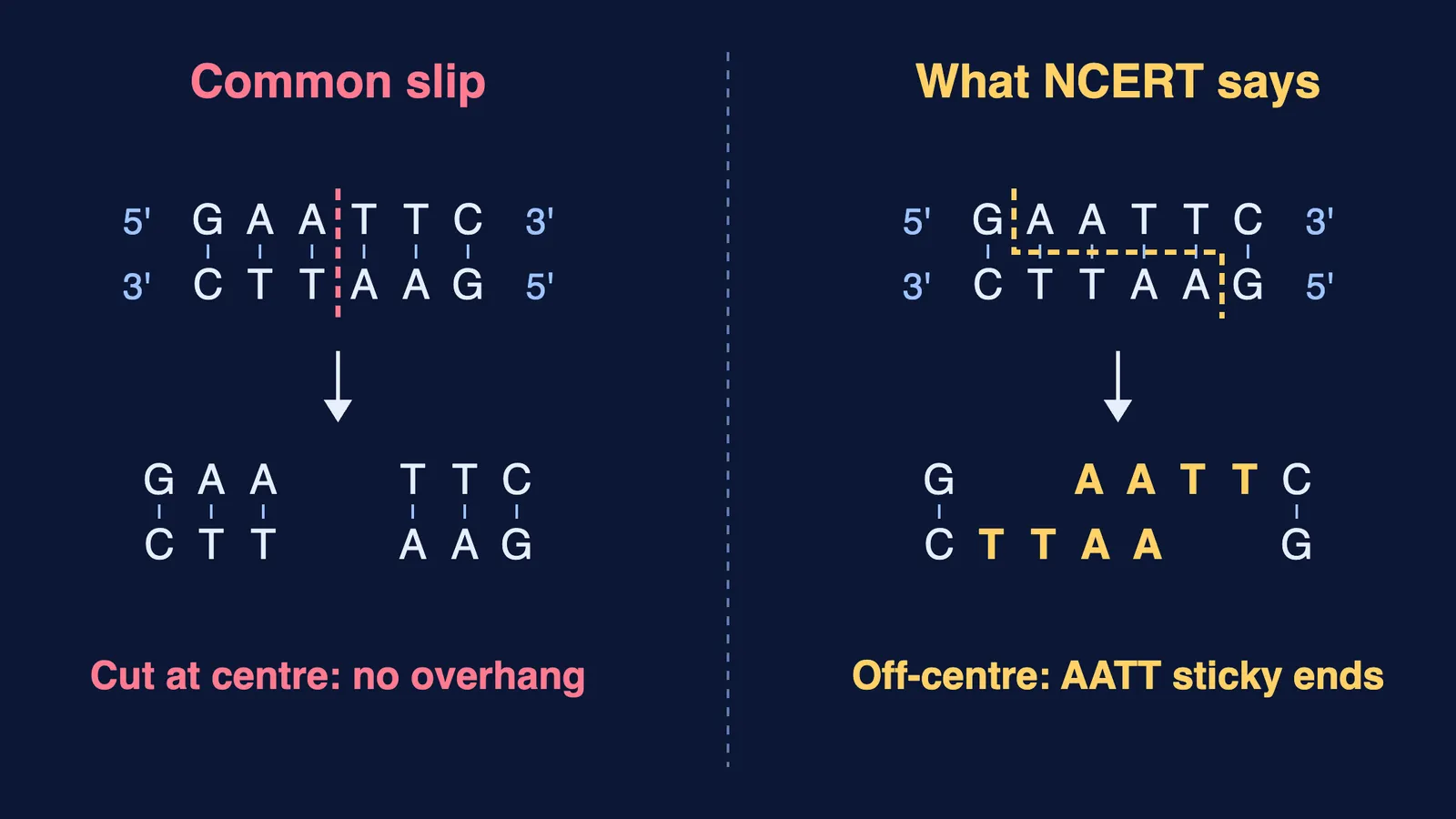
"EcoRI cuts GAATTC exactly at its centre."
Why it happens: splitting a symmetric site in half feels natural. What NCERT says (9.2.1, Figure 9.1): restriction enzymes cut a little away from the centre of the palindrome, between the same two bases on each strand; for EcoRI that is between G and A. Each piece keeps a short single-stranded overhang, the sticky end, which hydrogen-bonds with a matching cut end and so helps DNA ligase. Check: if EcoRI really split both strands at the exact centre, what would a cut vector and a cut gene be missing when they meet before ligation? (Overhangs to pair with. Both strands would stop at the same point, so the ends would have nothing to hold on to.) Habit: for EcoRI, write the cut as G, then AATTC, on both strands.
"A DNA palindrome is a strand that reads the same backwards, like MALAYALAM."
Why it happens: NCERT opens with the word example, and the word rule sticks. What NCERT says (9.2.1): in DNA, the two strands read the same when you keep the reading direction fixed, for example 5' to 3' on each. Check: 5'-GATTAG-3' reads the same backwards. Is it a DNA palindrome? (No. Read 5' to 3', the other strand gives CTAATC. Compare 5'-ACGCGT-3', whose partner read the same way is also ACGCGT.) Habit: write the partner strand and read both 5' to 3' before you decide.
Which look-alike terms get swapped?
"The R in EcoRI stands for restriction."
Why it happens: it is a restriction enzyme, so R seems obvious. What NCERT says (9.2.1): the first letter is the genus, the next two the species, R is taken from the strain (RY 13), and the Roman numeral records which enzyme from that strain was found first, second and so on. Check: a friend expands EcoRI as "E. coli, restriction enzyme, number one". Mark each part. (E and co: right. R: wrong, it is the strain. I: right in spirit, the first enzyme isolated from that strain.) Habit: decode names as genus, species, strain, order.
"A selectable marker tells you which colonies carry your gene."
Why it happens: "selection" sounds like the final step, picking the winners. What NCERT says (9.2.2, 9.3.4): the marker weeds out cells that took up no plasmid and allows only transformed cells to grow; telling recombinants from non-recombinants needs a second trick, such as inactivating another gene by insertion. Check: after transforming E. coli with a ligation mix, an ampicillin plate shows 300 colonies. Do all 300 carry your insert? (Not necessarily. All 300 took up a plasmid, but some may hold a vector with no insert, a non-recombinant.) Habit: say "transformant" for surviving the marker and keep "recombinant" for carrying the insert. Our post on selectable markers and replica plating walks through the plates.
"Making cells competent is a treatment for the DNA."
Why it happens: the DNA has to get in, so it seems the DNA must be changed. What NCERT says (9.2.3): being hydrophilic, DNA cannot pass through membranes, so the bacteria themselves are treated with a set concentration of a divalent ion, calcium for instance, which raises the efficiency with which DNA enters through pores in the cell wall; heat shock between spells on ice then drives the recombinant DNA in. Check: a student soaks a tube of purified plasmid in a calcium solution and says the plasmid is now competent. What should have been treated? (The bacteria. Competence describes the host cell.) Habit: remember the section title, competent host.
Which plate shows the recombinant?
"In pBR322, the recombinants are the colonies that survive tetracycline."
Why it happens: surviving an antibiotic feels like success. What NCERT says (9.2.2): foreign DNA ligated at the BamH I site sits inside the tetracycline resistance gene, so recombinants lose tetracycline resistance; they grow with ampicillin but not with tetracycline, while non-recombinants grow on both. Check: a classmate ligates the insert at the Sal I site instead. NCERT Figure 9.4 draws Sal I inside tetR too. Should she now pick the colonies that survive tetracycline? (No. The insert still breaks tetR, so her recombinants are again the ampicillin-grown colonies that fail on tetracycline.) Habit: find where the insert went, then ask which resistance it broke.
What sets the copy number?
"The ori only marks where replication starts; it has nothing to do with how many copies you get."
Why it happens: "origin" sounds like a starting line and nothing more. What NCERT says (9.2.2): the ori is where replication begins, and it also controls the copy number of any DNA linked to it, so recovering many copies needs a vector whose ori supports a high copy number. Check: vectors P and Q carry the same gene, the same ampR and the same single cloning site, yet cells hold far more copies of P. Which feature must differ? (The ori.) Habit: tie "how many copies" to ori every time.
A 60-second self-check before you mark
Then reread the option for one swapped word: strain for species, host for DNA.
Which of these slips keeps catching you? Fermi's AI tutor works out what you already know and builds a plan for the session.


