On this page
NCERT Class 11 Biology (Reprint 2026-27) covers plant growth in Chapter 13, and the NEET (UG) 2026 syllabus lists it in Biology Unit 4, Plant Physiology, from seed germination and growth rates to the five growth regulators. Slips on it rarely come from skipping pages; they come from a familiar word in the wrong place.
Below are eight frequent mix-ups. Each has why it catches students, what NCERT says, a check and a habit. To see how this chapter sits beside photosynthesis and respiration, start with our guide to preparing plant physiology for NEET.
What counts as growth, and how do you compare it?
"Growth means more cells, so an organ whose cells are not dividing cannot be growing."
Cell division is the first picture attached to growth. Per NCERT 13.1, growth is a size increase that is permanent and cannot be reversed, whether in a whole organ, a part of it or a single cell. NCERT 13.1.2 adds that growth at the level of the cell is mainly an increase in protoplasm, and it sets two cases side by side: a maize root apical meristem shows growth as a rise in cell number, while a watermelon shows it as a rise in cell size. Check: a fruit doubles in volume over a week while its cell count stays fixed. Has it grown? (Yes, by cell enlargement, as long as the increase is irreversible.) Habit: ask "more cells or bigger cells?" before you rule growth out.
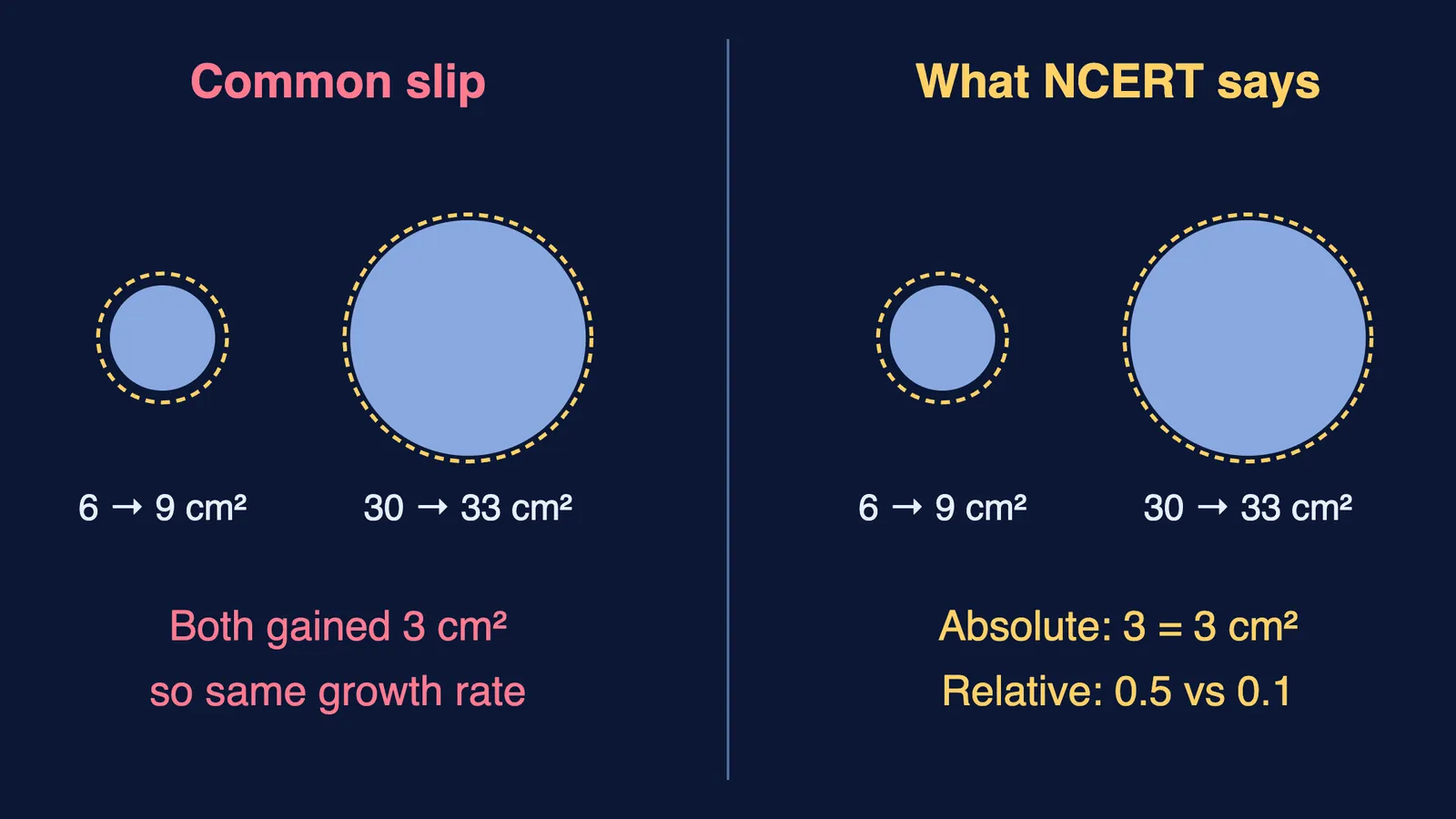
"Two leaves that gained the same area grew at the same rate."
The absolute gain is worked out first, so it feels like the answer. NCERT 13.1.4 separates two measures: absolute growth rate is total growth per unit time, while relative growth rate expresses it per unit of starting size, a shared baseline. Check: leaf P goes from 6 to 9 cm² and leaf Q from 30 to 33 cm² over the same two days. Which has the higher relative growth rate? (P: it gained 3 ÷ 6 = 0.5 of its starting area against Q's 3 ÷ 30 = 0.1 over the same two days, though both gained 3 cm².) Habit: when starting sizes differ, divide by the starting size before you compare.
Where along a root tip does each phase sit?
"A large vacuole is the mark of a young, meristematic cell."
"Young" and "new feature" get paired by instinct. NCERT 13.1.3 puts it the other way round. Cells of the meristematic phase, at the apex, are rich in protoplasm, with big nuclei and thin cellulose primary walls. More vacuolation, cell enlargement and fresh wall deposition belong to the elongation phase just behind them, and cells further back reach their maximum size in the maturation phase. Check: true or false? "Along a root, the cells with the largest nuclei and the thinnest walls are also the most vacuolated." (False. Those are the dividing cells at the apex; vacuolation rises in the elongation zone behind them.) Habit: link vacuoles with stretching, not with dividing.
Which look-alike terms get swapped?
"Parenchyma turning into interfascicular cambium is redifferentiation."
The two words differ by one prefix and share a paragraph. NCERT 13.2 calls it dedifferentiation when a living, differentiated cell that had stopped dividing gets that ability back, as when fully differentiated parenchyma forms interfascicular cambium or cork cambium. Redifferentiation is the next step: cells made by such a meristem stop dividing again and mature for a specific job. Check: put these in order and name the two changes between them: a cambium cell dividing; a mature cell that has stopped dividing again; a fully differentiated parenchyma cell. (Parenchyma, then the dividing cambium cell, then the mature cell: dedifferentiation first, redifferentiation second.) Habit: de- means division is regained; re- means it is lost again and the cell specialises.
"Development is just another word for growth."
Everyday speech blurs them. NCERT 13.3 treats development as the sum of growth and differentiation, covering every change in the life cycle from seed germination to senescence. Check: an old leaf turns yellow and dies. Is that outside development because nothing is getting bigger? (No. Figure 13.8 runs the developmental sequence of a cell through senescence to death.) Habit: growth is about size; development is the whole life story.
Which growth regulator does what?
"ABA is a terpene and gibberellic acid comes from carotenoids."
Few students picture these structures, so the labels drift. NCERT 13.4.1 lists them in one line: IAA belongs to the indole compounds, kinetin to the adenine derivatives, ABA to the carotenoid derivatives, GA3 to the terpenes, and ethylene is a gas. Check: of GA3 and ABA, which one does NCERT call a derivative, and of what? (ABA, of carotenoids; GA3 is listed as a terpene itself.) Habit: learn the five as a single ordered chain, not as separate facts.
"Cytokinins, like auxins, keep the side buds asleep."
Auxins and cytokinins are both growth promoters in NCERT 13.4.1, so students assume they pull the same way. Section 13.4.3.1, on auxins, describes the growing apical bud holding back the lateral buds, while 13.4.3.3 says cytokinins help overcome apical dominance and support lateral shoot growth. Check: true or false? "A cytokinin spray on a plant with its tip intact should hold the axillary buds back even harder." (False.) Habit: two promoters can still sit on opposite sides of one event.
"Ethylene is largely an inhibitor, so like ABA it puts seeds and buds into dormancy."
Filing ethylene beside ABA invites borrowing ABA's effects. NCERT 13.4.3.5 says ABA inhibits seed germination and induces dormancy, which helps seeds survive drying out. Section 13.4.3.4 says ethylene does the opposite: it breaks seed and bud dormancy. Check: a batch of dormant potato tubers is treated with an ethylene source. Per NCERT, should you expect sprouting to be held back? (No. NCERT lists sprouting of potato tubers among ethylene's effects; holding seeds dormant is ABA's role.) Habit: sort by the effect named, never by the group label.
What should you check in 60 seconds before you mark?
Tomorrow, redo the checks with answers covered. Then test the same facts in exam formats with our plant growth questions in Statement I/II and List-I/List-II form.
Not sure which of these slips is yours? Fermi's AI tutor works out what you already know and builds a plan for the session.