On this page
This chapter is short, so NEET-style questions on it turn on single words: phloem or phloem parenchyma, root or stem, generally or always. Each slip below comes with what NCERT Class 11 Biology, Chapter 6 (Reprint 2026-27) actually says, a quick check and a habit.
The NEET (UG) 2026 syllabus puts plant tissues and root, stem and leaf anatomy in Biology Unit 2 (Structural Organisation in Animals and Plants). The current chapter has no secondary growth section, so neither does this list. If the chapter is new to you, start with our chapter prep guide for plant anatomy in NEET.
Which tissue system does a layer belong to?
"Ground tissue means parenchyma."
Why it happens: the cortex, pith and medullary rays you draw most are parenchyma.
What NCERT says: ground tissue is everything except the epidermis and the vascular bundles, and it is built from all three simple tissues, parenchyma, collenchyma and sclerenchyma (NCERT 6.1.2).
Check: in a young sunflower stem, is the collenchyma hypodermis part of the ground tissue? Yes. It is neither epidermis nor a vascular bundle, and NCERT counts it as the outer sub-zone of the cortex (6.2.3).
Habit: place a layer by position first, then name its cell type.
"A leaf has no ground tissue, because mesophyll is a system of its own."
Why it happens: the three systems are usually taught on a stem or root, so the leaf's parts look like a new scheme.
What NCERT says: a leaf's ground tissue is its mesophyll, thin-walled cells that contain chloroplasts (6.1.2). NCERT's leaf section has three parts, epidermis, mesophyll and vascular system (6.2.5); read with 6.1.2, those are the same three systems.
Check: sort four leaf cells into tissue systems: a bulliform cell, a spongy parenchyma cell, a guard cell and a xylem vessel from the midrib. Bulliform and guard cells are epidermal (bulliform cells are modified upper epidermal cells, 6.2.6), spongy parenchyma is ground, and the vessel is vascular.
Habit: for any leaf cell, ask "skin, vein or the rest?" The rest is ground tissue.
Which look-alike terms get swapped?
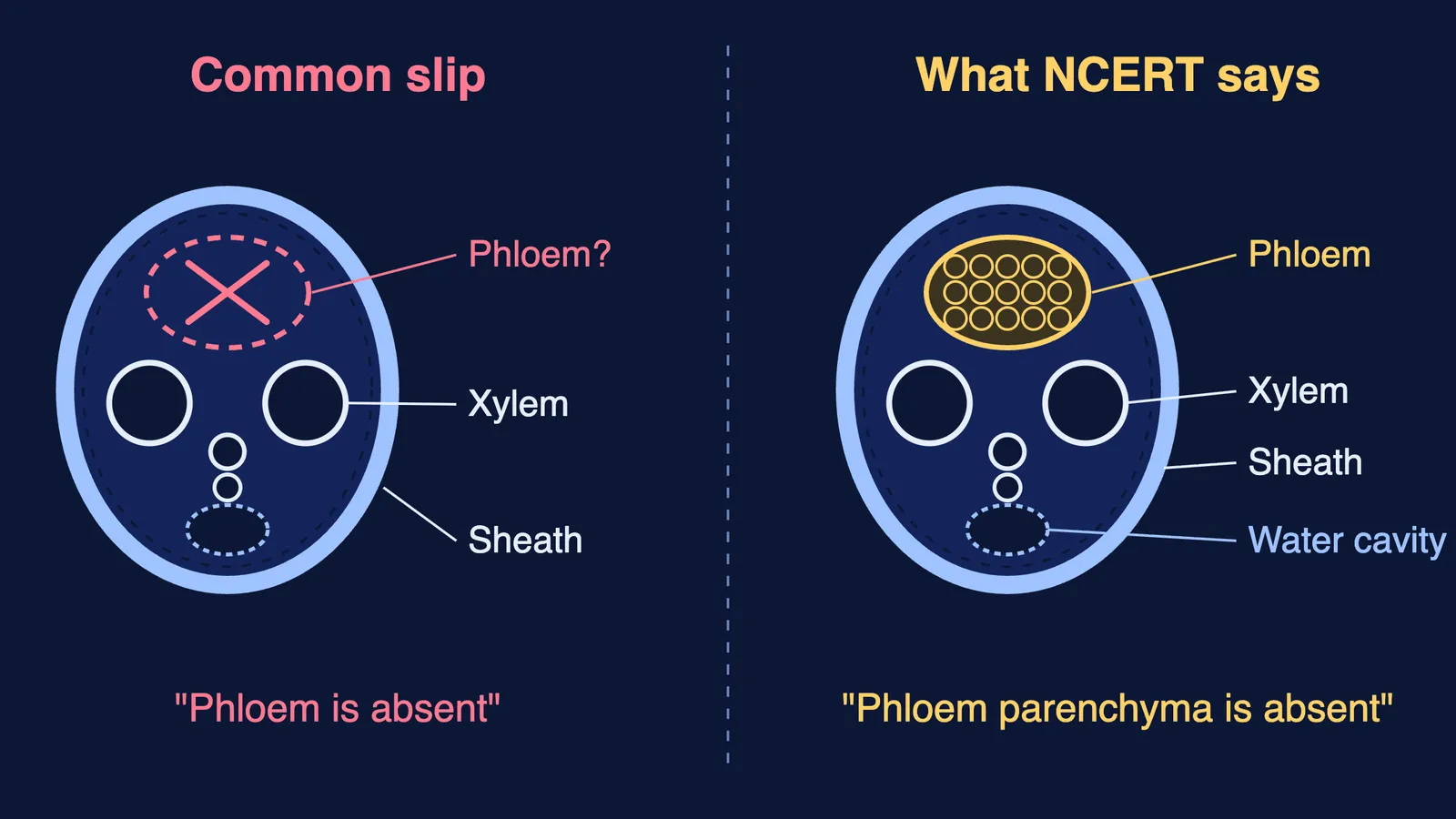
"The vascular bundle of a monocot stem has no phloem."
Why it happens: the NCERT line is about phloem parenchyma, and under time pressure the eye stops at the first word.
What NCERT says: monocot stem bundles are conjoint and closed, so xylem and phloem sit together on one radius; the missing tissue is phloem parenchyma, and water-containing cavities are present inside the bundle (6.2.4, 6.1.3).
Check: could a bundle with no phloem be called conjoint? No. Conjoint needs xylem and phloem on one radius.
Habit: when a statement says "absent", underline the full name of what is absent.
"A root hair is a separate cell sitting on the root's surface."
Why it happens: diagrams draw the hair as a distinct finger, and stem trichomes, usually multicellular, look like add-ons.
What NCERT says: each root hair is one epidermal cell stretched outward; in the sunflower root, many epiblema cells stick out as these single-celled hairs (6.1.1, 6.2.1).
Check: how many cells make up one root hair together with the epiblema cell it grows from? One.
Habit: never say "root hair" without "outgrowth of an epiblema cell" in your head.
Where does a rule stop applying?
"Dicots have a small pith and monocots a large one."
Why it happens: NCERT calls the dicot root's pith small or inconspicuous and the monocot root's pith large and well developed, and students turn a root contrast into a dicot-versus-monocot law.
What NCERT says: that contrast is about roots only (6.2.1, 6.2.2). In the young dicot stem, a large number of rounded parenchyma cells with big intercellular spaces fill the centre, and these form the pith (6.2.3).
Check: a stem section shows a ring of bundles around a broad parenchyma centre. Does the broad centre rule out a dicot? No. The ring of bundles is the dicot stem's mark, and a sizeable pith fits it.
Habit: tag every size word with an organ as well as a group: "dicot root pith: small".
"Only the monocot stem has bundle sheaths."
Why it happens: the sclerenchymatous bundle sheath is a headline monocot stem feature.
What NCERT says: in the dorsiventral leaf too, every vascular bundle sits inside a sheath of thick-walled cells (6.2.5). NCERT names the sheath's tissue as sclerenchyma only for the monocot stem (6.2.4).
Check: does "every bundle sits in a thick-walled sheath" alone prove a monocot stem? No. A dorsiventral leaf fits too; look for scattered bundles or a sclerenchymatous hypodermis.
Habit: for each structure, list every organ the chapter gives it to.
"The upper surface of a dicot leaf never has stomata."
Why it happens: "more on the lower side" gets stored as "only on the lower side".
What NCERT says: in a dorsiventral leaf, the abaxial (lower) epidermis generally carries more stomata than the adaxial (upper) one, and the upper surface may even have none (6.2.5). "May lack" is not "always lacks".
Check: fix "a dorsiventral leaf keeps all its stomata on the abaxial side." Better: the abaxial side generally has more; the adaxial side may have none.
Habit: write comparisons as comparisons (lower more than upper), never as bans.
What comes first in a dicot root?
"A young dicot root already has cambium between its xylem and phloem."
Why it happens: the bundles of a young dicot stem already have cambium between phloem and xylem (they are open), and students hand the root the same feature.
What NCERT says: in the primary sunflower root, NCERT calls the parenchyma cells lying between the xylem and phloem patches conjunctive tissue; a cambium ring between them develops only later (6.2.1). Cambium inside the bundle is a dicot stem feature (6.1.3).
Check: what lies between xylem and phloem in a young dicot stem bundle, and in a primary dicot root? Cambium in the stem; conjunctive tissue in the root.
Habit: read "later" as a time stamp. Primary section first, cambium after.
A 60-second self-check before you mark
Then test the routine on our eight worked practice questions on plant anatomy.
Not sure which of these eight slips you actually make? Fermi's AI tutor works out what you already know and builds a plan for the session.