On this page
Every slip below is checked against Chapter 4, Animal Kingdom, of NCERT's Class 11 Biology text (NCERT chapter kebo104, Reprint 2026-27), which the NMC's NEET (UG) 2026 syllabus places in Unit 1, Diversity in Living World. For the whole chapter, start with our guide to placing any animal in its phylum.
Which body-plan features do not travel together?
"Radial symmetry means the animal has only two germ layers."
Why it tempts: the first radial animals you meet, cnidarians and ctenophores, are also the diploblastic ones, so the two features fuse in memory.
What NCERT says (4.1.2, 4.1.3, 4.2.3, 4.2.9): coelenterates, ctenophores and echinoderms all have a radial body plan, but only the first two are diploblastic. Adult echinoderms are radial and still triploblastic and coelomate; their larvae are bilateral.
Check: describe *Ophiura*, the brittle star, in three answers: adult symmetry, larval symmetry, number of germ layers. (Radial, bilateral, three.)
Habit: fill symmetry and germ layers as two separate columns, never as one.
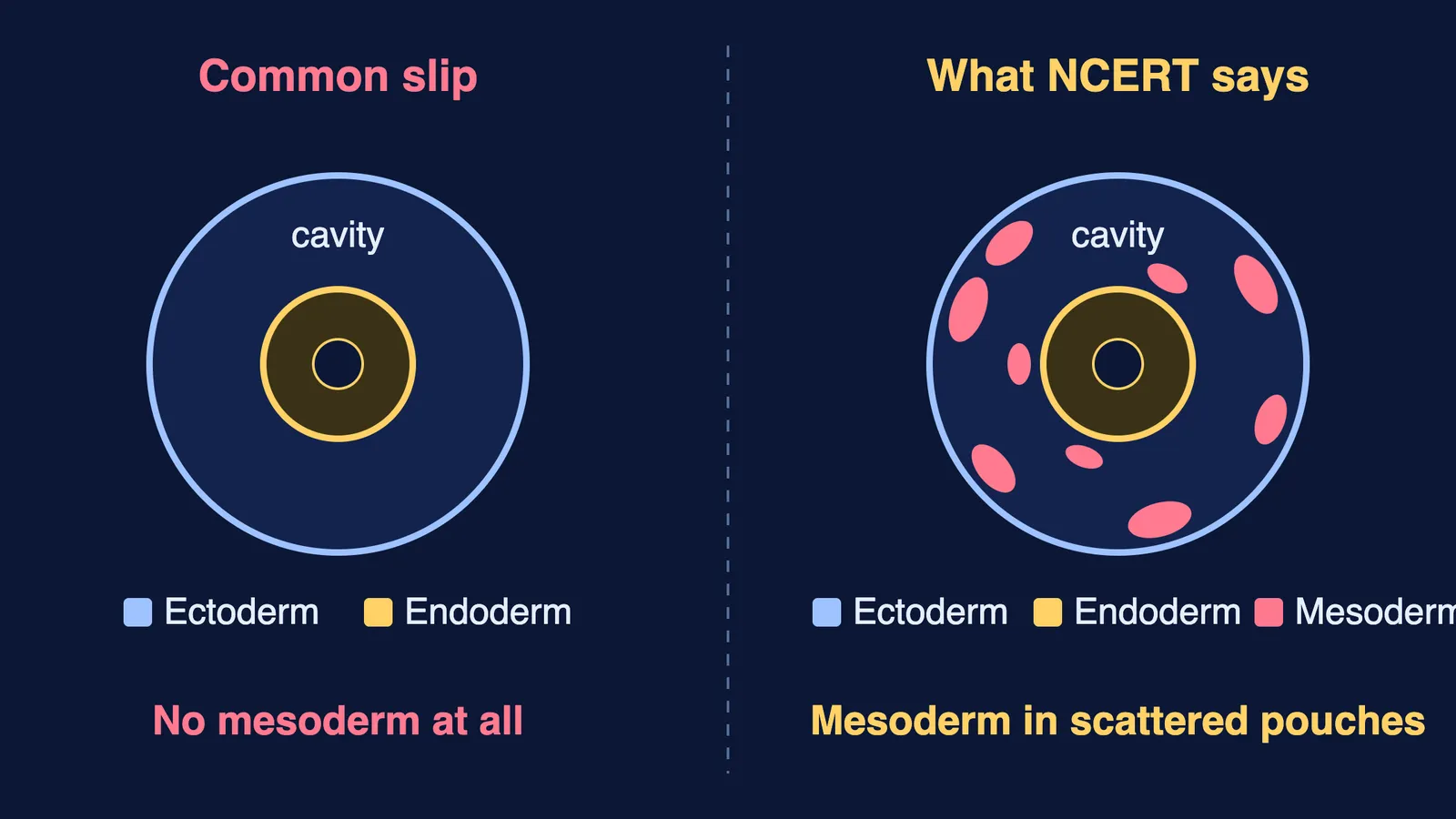
"Pseudocoelomates have no mesoderm; that is what pseudo means."
Why it tempts: "false cavity" sounds like "missing layer".
What NCERT says (4.1.4, 4.2.5): in a pseudocoelom, mesoderm is present but lies as scattered pouches between ectoderm and endoderm instead of lining the cavity. Roundworms are triploblastic pseudocoelomates.
Check: *Wuchereria* has a body cavity that mesoderm does not line. Is it diploblastic or triploblastic? (Triploblastic. What is missing is the lining, not the layer.)
Habit: ask two questions in turn: is there mesoderm, and does it line the cavity?
"Every coelomate phylum is segmented."
Why it tempts: the earthworm, a coelomate, is also NCERT's one example of metamerism in 4.1.5.
What NCERT says (4.2.8, Table 4.2): molluscs are triploblastic coelomates with an unsegmented body, and Table 4.2 also marks segmentation absent for echinoderms and hemichordates.
Check: *Pinctada* and *Hirudinaria* are both coelomates. Which would you mark as segmented? (*Hirudinaria*, the leech, an annelid. *Pinctada*, the pearl oyster, is a mollusc.)
Habit: read the coelom and segmentation columns of Table 4.2 as two different questions. If segmentation still blurs with surface rings, our explainer on what metameric segmentation means separates the two.
Which way round does it run?
"Sponges digest their food in the spongocoel, as if it were a stomach."
Why it tempts: a big central cavity with food-carrying water looks like a gut.
What NCERT says (4.2.1): the spongocoel is a stop on the water route from the ostia to the osculum, lined with choanocytes, and digestion in sponges is intracellular.
Check: a food particle is drawn into a *Sycon*. Is it broken down in the water of the spongocoel or within a cell? (Within a cell.)
Habit: label every cavity by what it carries: water, food or blood.
**"In *Obelia*, medusae produce polyps asexually."**
Why it tempts: the cycle is learned as one sentence with two arrows, and "sexually" and "asexually" trade places easily.
What NCERT says (4.2.2): it runs the other way. Polyps produce medusae asexually, and medusae form polyps sexually; NCERT names this alternation of generations, or metagenesis.
Check: a classmate's notes read "medusa to polyp: asexual". Which word is wrong, and which of the two forms is the sessile, cylindrical one? (Asexual should read sexual; the polyp is the sessile form.)
Habit: draw the cycle as a loop and label the polyp-to-medusa arrow "asexual" before writing anything else.
Which vertebrate labels get over-read?
"Every animal in a Tetrapoda class has two pairs of limbs."
Why it tempts: NCERT's vertebrate chart tags Tetrapoda "(bear limbs)", and its summary groups Amphibia, Reptilia, Aves and Mammalia there for having two pairs of limbs.
What NCERT says (4.2.11.4, 4.2.11.5, Summary): the class descriptions carry exceptions. Most amphibians, not all, have two pairs of limbs, and *Ichthyophis* is listed as limbless. Reptile limbs are two pairs only when present, and the summary notes that snakes lack limbs.
Check: *Bangarus*, the krait, is one of NCERT's reptile examples. Does the reptile description require it to have limbs? (No. Reptile limbs are described as two pairs only when present, and snakes have none.)
Habit: treat "most" and "when present" in a class description as a flag that exceptions exist.
"Egg-laying animals always pass through a larva."
Why it tempts: amphibians, the egg-layers you draw most, develop indirectly.
What NCERT says (4.2.1, 4.2.11.3, 4.2.11.5, 4.2.11.6): indirect development means a larval stage that looks unlike the adult. Reptiles and birds are oviparous yet develop directly, and bony fishes are mostly oviparous with direct development.
Check: *Columba* and *Hyla* both lay eggs. Which one develops directly? (*Columba*, the pigeon. *Hyla*, the tree frog, develops indirectly.)
Habit: keep "how the young leave the mother" and "whether there is a larva" as two separate facts.
Which numbers get swapped?
"A three-chambered heart has one auricle and two ventricles."
Why it tempts: the chamber count is given as one number, and the split is easy to flip.
What NCERT says (4.2.11.2, 4.2.11.3, 4.2.11.4, 4.2.11.5): cartilaginous and bony fishes both have one auricle and one ventricle; amphibians have two auricles and one ventricle. Reptile hearts are usually three-chambered, but crocodiles have four chambers.
Check: write the hearts of *Scoliodon* and *Salamandra* as auricles plus ventricles. (*Scoliodon*, the dog fish: 1 + 1. *Salamandra*, the salamander: 2 + 1.)
Habit: write a heart as auricles plus ventricles, such as 2 + 1, never as a bare total.
"Bony fishes carry 6-15 pairs of gill slits."
Why it tempts: both are gill-breathing aquatic vertebrates, and only one gill number tends to stick.
What NCERT says (4.2.11.1, 4.2.11.3): the 6-15 pairs of gill slits belong to cyclostomes. Bony fishes have four pairs of gills, each side covered by an operculum.
Check: which number goes with *Myxine* and which with *Catla*: four pairs, or 6 to 15 pairs? (*Myxine*, the hagfish: 6 to 15 pairs of gill slits. *Catla*: four pairs of gills.)
Habit: attach every number in this chapter to a named class before you learn it.
What should you check in the last 60 seconds?
Which of these nine slips would catch you today? Fermi's AI tutor works out what you already know and builds a plan for the session.