On this page
Every slip below is checked against NCERT Class 12 Biology, Chapter 7, Human Health and Disease (NCERT chapter lebo107, Reprint 2026-27); the NMC's NEET (UG) 2026 syllabus puts this chapter in its Unit 8 (Biology and Human Welfare). For the basics, see our human health and immunity guide for NEET.
This is a study summary, not medical advice.
Which disease names and vectors mislead you?
"Ringworm is caused by a worm."
Why it tempts: the name sits beside two real worms in the same section.
What NCERT says (7.1): ringworm is a fungal infection, caused by species of *Microsporum*, *Trichophyton* and *Epidermophyton*. The helminths NCERT names are the roundworm *Ascaris* and the filarial worm *Wuchereria*.
Check: sort ringworm, ascariasis and filariasis into "fungus" and "helminth". (Ringworm alone goes under fungus.)
Habit: file each disease by its pathogen's group, never by its everyday name.
**"Every mosquito-borne disease in this chapter is spread by *Anopheles*."**
Why it tempts: the malaria cycle drills *Anopheles* into you, so it gets reused.
What NCERT says (7.1): the female *Anopheles* carries *Plasmodium*. Dengue and chikungunya are linked to *Aedes* mosquitoes. For filariasis, NCERT says only that female mosquito vectors pass on *Wuchereria*, without naming a genus.
Check: a flashcard reads "chikungunya: *Anopheles*". What genus does NCERT give instead, and what does it give for filariasis? (*Aedes*; no genus, only "female mosquito vectors".)
Habit: write the genus beside each disease, or "female mosquito" where none is named.
"Malaria's chill and fever begin when the mosquito injects the parasite."
Why it tempts: the bite is the most vivid event.
What NCERT says (7.1): sporozoites from the bite multiply first in liver cells and only then attack red blood cells. Their rupture is linked with release of haemozoin, a toxic substance NCERT ties to the chill and high fever returning every three to four days.
Check: what must happen between the bite and the first chill? (Multiplication in liver cells, then RBC attack, rupture and haemozoin release.)
Habit: tie each symptom to the stage that causes it.
Which immunity terms get mixed up?
"Interferons are antibodies, so they belong to acquired immunity."
Why it tempts: both are proteins that fight infection.
What NCERT says (7.2.1): interferons make up the cytokine barrier, one of the four barriers of innate immunity. A cell already infected by a virus secretes them, and they shield cells not yet infected. Antibodies are made by B-lymphocytes (7.2.2).
Check: fill in. Interferons: made by ___, part of ___ immunity. Antibodies: made by ___, part of ___ immunity. (Virus-infected cells, innate; B-lymphocytes, acquired.)
Habit: for each defence protein, ask who makes it.
"A vaccine is an injection of ready-made antibodies."
Why it tempts: a vaccine and an antitoxin both arrive by injection.
What NCERT says (7.2.4): a vaccine carries antigenic proteins of a pathogen, or the pathogen itself in inactivated or weakened form. The body then makes its own antibodies plus memory B and T cells, and NCERT lists deliberate immunisation as a way of inducing active immunity (7.2.3). Giving preformed antibodies, as in an antitoxin, is passive immunisation.
Check: fill the blanks. A vaccine supplies ___; an antitoxin supplies ___. Which of the two does NCERT say generates memory cells? (Antigen; antibodies; the vaccine.)
Habit: ask whether a shot brings antigen or antibody.
"Primary lymphoid organs are where the primary immune response happens."
Why it tempts: the chapter uses "primary" for both a response and a set of organs.
What NCERT says: the primary response is the low-intensity response to a first encounter with a pathogen (7.2.2). Primary lymphoid organs, bone marrow and thymus, are where immature lymphocytes become antigen-sensitive. Secondary organs, such as the spleen, lymph nodes and tonsils, are where lymphocytes meet antigen and multiply into effector cells (7.2.7).
Check: on a first infection, antigen reaching the Peyer's patches of the small intestine activates lymphocytes there. Primary or secondary lymphoid tissue? (Secondary, even though the response is primary.)
Habit: for organs, "primary" means where lymphocytes mature; for responses, it means first meeting.
What goes wrong on HIV and cancer?
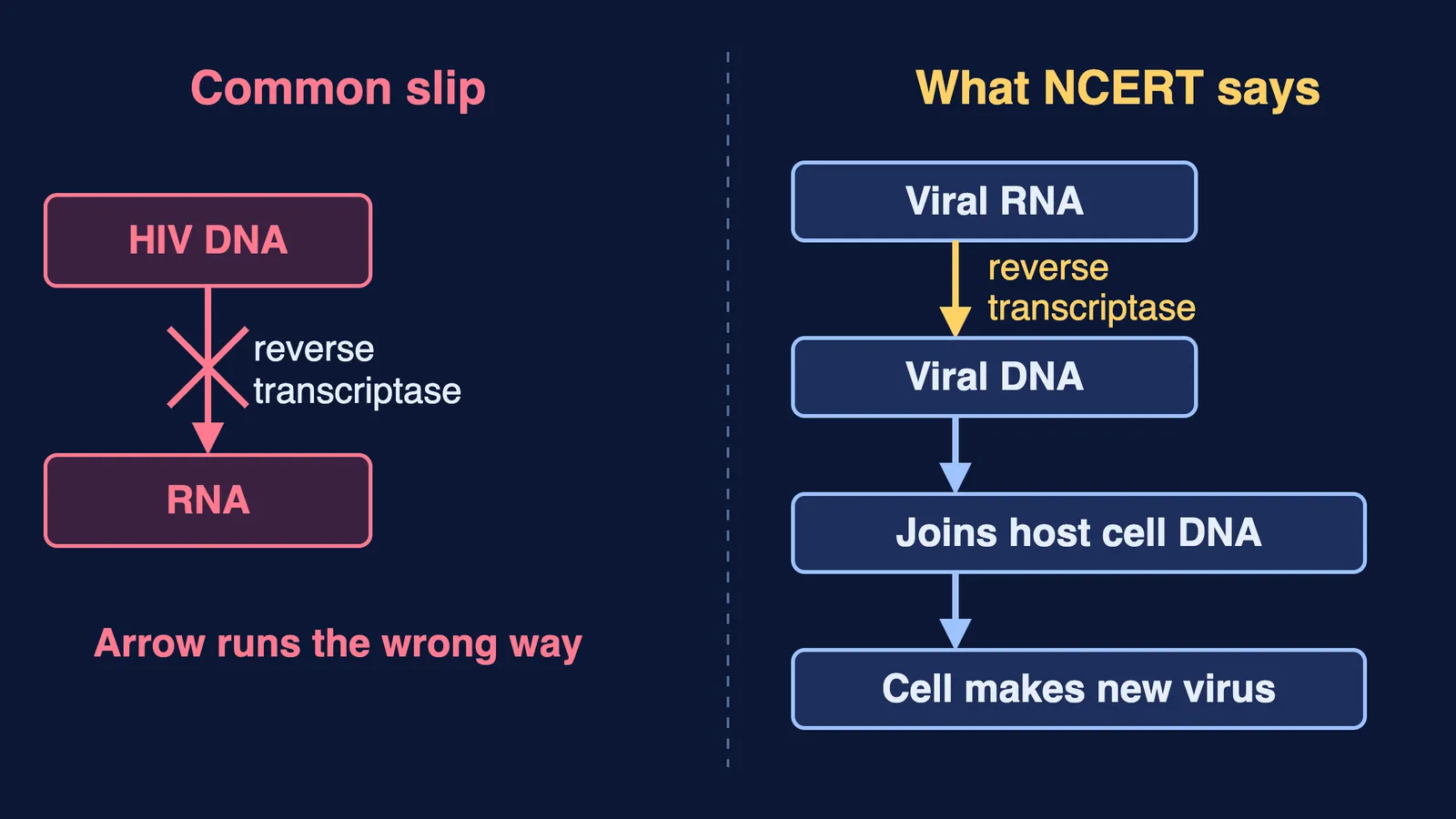
"Reverse transcriptase turns HIV's DNA into RNA."
Why it tempts: transcription is learnt as DNA to RNA.
What NCERT says (7.3): HIV is a retrovirus, an enveloped virus with an RNA genome. Inside a macrophage, reverse transcriptase uses that RNA to form viral DNA, which joins the host cell's DNA and directs the cell to make virus particles.
Check: spot the error in "inside a macrophage, reverse transcriptase reads host DNA to make HIV's RNA genome". (Reversed: it uses viral RNA to make viral DNA, which then joins the host DNA.)
Habit: read "reverse" as an arrow pointing from RNA back to DNA.
"Only viruses carry cancer genes, so a normal cell has none."
Why it tempts: viral oncogenes come first in the paragraph, so "oncogene" gets filed as a virus word.
What NCERT says (7.4): oncogenic viruses carry viral oncogenes, but normal cells also contain cellular oncogenes (c-onc), or proto-oncogenes. If these are activated under certain conditions, they could lead to oncogenic transformation.
Check: a cell has never met an oncogenic virus. Can it still hold genes linked to cancer, and what are they called? (Yes: proto-oncogenes, also written c-onc.)
Habit: pair every "viral" cancer term with its "cellular" twin.
Which way does drug tolerance run?
"With repeated use, a smaller dose gives the same effect."
Why it tempts: "getting used to" sounds like needing less.
What NCERT says (7.5.2): repeated drug use raises the tolerance level of receptors in the body, so they respond only to higher doses, which leads to greater intake.
Check: if receptor tolerance rises, does the dose needed for the earlier effect go up, stay level or fall? (It goes up.)
Habit: link tolerance to the receptor, and the receptor to the dose.
A 60-second self-check before you mark
Name: does the everyday name match the pathogen's group?
Vector: which mosquito does NCERT actually name for this disease?
Stage: which step of the cycle causes this symptom?
Shot: does it bring antigen or ready-made antibody?
Arrow: RNA to DNA, or DNA to RNA?
Dose: does tolerance push it up or down?
Then switch formats with our NCERT exceptions and odd-one-out questions on this chapter.
Not sure which of these slips is yours? Fermi's AI tutor works out what you already know and builds a plan for the session.