On this page
Put your face in a basin of cold water and within seconds your heart starts to slow, without any effort from you. It is the mammalian diving reflex, an automatic response shared with diving mammals such as whales and dolphins. You can measure it in a school lab with a basin, a stopwatch and two fingers on a wrist.
What is the mammalian diving reflex?
In humans, the diving reflex can be set off by putting the face in cold water. Liu and Vagula's 2021 paper in HAPS Educator lists its main features: the heart slows (bradycardia), blood vessels at the body's edges narrow, the heart pumps less blood and average blood pressure rises. The same paper notes that it was first described in 1786, by Edmund Goodwyn.
A 2013 review by W. Michael Panneton in Physiology describes it as three reflexes working together: breathing stops (apnea), the heart slows and blood vessels narrow. He notes that all aquatic mammals have it, and so do land mammals, humans included.
Its likely main job, according to a 2005 review by Foster and Sheel, is to conserve oxygen for the brain and heart, delaying serious damage from low oxygen.
Why does heart rate slow when your face is in cold water?
The pathway has three steps, according to Liu and Vagula:
Sensor. Water colder than about 21 °C stimulates cold receptors (thermoreceptors) in the skin of the face.
Messenger in. The signals travel through the trigeminal nerve, the main sensory nerve of the face, to the nucleus tractus solitarius in the brainstem.
Messenger out. Brainstem centres then activate the vagus nerve, and the heart beats more slowly.
Panneton's review describes the sharp slowing of the heart during submersion as "mediated via the parasympathetic vagus nerve". It adds that the sympathetic nervous system counters the drop in blood pressure that follows, while blood vessels in the skin, muscles and gut narrow and send blood elsewhere. So both halves of the autonomic nervous system are active at once.
How much does heart rate drop during a face dip?
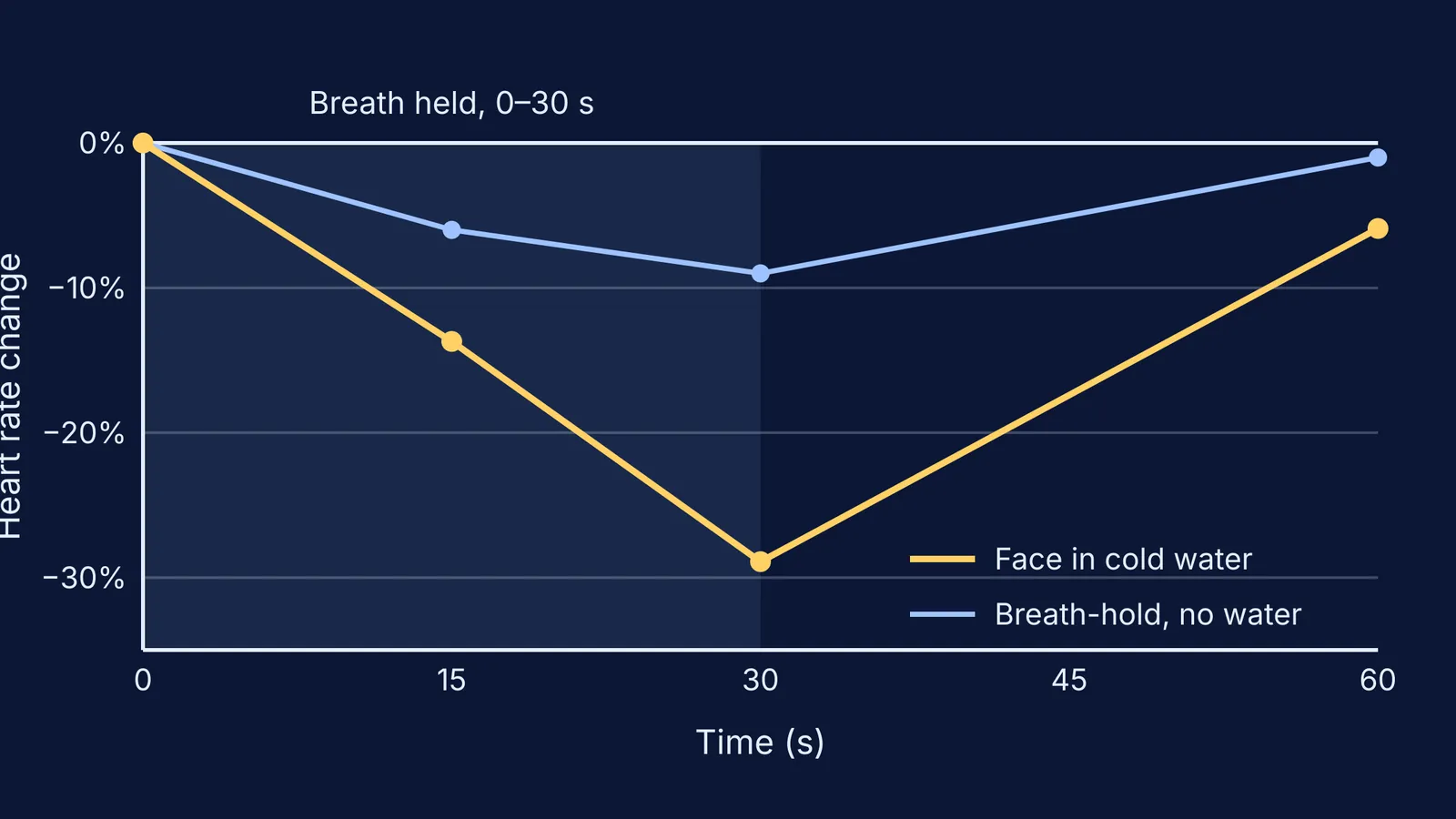
Liu and Vagula used heart-rate data from 42 students aged 18–22 in a physiology lab course. Each one took a deep breath and put their face, up to the cheeks, in water at 10–14 °C.
Average heart rate fell from 81.0 beats per minute at rest to 68.9 at 15 seconds and 56.5 at 30 seconds.
That is an average drop of about 29% at 30 seconds. All 40 students who managed the full 30 seconds had a lower heart rate.
Thirty seconds after lifting their faces out, the average was back up to 76.0.
Holding the breath without water, the comparison test, lowered heart rate by only 9% on average, a change that was not statistically significant.
Individual drops ranged from 5% to 75%, and male and female students responded alike.
The breath-hold comparison suggests that the cold, wet face does most of the work, not the held breath alone.
How can you test the diving reflex safely in class?
Work in pairs: one subject, one counter with a stopwatch.
Rest. The subject sits quietly for two minutes. The counter finds the pulse at the wrist, counts beats for 15 seconds and multiplies by 4 to get beats per minute.
Breath-hold. The subject takes a deep breath and holds it for up to 30 seconds, face out of the water. Count beats from second 15 to second 30.
Recover for two minutes.
Dip. Fill a basin with tap water and a few ice cubes. If you have a thermometer, aim for 10–14 °C, the range used in the study. Deep breath, then lower the forehead, eyes and cheeks into the water for up to 30 seconds. Count beats from second 15 to second 30.
After. Count once more, starting 30 seconds after the face comes out.
Worked example. Say your resting count is 20 beats in 15 seconds, so 80 beats per minute. During the breath-hold you count 18 beats (72 per minute), a 10% drop. In the dip you count 14 beats (56 per minute): (80 − 56) ÷ 80 = 0.30, a 30% drop. The gap between 10% and 30% is the diving reflex at work.
If the autonomic nervous system still feels like a list of names, the Fermi Concept Library gives every concept in biology its own lesson and shows its place in the map. You can also bring your class data to Fermi's AI tutor, which works through problems alongside you and checks your understanding as it goes.
For more heart physiology, read the maths of why athletes have a lower resting heart rate and why cardiac muscle cannot be tetanised, or why we shiver when we are cold.