

On this page
At rest, your heart has one job: move enough blood to supply your body. It can do that with big beats or with many beats. How a trained heart shifts that balance is the whole reason an athlete's pulse runs slow, and you can show it with one multiplication.
What is a normal resting heart rate, and how low do athletes go?
For most adults, a resting heart rate between 60 and 100 beats per minute is normal, according to the American Heart Association. The same page notes that an athlete or more active person may have a resting heart rate as low as 40 beats per minute.
The Merck Manual's professional page on athlete's heart adds that, rarely, an athlete's resting rate falls below 40 beats per minute.
Why do athletes have a low resting heart rate?
Start with an equation from Class 11 biology.
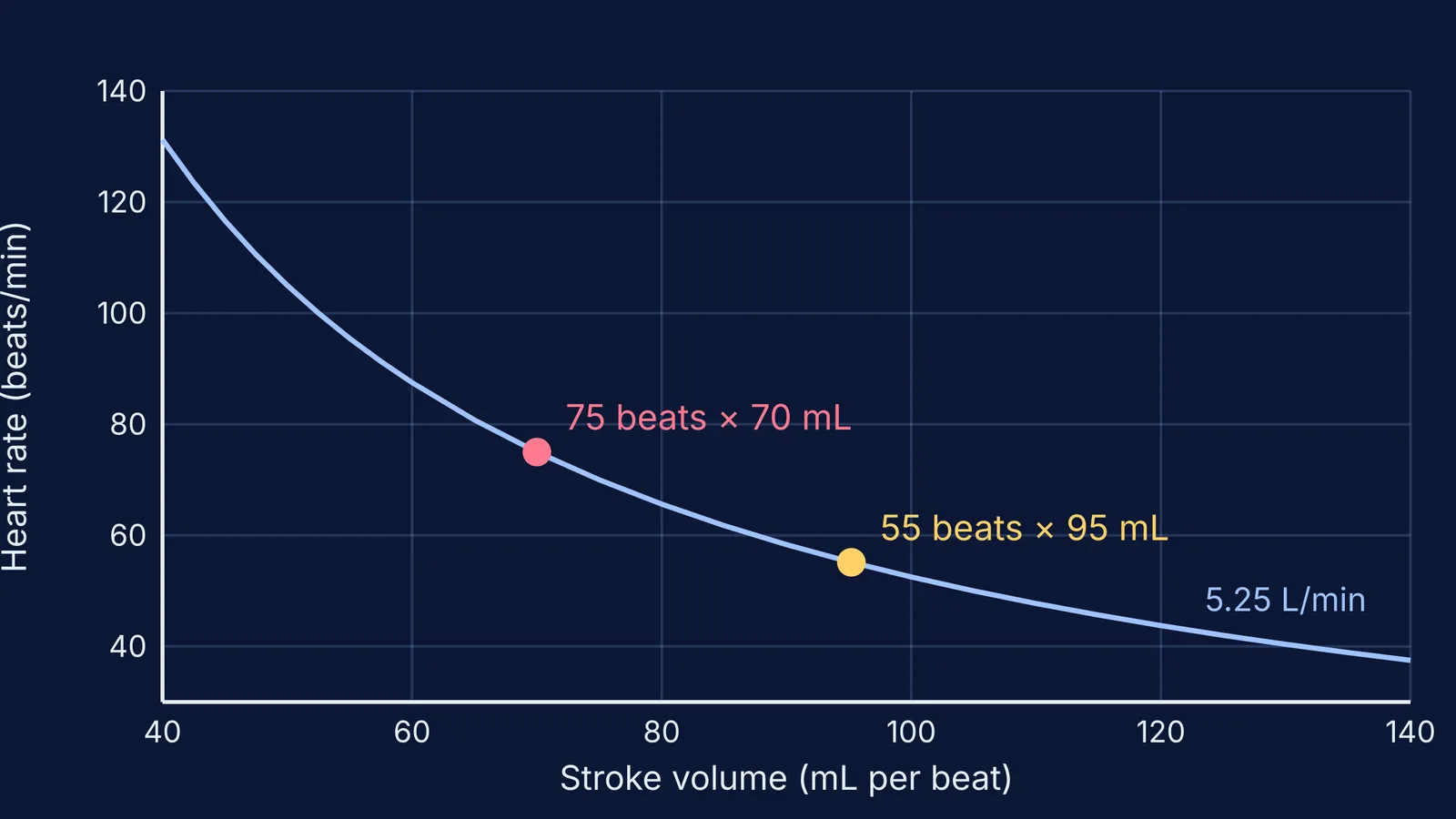
Cardiac output is the volume of blood each ventricle pumps per minute, and it equals heart rate × stroke volume (OpenStax Anatomy and Physiology 2e). Stroke volume is the blood pushed out in a single beat. The same chapter gives typical resting values for a 70 kg adult: a stroke volume of about 70 mL, a heart rate of about 75 beats per minute, and a mean cardiac output of 5.25 L/min.
Endurance-trained hearts move more blood per beat than untrained ones. In a 2025 study in Experimental Physiology, researchers compared 10 endurance-trained athletes with 10 untrained people matched for body surface area. At rest, the athletes' stroke volume was 36% higher. The gap grew to 63% when both groups cycled at a heart rate of 140 beats per minute. The authors tie the difference to how the ventricle fills between beats.
The nervous system plays a part too. Merck's page on athlete's heart says the lower heart rate "results primarily from increased vagal tone": the vagus nerve acts as a brake on the heart's natural pacemaker, and in trained athletes that brake is stronger. Merck also notes that maximal stroke volume and cardiac output rise with training, contributing to a lower resting heart rate and a longer filling time between beats.
Worked example: how many beats does a trained heart save?
Here is the calculation, using the typical resting values from OpenStax and the 36% stroke-volume difference from the 2025 Experimental Physiology study. One assumption: the resting body needs the same blood flow whether or not it is trained.
Untrained heart: 75 beats/min × 70 mL = 5,250 mL/min, which is 5.25 L/min.
Trained heart: a stroke volume 36% higher is 70 mL × 1.36 = 95.2 mL per beat.
Rearrange the equation: heart rate = cardiac output ÷ stroke volume = 5,250 ÷ 95.2 = 55.1, so about 55 beats per minute.
Beats saved: 75 − 55 = 20 beats per minute. Over a day, 20 × 60 × 24 = 28,800 fewer beats.
Push it further: to deliver 5,250 mL/min at 40 beats per minute, each beat would need 5,250 ÷ 40 ≈ 131 mL.
Step 5 shows how large the change in each beat must be for a resting rate near 40. Heart rate and stroke volume are inversely proportional at a fixed output: double the stroke volume and the rate halves. That is the curve in the diagram at the top of this post.
Three mistakes cost marks on questions like this:
Mixing mL and L. Write 5,250 mL/min, then divide by 1,000 to get 5.25 L/min.
Treating the change as a straight subtraction. A 36% bigger stroke does not cut the rate by 36%; 75 ÷ 1.36 gives about 55, a fall of about 26%.
Confusing per beat with per minute. Stroke volume is per beat; cardiac output is per minute.
For more practice with these numbers, work through our guide on how to calculate cardiac output, stroke volume and heart rate. To see why a fuller heart pumps harder, read about the Frank-Starling law of the heart.
Is a low resting heart rate always a good sign?
Not on its own. A slow pulse in a fit, well person is usually the training effect described above. But the Merck Manual says symptoms such as chest pain, breathlessness or palpitations should prompt a search for an underlying heart problem. If a slow pulse comes with symptoms like these, or you are simply unsure, talk to a doctor rather than relying on a fitness watch or this article.
How do you practise questions on cardiac output?
The skill tested in NEET-UG-style questions is rearranging one equation and keeping units straight. If the rearranging is where you slip, the Fermi Problem Library has worked problems with a step-by-step solver that explains the reasoning rather than printing an answer. If terms like stroke volume or vagal tone are still fuzzy, the Fermi Concept Library gives each concept in biology and physics its own lesson.
For a hands-on follow-up, try this class experiment on how fast heart rate recovers after exercise.


