

On this page
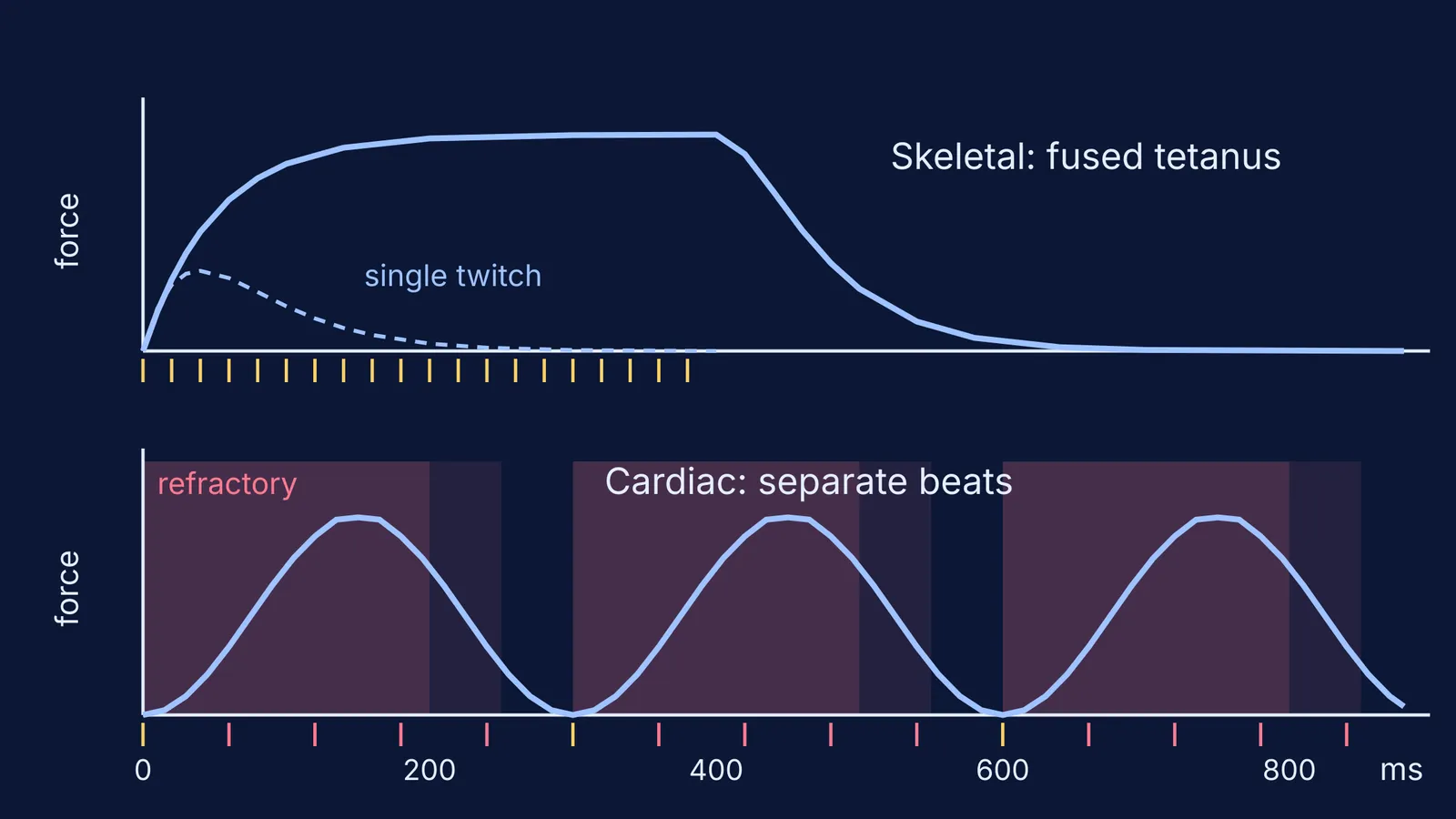
Stimulate skeletal muscle fast enough and its twitches merge into one steady pull. Heart muscle gives separate beats however fast the impulses come, because a cardiac cell cannot fire again while it is contracting. It is a classic reasoning question in muscle physiology, and the twitch graph above is the quickest way to remember it.
What is tetanus in skeletal muscle?
One action potential in a skeletal muscle fibre produces one twitch, and a twitch "can last for a few milliseconds or 100 milliseconds, depending on the muscle type", according to the open textbook OpenStax Anatomy and Physiology 2e.
If a second stimulus arrives while the first twitch is still going, the second twitch is stronger; OpenStax calls this wave summation. When the tension reaches about three to four times that of a single twitch, the muscle is in incomplete tetanus, and when stimuli come so fast that the relaxation phase disappears, it is in complete tetanus (same OpenStax chapter).
Summation works only because the electrical event is short and the mechanical one is long. A typical skeletal muscle action potential lasts 2-5 ms, while the contraction may last 100 to 1,000 ms, as the teaching site BasicPhysiology.org explains. The fibre is ready to fire again long before it has relaxed, so contractions stack up.
For the clinical meanings, see our post on muscle disorders such as myasthenia gravis and tetany.
Why can cardiac muscle not undergo tetanus?
The action potential of a cardiac contractile cell has a long plateau phase, held up by calcium ions entering through slow Ca2+ channels, and the whole event lasts 250-300 ms, according to OpenStax Anatomy and Physiology 2e, section 19.2.
The absolute refractory period of cardiac contractile muscle lasts about 200 ms and the relative refractory period about 50 ms, a total of about 250 ms (OpenStax, section 19.2).
Set that beside the 2-5 ms skeletal action potential from BasicPhysiology.org and the cardiac window is at least 50 times longer.
The long window lines up with the contraction itself. A StatPearls review by Wei, Yohannan and Richards describes the working heart muscle's action potential as lasting several hundred milliseconds, "with the delayed repolarization securing a refractory state for new excitations throughout the entire contraction phase" (StatPearls, NCBI Bookshelf). So any impulse that arrives while the cell is contracting is ignored. There is nothing to summate, and tetanus cannot happen.
OpenStax states the purpose directly: the refractory period is very long to prevent tetany, which in the heart "is not compatible with life, since it would prevent the heart from pumping blood" (OpenStax, section 19.2).
How does the long refractory period keep the heart in rhythm?
A heart pumps by alternating: it contracts to push blood out, then relaxes to fill again. A chamber held in a sustained contraction could not refill, so it would stop pumping. The long refractory period lets each cell finish its contraction before another electrical event can occur, as the caption of OpenStax's action potential figure puts it.
It also protects the rhythm. Each impulse from the pacemaker gives one beat, and a stray early impulse that lands inside the refractory window does nothing. How that impulse spreads from cell to cell is covered in our post on intercalated discs in cardiac muscle.
How do you read the twitch graph in a NEET-UG question?
Work through the lower graph in the image. Stimuli arrive every 60 ms, and the first one at 0 ms starts a beat.
The stimuli at 60, 120, 180 and 240 ms all fall inside the roughly 250 ms refractory window that OpenStax gives, so in this model none of them produces a contraction.
The stimulus at 300 ms finds the cell excitable again and starts beat two.
So only one stimulus in five gives a beat, and the force graph shows separate humps that return to the baseline.
Skeletal muscle stimulated every 20 ms (upper graph) recovers within milliseconds, so twitches overlap and force climbs to a flat plateau: tetanus.
Use this checklist when a graph or assertion-reason question appears:
Steps that climb into a flat plateau under rapid stimulation: skeletal muscle, summation and tetanus.
Separate humps that return to baseline even with rapid stimulation: cardiac muscle.
Asked why: the long refractory period, about 250 ms, caused by the calcium plateau of the action potential.
Asked about significance: the heart relaxes and refills between beats, keeping the pumping rhythm.
Trap: cardiac muscle is striated too, so striation is not the reason. Our guide to striated, smooth and cardiac muscle types sets out the differences.
If the plateau phase or summation still feels abstract, the Fermi Concept Library has a lesson for each biology concept, with its place in the map. To practise the reasoning on graph questions, the Fermi Problem Library has worked problems with a step-by-step solver that explains the reasoning rather than printing an answer.
Next time you see a twitch graph, check the refractory window first. It tells you which muscle you are looking at.


