

On this page
The biology syllabus groups several severe conditions under "disorders of the muscular and skeletal system". Because myasthenia gravis, muscular dystrophy and tetany all result in muscle failure or spasms, they are easy to confuse on an exam. However, if you look at the cellular biology behind each condition, they are completely different processes. One is caused by an immune system mistake, another by a broken genetic blueprint, and the third by a chemical imbalance circulating in your blood.
Understanding the exact physiological mechanism makes it much easier to remember the symptoms and differentiate these conditions. Here is exactly what goes wrong in each disorder at the microscopic level.
What is myasthenia gravis?
Myasthenia gravis is an autoimmune disorder that targets the neuromuscular junction—the tiny gap where a motor nerve meets a muscle fibre. It is a relatively rare condition, affecting roughly 20 per 100,000 population in the United States (NCBI StatPearls).
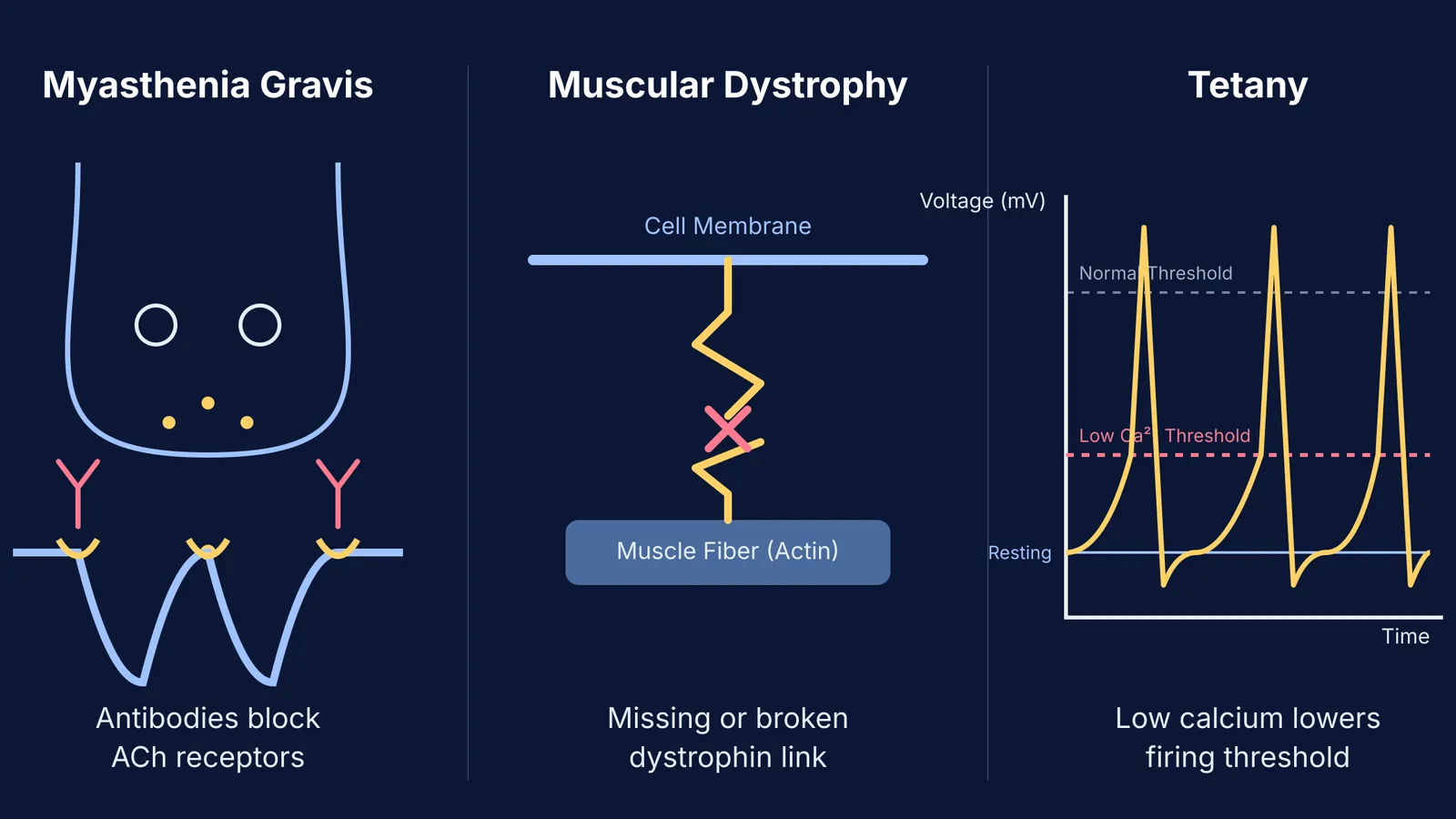
When a healthy motor nerve tells a muscle to move, it fires an action potential that travels down to the nerve terminal. The nerve terminal then releases a chemical messenger called acetylcholine (ACh) into the synaptic cleft. This chemical diffuses across the gap and binds to specific ACh receptors on the folded surface of the muscle's membrane (the sarcolemma). This binding opens ion channels, triggering the muscle to contract.
In a patient with myasthenia gravis, the body's immune system mistakenly produces antibodies that circulate in the blood, bind to, and physically block or destroy these ACh receptors. Because the receptors are covered up by the Y-shaped antibodies, the muscle cannot receive the nerve's chemical signal. This leads to profound fatigue, progressive weakening, and eventually paralysis of skeletal muscles, particularly as the day goes on and the limited supply of active receptors becomes overworked.
What causes muscular dystrophy?
Muscular dystrophy is not a single disease, but a broad group of genetic disorders characterised by the progressive degeneration of skeletal muscle tissue. The most common and severe form, Duchenne muscular dystrophy (DMD), has an estimated incidence of 1 in 3,600 male live-born infants (NCBI StatPearls).
The underlying cause is a mutation in the gene responsible for building a crucial structural protein called dystrophin. You can think of dystrophin as a mechanical shock absorber or anchor. It physically links the internal actin cytoskeleton of the muscle fibre to the surrounding extracellular matrix. Without this stable anchor, the simple, everyday act of contracting places immense stress on the muscle cell membrane, tearing it apart over time. The damaged muscle fibres eventually die and are replaced by fat and connective tissue.
Because the massive dystrophin gene is located on the X chromosome, the condition is an X-linked recessive trait. This is why it primarily affects boys: they possess only one X chromosome, meaning they lack a backup copy of the gene if theirs is mutated. You can see how these traits are passed down in Mendelian disorders: sickle-cell anaemia, thalassemia and PKU.
Why does tetany cause muscle spasms?
Unlike the other two disorders, tetany is not a structural disease of the muscle or a targeted immune attack. It is a symptom of a metabolic imbalance: specifically, rapid spasms or wild contractions caused by low calcium ions (Ca²⁺) in the body fluid.
The physiology of tetany is famously counterintuitive. We know that calcium is required *inside* the muscle for contraction, as explained in Muscle contraction step by step: calcium, actin and myosin. However, extracellular calcium plays a completely different role: it stabilises the resting membrane potential of peripheral nerves.
When total serum calcium drops below 8.5 mg/dL (NCBI StatPearls), the threshold voltage required to trigger a nerve impulse is lowered closer to the nerve's resting potential. Because the trigger is suddenly much more sensitive, nerves begin to fire spontaneously. This sends uncontrolled, rapid contraction signals to the muscles, resulting in spasms that can be extremely painful.
The medical clue checklist
When faced with a clinical vignette or a multiple-choice question, you can quickly differentiate these three disorders by looking for specific keywords in the scenario. Keep this mental checklist handy:
Myasthenia Gravis: Look for "autoimmune", "antibodies", "neuromuscular junction", "acetylcholine receptors", or symptoms of "fatigue that worsens with exercise".
Muscular Dystrophy: Look for "genetic", "progressive degeneration", "young boy" (X-linked), or "dystrophin protein".
Tetany: Look for "low Ca²⁺ in body fluid", "hypocalcemia", "wild contractions", or "spasms".
If you have gaps in your understanding of how action potentials, receptor binding and calcium ions interact at the cell membrane, the Fermi Concept Library has a lesson for each of these concepts and its place in the map. Understanding the physiological mechanism makes the resulting symptoms much easier to remember and apply.


