On this page
The NEET (UG) 2026 syllabus lists plant morphology, root to seed, under Biology Unit 2, and Chapter 5 of Class 11 NCERT Biology is the text for it. Many wrong answers here come from a word that sounds like one thing and is defined as another.
Below are eight frequent slips: why each happens, what the NCERT chapter (Reprint 2026-27) says by section, a quick check and a habit. New to the chapter? Our NEET plan for this chapter sets out the order.
Where do the ovary and the ovules sit?
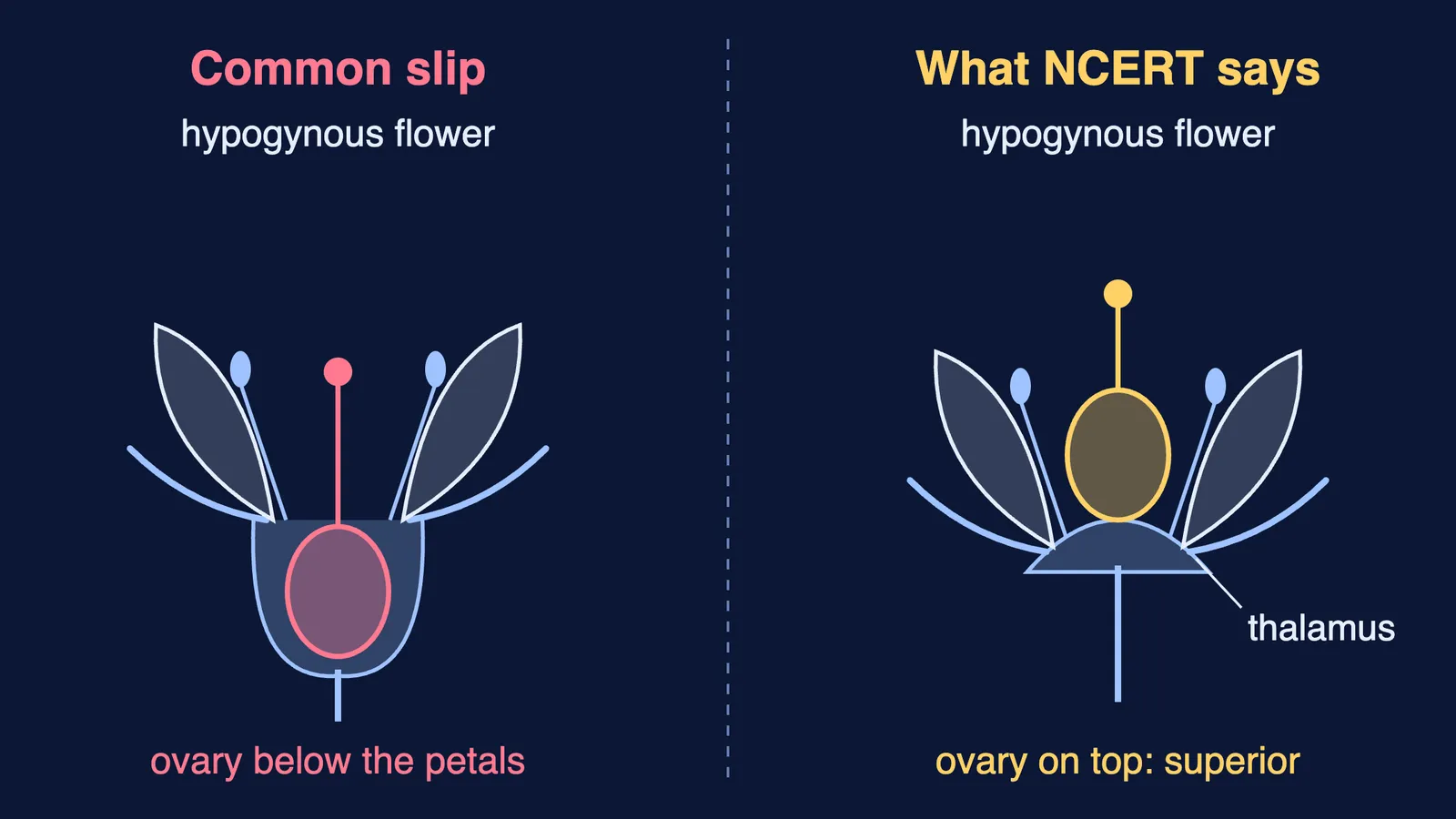
"A hypogynous flower has its ovary below the other parts, so the ovary is inferior."
Why it happens: "hypo" sounds like "under", and students attach it to the ovary, not the other whorls.
What NCERT says (5.5): in a hypogynous flower the gynoecium sits highest with the other whorls below it, so the ovary is superior (mustard, china rose, brinjal).
Check: on the thalamus of a brinjal flower, which is attached higher, the ovary or the stamens? (The ovary.)
Habit: read "hypogynous" as "the other parts are under the gynoecium", then write "superior" next to it.
"Rose has an inferior ovary, because its petals ring the ovary."
Why it happens: students recall only two labels.
What NCERT says (5.5): in a perigynous flower the gynoecium is central and the other parts sit on the thalamus rim at roughly the same level, so the ovary is half inferior (plum, rose, peach). Only when the rim grows up, encloses the ovary completely and fuses with it, as in guava and cucumber, is it inferior.
Check: rank mustard, peach and cucumber by how much of the ovary the thalamus encloses. (Mustard none, peach partly, cucumber completely.)
Habit: keep three boxes, superior, half inferior and inferior, and never let perigynous fall into the third.
"Pea ovules sit in a single row along the pod."
Why it happens: an opened pod shows what looks like one line of peas.
What NCERT says (5.5.1.4): in marginal placentation (pea) a single placental ridge runs down the ventral suture, carrying two rows of ovules.
Check: one ridge, how many rows of ovules on it, and along which suture? (Two; ventral.)
Habit: say "marginal: one ridge, two rows" as a single phrase.
Which look-alike terms get swapped?
"Aestivation describes how the petals sit over the sepals."
Why it happens: it is learnt from diagrams showing several whorls at once.
What NCERT says (5.5.1.2): aestivation compares each sepal, or each petal, in the bud only with members of its own whorl; a second whorl plays no part.
Check: "in the bud, petal edges just meet without overlapping." Aestivation, and which type? (Yes: valvate, as in Calotropis.)
Habit: before naming a type, cover every whorl except the one you are judging.
"Imbricate means every petal overlaps the next one in the same direction."
Why it happens: both types involve overlap, so the definitions get traded.
What NCERT says (5.5.1.2): overlap that runs one way round, each margin over the next, is twisted (china rose, lady's finger, cotton); overlap with no set direction is imbricate (Cassia, gulmohur).
Check: in a bud, every sepal's right edge lies over its neighbour's left edge, all the way round. Twisted or imbricate, and one NCERT plant? (Twisted; lady's finger.)
Habit: twisted = one direction; imbricate = no fixed direction.
"Polyandrous means a flower with many stamens."
Why it happens: "poly" suggests number, as it does in polyadelphous.
What NCERT says (5.5.1.3): polyandrous means the stamens stay free; the "-adelphous" words count the bundles stamens are joined into: one in china rose, two in pea, more than two in citrus.
Check: a flower has many stamens, all fused into a single bundle. Polyandrous or monoadelphous? (Monoadelphous.)
Habit: read "-adelphous" as "how many bundles", and "polyandrous" as "no bundles at all".
Which comes first, and where does growth happen?
"The flower at the tip of any inflorescence is always the youngest."
Why it happens: the racemose picture gets applied everywhere.
What NCERT says (5.4): a racemose main axis goes on growing, with flowers in acropetal succession; a cymose axis ends in a flower, so its growth is limited, with flowers in basipetal order. Basipetal means newer flowers form further from the apex, so in a cyme the terminal flower is not the youngest.
Check: a shoot's apex has already opened as a flower; a week later a new bud appears halfway down. Acropetal or basipetal? (Basipetal.)
Habit: write "acropetal" or "basipetal" beside the type before judging any flower's age.
"A root grows longer in the zone where the root hairs are."
Why it happens: root hairs are the visible part, so they get credit for growth.
What NCERT says (5.1.1): cells just behind the meristematic region lengthen and enlarge rapidly and account for growth in length (region of elongation); root hairs come from epidermal cells further back, in the region of maturation.
Check: ink dots at equal gaps along a young root tip; predict from 5.1.1 which zone's dots spread most. (Elongation.)
Habit: list the zones from the root cap up, tagging "grows" and "absorbs" to different ones.
A 60-second self-check before you mark
Is the term about the bud, the ovary's position, the ovules or the stamens?
For any ovary word, have you written superior, half inferior or inferior beside it?
For an inflorescence, have you named the order, acropetal or basipetal?
Does the example plant match NCERT's own list for that term?
Did a prefix (hypo-, poly-) make you guess?
See the three ovary positions drawn in our explainer on hypogynous, perigynous and epigynous flowers.
Not sure which of these slips is yours? Fermi's AI tutor works out what you already know and builds a plan for the session.