

On this page
What is floral insertion and why does ovary position matter?
When botanists examine a flower, one of the first structural features they determine is floral insertion: the arrangement of the calyx, corolla, and stamens relative to the ovary on the receptacle (thalamus). In his 1789 treatise *Genera Plantarum*, French botanist Antoine Laurent de Jussieu demonstrated that this insertion height provides a reliable morphological fingerprint for classifying flowering plants into natural families.
The biological significance of this geometry centers on protecting developing ovules. In a phylogenetic analysis across 135 million years of floral diversification, botanist Peter K. Endress showed that the structural integration of floral whorls—known as synorganization—has repeatedly evolved to shield ovules from herbivores and foraging pollinators (Endress, 2011). When organs insert below the carpels, the ovary remains exposed atop the receptacle. When the receptacle surrounds or fuses with the carpels, the ovary becomes sunken, altering how the fruit forms.
What is a hypogynous flower and what makes its ovary superior?
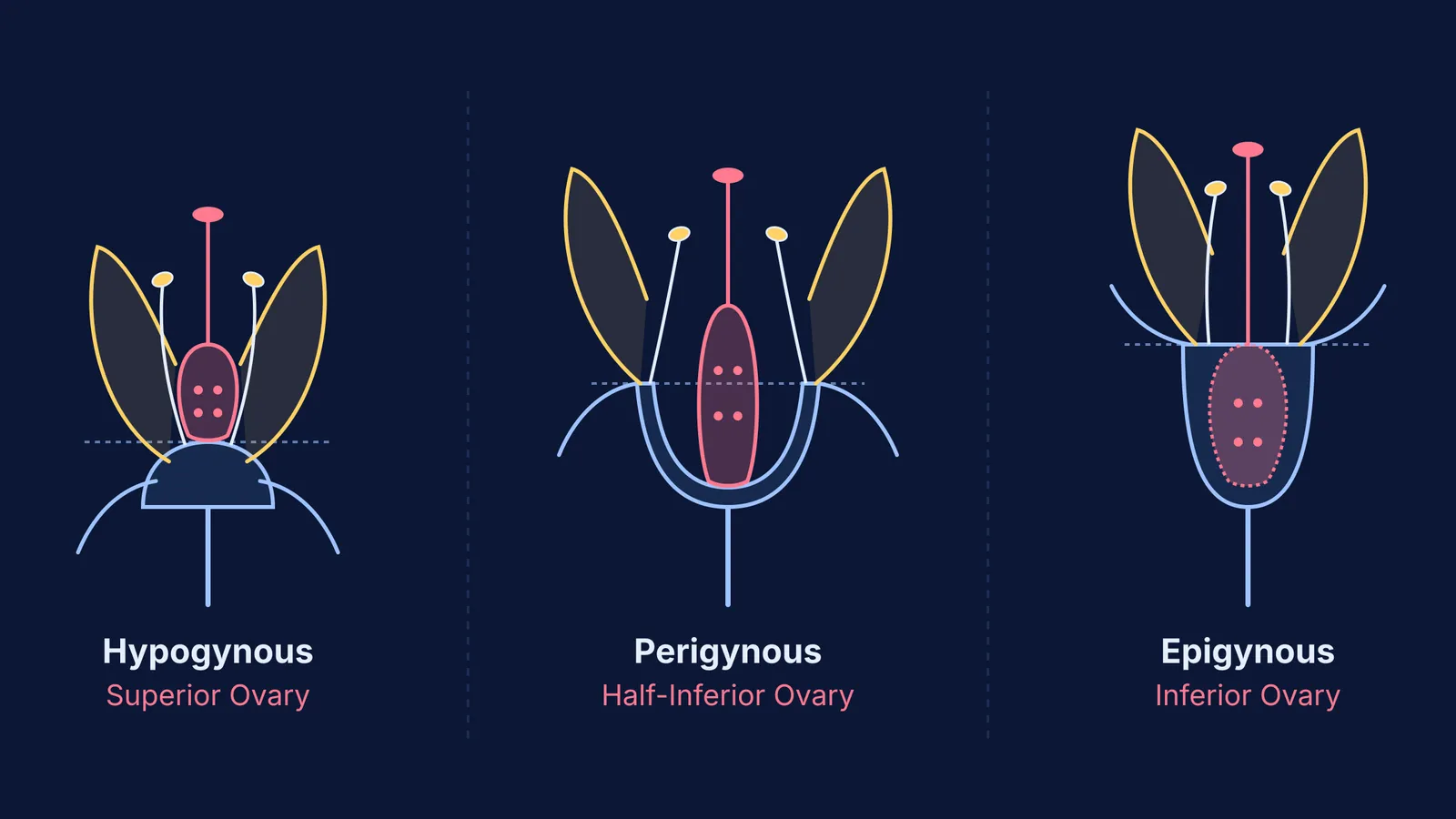
In a hypogynous flower (from Greek *hypo* meaning under, and *gyne* meaning female), the gynoecium sits at the highest point of a convex or conical thalamus. The sepals, petals, and stamens insert sequentially beneath the base of the ovary.
Because all other whorls arise below it, the ovary is termed superior. When petals and stamens drop after fertilisation, the fruit matures directly atop the floral stalk. Common examples include mustard (*Brassica*), China rose (*Hibiscus*), and brinjal (*Solanum melongena*). In brinjal and tomato, the persistent calyx remains attached directly below the mature fruit.
The Fermi Concept Library covers every concept in physics, chemistry, biology, mathematics and computing, each with its own lesson and its place in the map.
How do perigynous flowers differ from epigynous flowers?
The difference between perigyny and epigyny rests on whether the floral receptacle fuses with the ovary wall:
Perigynous flowers (*peri* meaning around): The receptacle forms a concave, cup-like hypanthium. The ovary sits in the center of the cup, while sepals, petals, and stamens arise from its rim at roughly mid-height of the ovary. Because the ovary is neither elevated nor buried in fused tissue, it is half-inferior. Examples include plum (*Prunus domestica*), peach, and rose.
Epigynous flowers (*epi* meaning upon): The margin of the thalamus grows upward, enclosing the ovary completely and fusing with its outer wall. Sepals, petals, and stamens arise from the top of the ovary, making the ovary inferior. Examples include cucumber (*Cucumis sativus*), guava (*Psidium guajava*), and the ray florets of sunflower (*Helianthus annuus*).
Developmental studies show that epigyny is a flexible trait that has evolved repeatedly through allometric growth shifts (Soltis et al., 2003). In sugar beet (*Beta vulgaris*), flowers even begin development with superior ovaries before an expanding hypanthium produces a semi-inferior ovary at maturity (Flores Olvera et al., 2008).
What examples should you remember for exams?
Exam questions frequently test recall across these three categories:
Hypogynous (superior ovary): Mustard, China rose, brinjal, petunia, and chilli. Floral parts detach cleanly from underneath the fruit.
Perigynous (half-inferior ovary): Plum, rose, and peach. The cup-shaped hypanthium surrounds the carpels loosely.
Epigynous (inferior ovary): Guava, cucumber, bitter gourd, and sunflower ray florets. Dried remnants of sepals and stamens persist at the crown of the fruit opposite the stalk.
Recognizing ovary position clarifies related floral topics, such as ovule placentation patterns, aestivation types in floral petals, and the origin of accessory flesh in false fruits and floral structures.
How can you identify floral insertion on an unfamiliar specimen?
Follow this four-step diagnostic framework when dissecting an unfamiliar flower:
Trace the receptacle: Follow the pedicel upward to where it broadens into the thalamus.
Bisect vertically: Make a clean longitudinal cut through the center of the pistil and receptacle.
Check insertion levels: Note whether stamens and sepals attach below the ovary base, on a free rim halfway up, or at the top of the ovary.
Test for tissue fusion: Gently probe whether the surrounding floral tube peels free from the ovary. If it is detached, the flower is perigynous; if fused completely to the ovary wall, it is epigynous.
To practice identifying floral structures from written descriptions and diagrams, the Fermi Problem Library provides worked problems with a step-by-step solver that explains the reasoning rather than printing an answer.


