

On this page
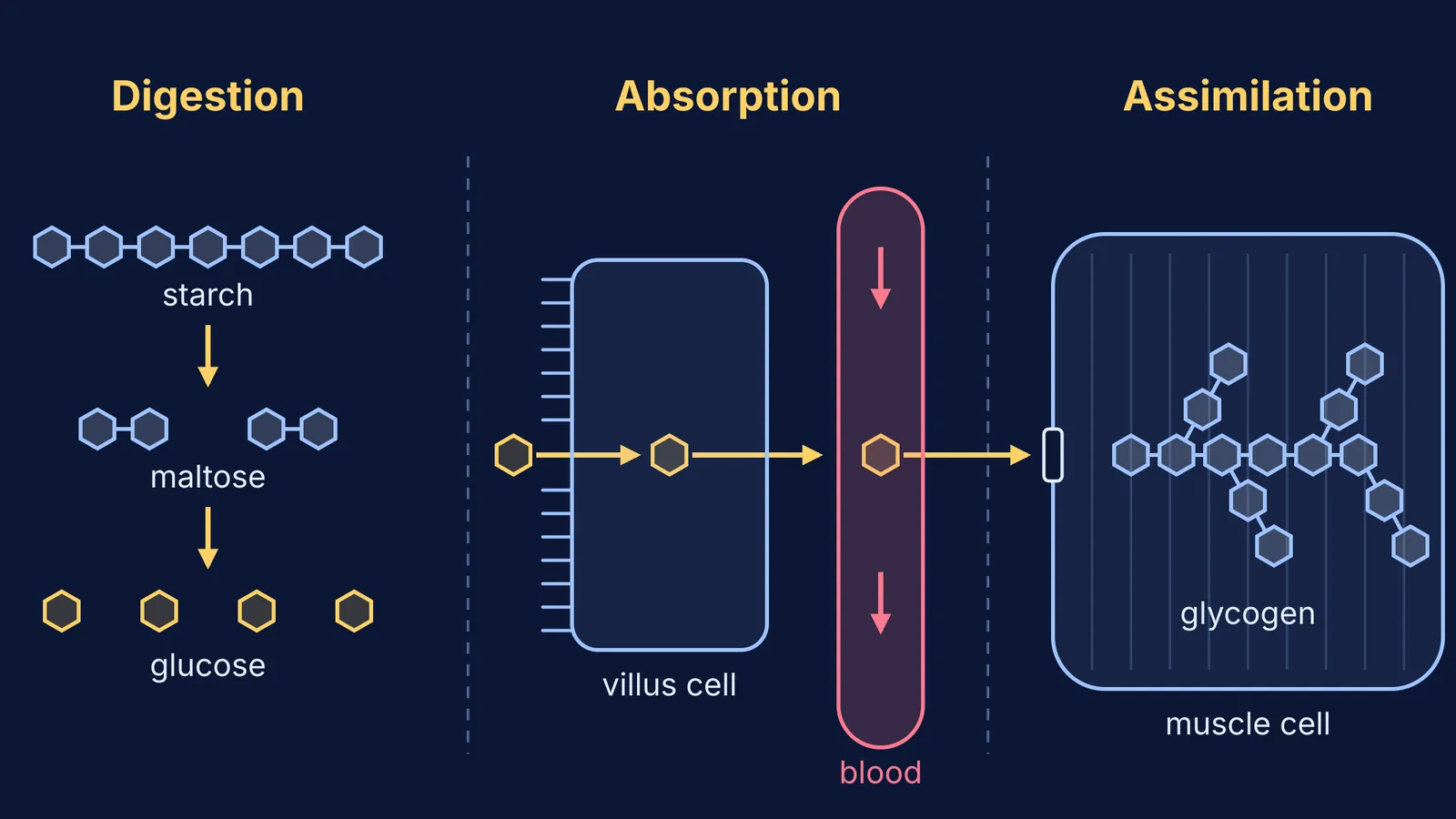
Digestion, absorption and assimilation sit in the same chapter and often in the same answer, but they are three different stages. The easiest way to keep them apart is to follow one molecule from a plate of rice to the muscle in your leg.
What is the difference between digestion, absorption and assimilation?
These definitions follow CBSE's Class XI Biology reading material on digestion and absorption for 2025-26, which is adapted from the NCERT textbook:
Digestion is the conversion of complex food substances into simple absorbable forms, by mechanical and biochemical methods.
Absorption is the process by which the end products of digestion pass through the intestinal mucosa into the blood or lymph.
Assimilation is when the absorbed substances reach the tissues, which use them for their activities.
A quick test: ask where the molecule is. Still inside the gut and being broken down: digestion. Crossing the gut wall into blood or lymph: absorption. Inside a body cell, being used or built into something: assimilation.
How does one glucose molecule get from starch to a muscle cell?
Follow one glucose unit locked in a starch chain in your dal-chawal. The steps come from the same CBSE reading material and the OpenStax section on chemical digestion and absorption.
Mouth (digestion). Salivary amylase, working best at pH 6.8, hydrolyses about 30 per cent of starch into the disaccharide maltose. Our glucose may now be half of a maltose.
Duodenum (digestion). Pancreatic amylase breaks the remaining starch into disaccharides, and maltase in the intestinal juice splits maltose into glucose plus glucose, very close to the cells lining the intestine. Our glucose is free; digestion is over. Our guide to digestive enzymes and where each one acts covers the others.
Lining cell in the jejunum or ileum (absorption begins). Glucose enters the cell by co-transport with sodium ions, a form of secondary active transport. These cells cover the villi of the small intestine.
Into the blood (absorption complete). Glucose leaves the lining cell by facilitated diffusion, enters a capillary and travels to the liver in the hepatic portal vein. The liver can pass glucose on through the circulation to other tissues.
Into a muscle cell (assimilation begins). Skeletal muscle is a primary target of insulin, which moves glucose transporters to the cell membrane so glucose can diffuse in, says OpenStax on the endocrine pancreas. Inside, hexokinase turns it into glucose-6-phosphate, which traps it in the cell.
Used or stored (assimilation). Muscle breaks glucose down in glycolysis to make ATP, as OpenStax describes for muscle, or stores it as glycogen to draw on later. Our post on starch vs glycogen explains why animals store it that way.
Where do students usually mix them up?
Stopping absorption too early. Glucose inside a lining cell has not finished being absorbed; the definition says into the blood or lymph.
Calling glycogen formation digestion. Digestion breaks molecules down in the gut. Joining glucose into glycogen inside a cell is assimilation.
Saying absorption happens only in the small intestine. The CBSE material lists absorption in the mouth (certain drugs), stomach (water, simple sugars, alcohol) and large intestine (water, some minerals, drugs), with the maximum in the small intestine.
Forgetting that fats take another road. Fatty acids and glycerol are packed into chylomicrons that enter the lacteals, the lymph vessels of the villi, rather than going straight into blood.
The small intestine still does most of the work: almost all ingested food, 80 per cent of electrolytes and 90 per cent of water are absorbed there, according to OpenStax Anatomy and Physiology.
Can you answer these five one-mark questions?
Cover the answers and write yours in one line each. Every answer is in this post, drawn from OpenStax and the CBSE reading material.
Name the enzyme that converts maltose into glucose, and the process it is part of. Answer: maltase; digestion.
In which two regions of the small intestine are the simple products of digestion absorbed? Answer: the jejunum and the ileum.
A muscle cell joins glucose units into glycogen. Which of the three processes is this? Answer: assimilation.
Glucose enters intestinal lining cells by co-transport with which ion? Answer: sodium (Na+).
Roughly what share of starch does salivary amylase hydrolyse in the mouth? Answer: about 30 per cent, into maltose.
If a wrong answer came from a shaky idea underneath, the Fermi Concept Library gives each concept in biology its own lesson and its place in the map, so you can see how one idea connects to the next. For longer questions, the Fermi Problem Library has a step-by-step solver that explains the reasoning rather than printing an answer.
Next time one of the three words turns up, ask where the glucose is right now, and the right word follows.


