

On this page
In 1977, researchers Francisco Bolivar and Raymond Rodriguez constructed pBR322, one of the first widely used synthetic cloning vectors (Bolivar et al., 1977). It is exactly 4,361 base pairs long (GenBank). They designed it with two specific genes: one that grants resistance to the antibiotic ampicillin, and another to tetracycline. These are known as selectable markers.
pBR322 gets its name from "p" for plasmid, "BR" for its creators Bolivar and Rodriguez, and "322" to distinguish it from other plasmids they built in their laboratory. The two resistance genes operate in entirely different ways. The ampicillin resistance gene, *bla*, produces an enzyme called beta-lactamase. This enzyme is secreted into the space just outside the cell membrane, where it breaks down the antibiotic before it can cause harm. In contrast, the tetracycline resistance gene, *tetA*, builds an efflux pump. This pump sits in the cell membrane and physically ejects tetracycline molecules as fast as they can enter, keeping the internal concentration too low to disrupt the cell's machinery.
What is a selectable marker in a cloning vector?
When you study the role of a selectable marker antibiotic resistance in cloning vectors, it all comes down to separating the cells you want from the ones you do not.
Before you can understand the role of a selectable marker, you must understand the challenge of bacterial transformation. Bacteria do not naturally absorb foreign plasmids with high efficiency. When you mix a tube of engineered plasmids with a culture of host bacteria, usually only a very small fraction of the cells will actually take up the circular DNA.
A cell that absorbs the plasmid is called a transformant. To get the plasmids into the bacteria in the first place, you must use methods for getting DNA into host cells, such as a heat shock.
Once the cells are treated, you spread the mixture on an agar plate containing an antibiotic like ampicillin. If the plasmid carries a selectable marker for ampicillin resistance, the transformants will survive and form colonies. The non-transformants—the cells that failed to take up the plasmid—will die because they lack the resistance gene.
How does insertional inactivation work?
A transformant has the plasmid, but you still need to know if the plasmid actually carries your target gene. A plasmid with new DNA inserted into it is called a recombinant.
To make a recombinant pBR322 plasmid, scientists cut it open using a restriction enzyme. The target site for an enzyme like *BamHI* lies right in the middle of the tetracycline resistance gene. When a foreign piece of DNA is pasted into this spot, it breaks the gene's sequence, destroying its ability to protect the cell from tetracycline.
This trick is called insertional inactivation. The resulting recombinant plasmid still protects the cell against ampicillin, but it is now sensitive to tetracycline. A non-recombinant plasmid—one that simply closed back up without taking the insert—keeps both of its resistance genes intact.
How do you separate recombinants from transformants?
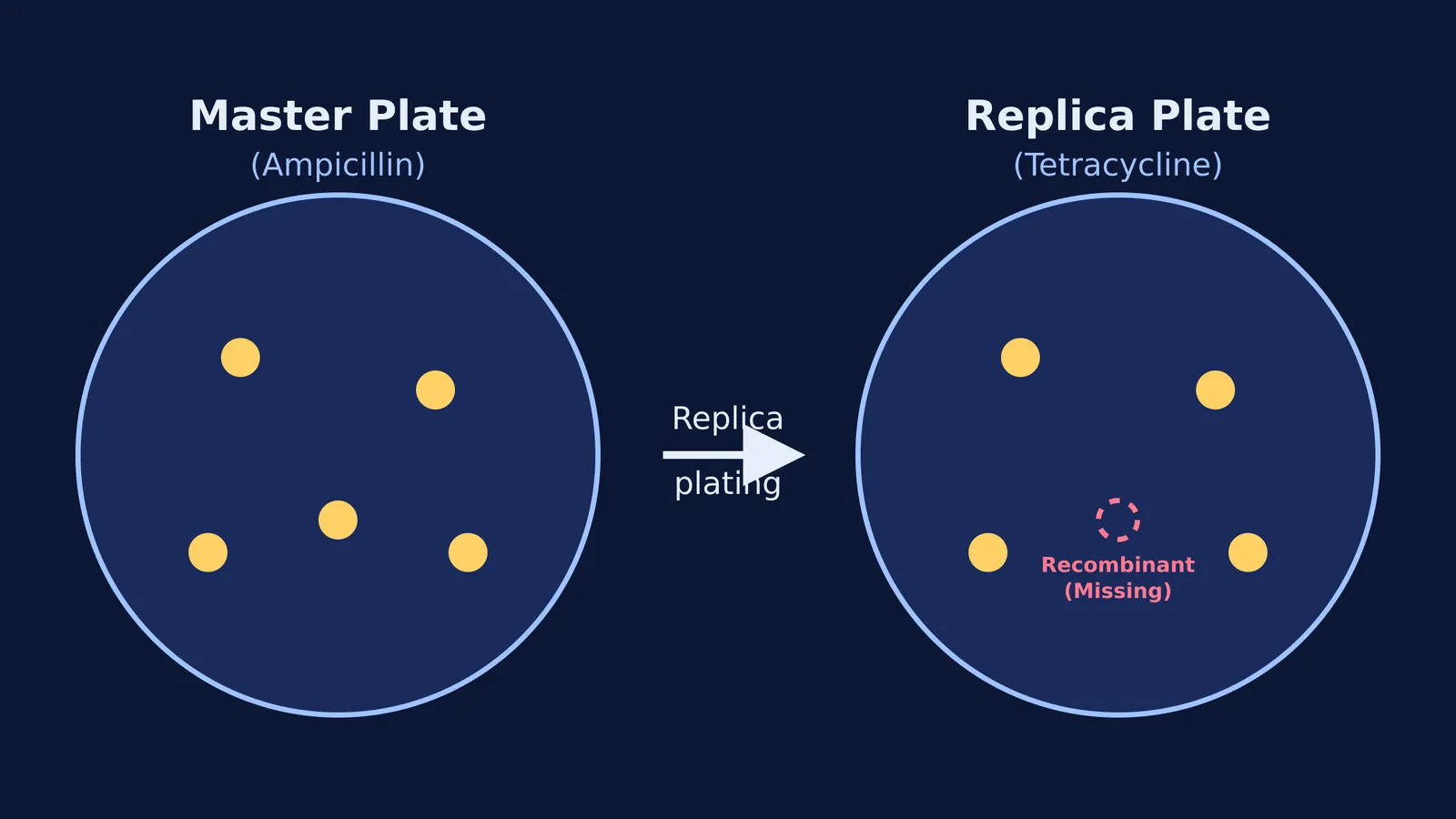
Because the recombinants have lost their tetracycline resistance, you cannot simply grow them on a tetracycline plate. They would die, and you would lose your hard-earned clones. Instead, researchers use a two-step method called replica plating.
The brilliance of replica plating lies in the velvet pad. Velvet is composed of a dense layer of tiny, upright threads. When you press the pad onto the master plate, these threads act like microscopic inoculation needles, picking up a few cells from each colony without smearing them together. Because the pad remains fixed in a solid ring, the spatial arrangement of the cells is preserved perfectly. When you stamp the pad onto the replica plate, you create a mirror image of the original colony pattern.
First, you grow the cells on a master plate containing ampicillin. This kills the non-transformants, leaving only the cells that took up a plasmid. Next, you press a velvet pad onto the master plate and stamp the exact colony pattern onto a second plate containing tetracycline.
The non-recombinants grow on both plates because their resistance genes are intact. The recombinants grow on the ampicillin plate but leave a blank space on the tetracycline plate. By comparing the two plates, you can spot the missing colonies, go back to your master plate, and pick the successful recombinants for your experiment.
If you are confused by which cells survive on which plate, the Fermi Concept Library can help. It has every concept in biology, each with its own lesson and its place in the map. This cycle of cutting, pasting and sorting is the foundation of genetic engineering, used for everything from studying basic biology to making human insulin by rDNA.


