

On this page
NCERT Class 12 Biology covers emergency contraception in one sentence. Chapter 3, Reproductive Health, says that “administration of progestogens or progestogen-estrogen combinations or IUDs within 72 hours of coitus have been found to be very effective as emergency contraceptives” (NCERT Biology Class 12, Chapter 3). This is for learning, not medical advice: decisions about actual use belong with a doctor or pharmacist.
How do emergency contraceptive pills work?
According to the same NCERT chapter, regular pills “inhibit ovulation and implantation as well as alter the quality of cervical mucus to prevent/retard entry of sperms.” Emergency pills use the same family of hormones, the progestogens, but as a high dose taken after sex rather than a small dose every day.
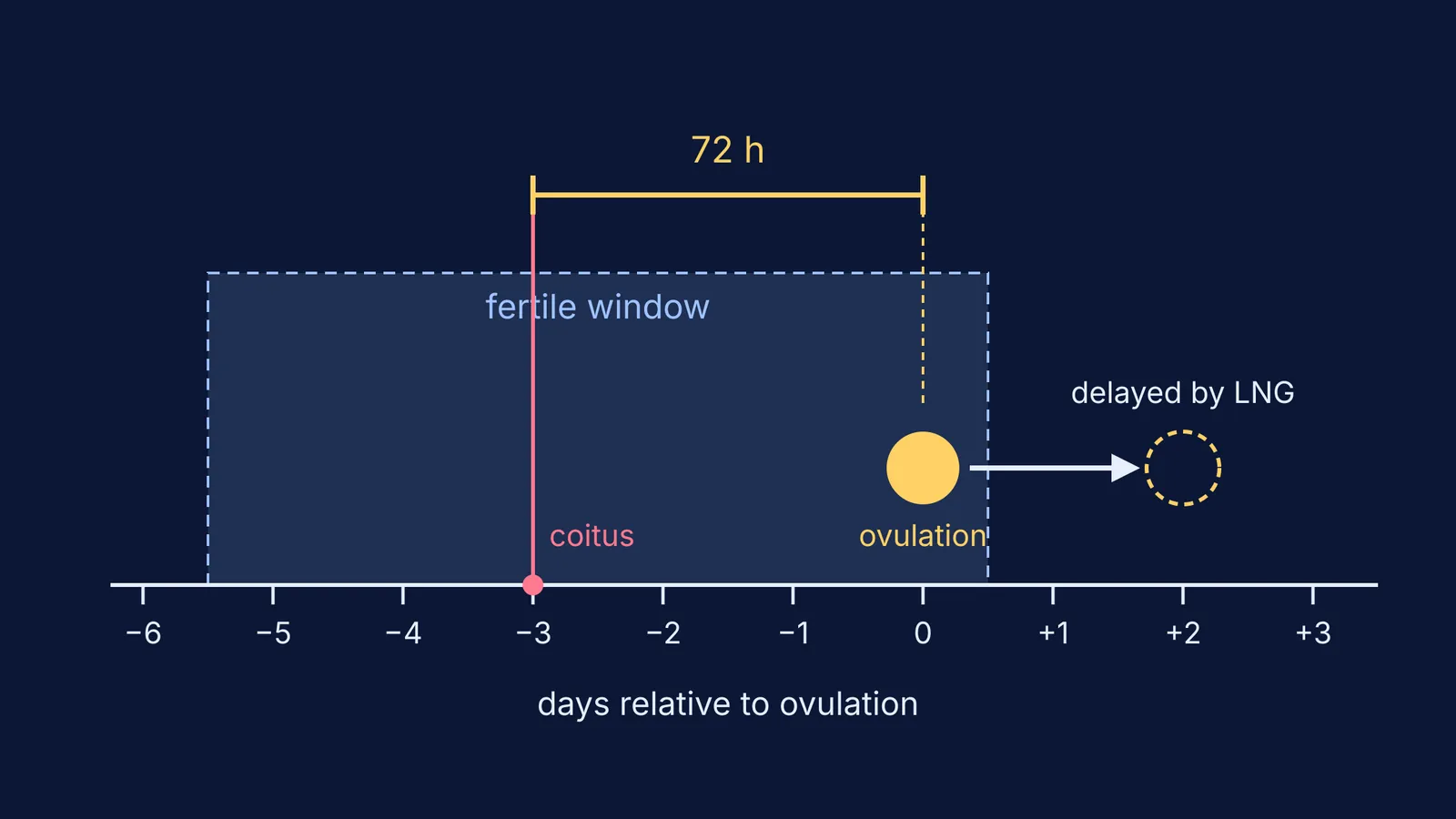
A 2013 review in the journal Contraception, led by Kristina Gemzell-Danielsson of Karolinska Institutet, concluded that the main mechanism of levonorgestrel (LNG) emergency contraception is delaying or inhibiting ovulation (Gemzell-Danielsson et al., 2013). The review found an extra effect on the uterine lining for the copper IUD, but not for the hormonal methods.
The World Health Organization states that emergency pills “prevent pregnancy by preventing or delaying ovulation and they do not induce an abortion” (WHO fact sheet on emergency contraception).
The chain to remember:
Sperm can survive in the female tract for some days: in one study, conception followed intercourse as early as five days before ovulation (Wilcox, Weinberg and Baird, NEJM 1995).
A high progestogen dose, given in time, holds back the release of the egg.
If ovulation comes late enough, the waiting sperm may no longer be able to fertilise it.
Why does timing matter for emergency contraception?
Timing matters because the pill has to act before the egg is released. A study that followed 221 women trying to conceive, over 625 menstrual cycles, found that conception happened only when intercourse fell in a six-day window ending on the estimated day of ovulation (Wilcox, Weinberg and Baird, NEJM 1995). The chance of conception rose from 0.10 for intercourse five days before ovulation to 0.33 on the day itself.
The Gemzell-Danielsson review adds the limit: LNG is no longer effective when given shortly before ovulation (Gemzell-Danielsson et al., 2013).
Older trials used the same 72-hour limit. One double-blind randomised trial enrolled 1,998 women at 21 centres, all starting treatment within 72 hours of unprotected coitus (Task Force on Postovulatory Methods of Fertility Regulation, Lancet 199805145-9)). Among the 1,955 women with a known outcome, 1.1% became pregnant with levonorgestrel against 3.2% with an older combined-pill (Yuzpe) regimen; both worked less well the longer women waited.
The WHO fact sheet now gives longer windows: up to 120 hours for LNG and ulipristal acetate pills, and 5 days for a copper IUD, and says sooner is better. NCERT's 72 hours is still the number to write in your exam.
What does the timeline look like in a 28-day cycle?
Take a 28-day cycle with ovulation on day 14 (practise other lengths with how to calculate ovulation day for 28, 30 and 35-day cycles).
Coitus on day 11, three days before ovulation and inside the fertile window: sperm can survive until the egg is released.
Case A: an LNG pill on day 11, soon after coitus. Ovulation is still days away, so the pill may be able to delay it.
Case B: the pill on day 13 or 14, just before or as the egg is released. The 2013 review says LNG is no longer effective shortly before ovulation, so the pill may fail.
Is an emergency pill the same as an abortion pill?
No. The WHO states that emergency contraception “cannot interrupt an established pregnancy or harm a developing embryo” (WHO). NCERT also keeps the two topics apart: medical termination of pregnancy (MTP) has its own section, 3.3.
Emergency pills are not meant as a regular method either: for women who use them repeatedly, the WHO advises counselling on regular options that may be more appropriate and more effective. Compare them in types of contraceptive methods and how each one works.
Can you answer these NEET-style questions?
According to NCERT, emergency contraceptives are very effective within: (a) 24 hours (b) 72 hours (c) 7 days (d) 21 days of coitus. Answer: (b).
Assertion: an LNG emergency pill taken shortly before ovulation is less likely to work. Reason: the main action of LNG emergency pills is delaying or inhibiting ovulation. Answer: both are true, and the reason explains the assertion.
Which is NOT listed by NCERT as an emergency contraceptive? (a) progestogens (b) progestogen-estrogen combinations (c) IUDs (d) vasectomy. Answer: (d). Vasectomy is a surgical, terminal method.
If hormone questions trip you up, the Fermi Concept Library gives every biology concept its own lesson, and the Fermi Problem Library has worked problems with a step-by-step solver that explains the reasoning rather than printing an answer.


