

On this page
Textbook diagrams usually show a 28-day menstrual cycle with ovulation in the middle, on day 14, even though the MSD Manual notes that most women do not have cycles of exactly 28 days. So students learn "ovulation happens on day 14", until a NEET-UG question gives a 30-day or 35-day cycle. This post gives you the rule that works, explains why, and walks through the common types of numerical.
Why do you count back 14 days instead of forward?
The cycle has two halves with ovulation between them. The phase before ovulation (the follicular phase) changes length from cycle to cycle. The phase after it (the luteal phase) varies much less.
The MSD Manual says the luteal phase lasts about 14 days and ends just before a period. The same page says the follicular phase is the phase that varies most in length, and that normal cycles range from about 24 to 38 days.
The corpus luteum causes this. After ovulation, the empty follicle becomes the corpus luteum and releases progesterone. If there is no fertilisation, it breaks down after about 14 days, hormone levels drop and the next period starts. That fairly steady lifespan makes the end of the cycle predictable. The start is not.
How to calculate ovulation day in a 30-day cycle?
Day 1 is the first day of bleeding. Use the rule from the section above.
Cycle length = 30 days.
Luteal phase = about 14 days (MSD Manual), ending when the next period starts.
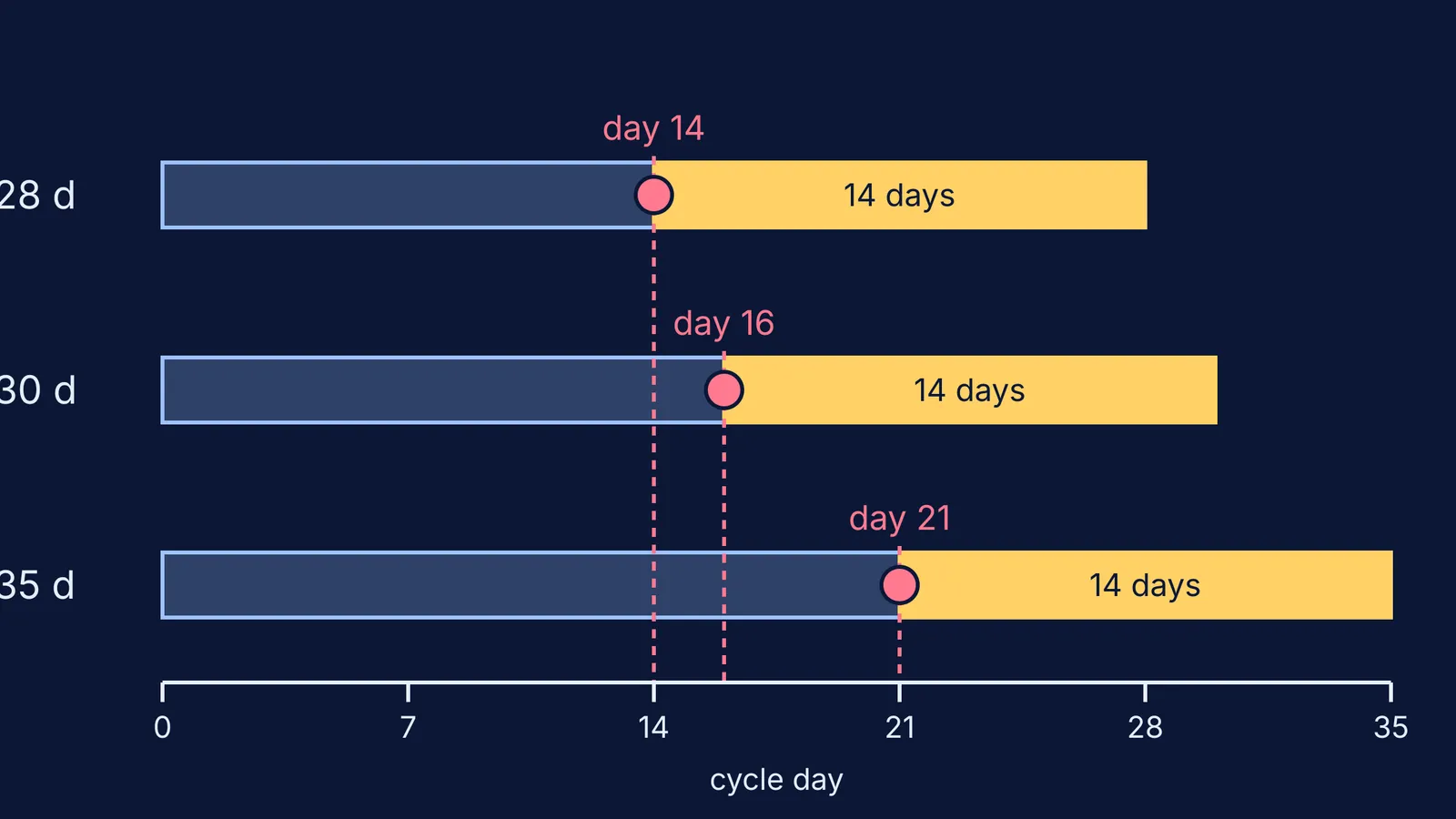
Ovulation day = 30 - 14 = day 16.
Follicular phase = days 1 to 16, which is 2 days longer than in a 28-day cycle.
In this model the extra two days all go into the follicular phase. The luteal phase doesn't stretch.
Worked numericals: 28, 30 and 35-day cycles
All of these use the 14-day luteal phase from the MSD Manual.
28-day cycle: 28 - 14 = day 14. This is the textbook case, and the only one here where "middle of the cycle" and "14 days before the period" give the same answer.
30-day cycle: 30 - 14 = day 16.
35-day cycle: 35 - 14 = day 21. If you halve the cycle you get day 17.5, which is wrong by more than three days.
Reverse question: Ovulation happened on day 18. How long is the cycle? 18 + 14 = 32 days.
Range question: A girl's cycles vary between 26 and 32 days. On which days could ovulation fall? 26 - 14 = 12 and 32 - 14 = 18, so between day 12 and day 18.
Phase question: In a 35-day cycle, how long is the follicular phase? 21 days. The luteal phase is still 14.
A common wrong option is the halving answer (15 for a 30-day cycle, 17.5 for 35), which catches students who divide by two.
If you'd like more problems like these, worked step by step, the Fermi Problem Library has a solver that explains the reasoning rather than printing an answer. To see how the LH surge and progesterone line up with these days, try our menstrual cycle hormone graph explained day by day.
Is ovulation really exactly 14 days before a period?
For NEET-UG, use 14. Real bodies vary more, and it helps to know how much.
A 2019 study in npj Digital Medicine by Bull and colleagues analysed 612,613 ovulatory cycles from 124,648 app users. The mean luteal phase was 12.4 days, not 14, and the mean follicular phase was 16.9 days. The authors also found that only 13% of cycles were exactly 28 days long (full text).
An earlier study in the BMJ by Wilcox and colleagues estimated the day of ovulation in 696 cycles from 213 women. It defined the fertile window as the five days before ovulation plus the day of ovulation. The authors found that in only about 30% of women did this window fall entirely between days 10 and 17 (full text).
You don't need these figures in the exam. They do help you remember why the rule counts back from the period. The luteal phase still varies less than the follicular phase, so counting back is the better estimate.
How to make this stick before the exam
Write the rule at the top of your Human Reproduction notes: ovulation = cycle length - 14.
Draw a cycle as a bar with a fixed-length luteal block on the right. Stretch only the left part.
For every hormone question, first find the ovulation day, then place the LH peak just before it.
Mix these numericals into your practice sets. Our Human Reproduction NEET practice questions with solutions and assertion-reason questions on timing and hormone traps are good places to start.
If the corpus luteum or the LH surge still feels unclear, the Fermi Concept Library has a lesson on each concept in biology.


