

On this page
The definition of an ideal contraceptive is one sentence in the NCERT Class 12 Biology chapter Reproductive Health, in Section 3.2 on population stabilisation and birth control. Several familiar questions lead back to it: why sterilisation is not ideal, why natural methods fall short, why NCERT calls IUDs ideal for women who want to space children.
What are the features of an ideal contraceptive?
NCERT's wording is: "An ideal contraceptive should be user-friendly, easily available, effective and reversible with no or least side-effects. It also should in no way interfere with the sexual drive, desire and/or the sexual act of the user." (NCERT, Chapter 3)
Split it into six tests you can check one at a time (the glosses are ours, not NCERT's):
User-friendly: simple to use correctly, without special skill or a daily routine.
Easily available: you can get it without special equipment or a trained provider.
Effective: it reliably prevents pregnancy.
Reversible: fertility returns when you stop.
No or least side-effects.
No interference with sexual drive, desire or the act.
How do common contraceptive methods score?
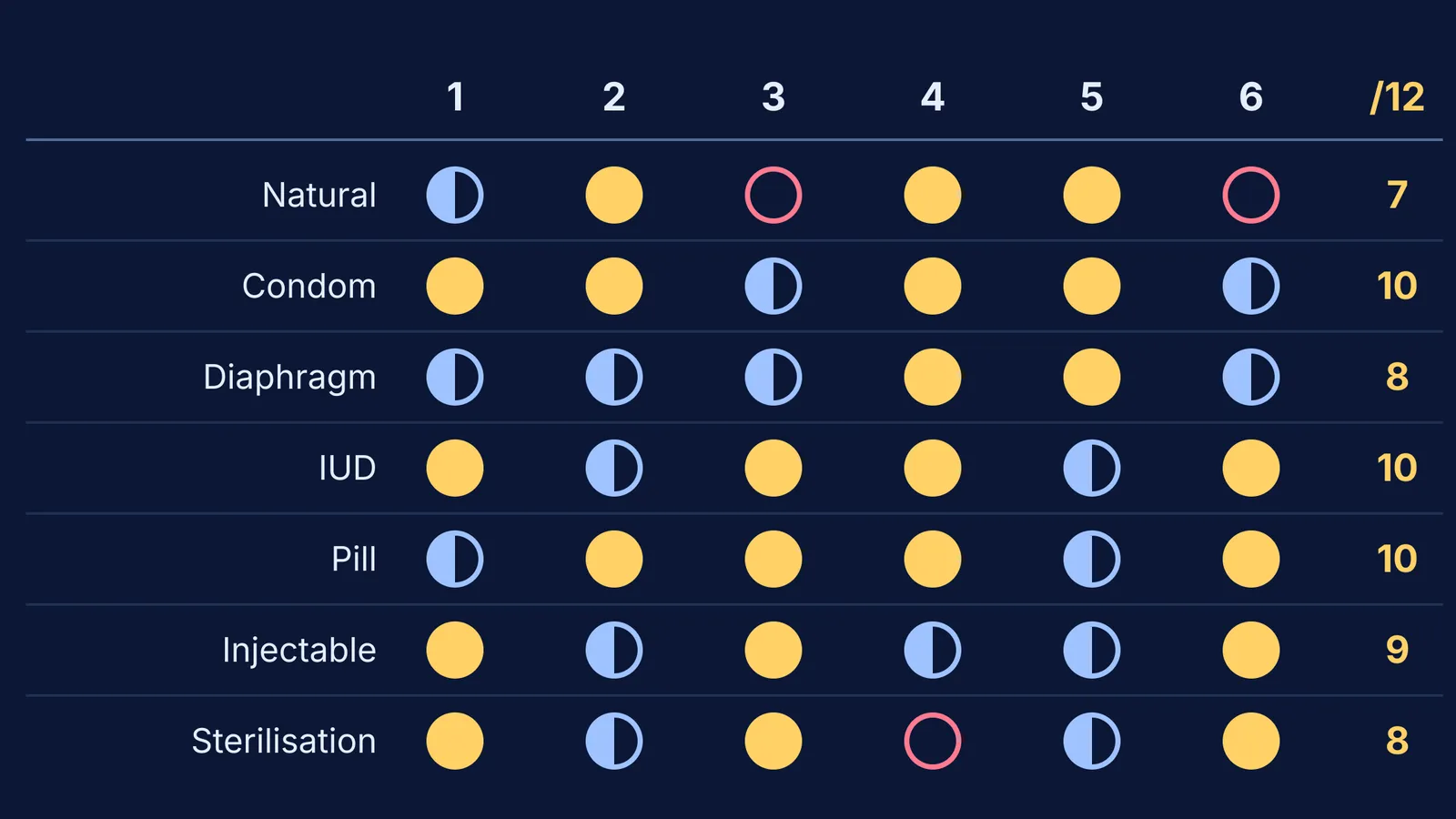
Score each test 2 (meets it), 1 (partly) or 0 (fails), for a maximum of 12. Every score below rests on a phrase from the NCERT chapter; the numbers in brackets follow the six tests in order.
Natural methods (periodic abstinence, withdrawal, lactational amenorrhea): 1, 2, 0, 2, 2, 0 = 7. NCERT says side effects are "almost nil" but chances of failure are "also high". Abstinence from day 10 to 17 of the cycle and withdrawal both change the act itself.
Condoms: 2, 2, 1, 2, 2, 1 = 10. Disposable, self-inserted and private, but put on "just before coitus", so they need an action at the moment of sex.
Diaphragms, cervical caps and vaults: 1, 1, 1, 2, 2, 1 = 8. Reusable, but inserted to cover the cervix during coitus and usually paired with spermicides to raise efficiency.
IUDs (Lippes loop, CuT, Cu7, Multiload 375, LNG-20): 2, 1, 2, 2, 1, 2 = 10. NCERT calls them effective and "ideal contraceptives for the females who want to delay pregnancy and/or space children", but a doctor or expert nurse has to insert them.
Oral pills: 1, 2, 2, 2, 1, 2 = 10. They are "very effective with lesser side effects", but must be taken daily for 21 days, then a 7-day gap, every cycle.
Injectables and implants: 2, 1, 2, 1, 1, 2 = 9. They act like pills, but their effective periods are "much longer", so on our reading a dose cannot be stopped as quickly as a daily pill.
Sterilisation (vasectomy, tubectomy): 2, 1, 2, 0, 1, 2 = 8. NCERT says these are "highly effective but their reversibility is very poor", so they fail test 4 outright.
Why does no method score 12 out of 12?
The tests pull against each other. The methods with almost no side effects (natural methods) have high failure; the permanent method (sterilisation) fails reversibility; IUDs need no action at the moment of sex but must be inserted by a doctor or expert nurse. NCERT also stresses that choosing a method "should always be undertaken in consultation with qualified medical professionals" (NCERT, Chapter 3).
One feature is missing from NCERT's list: protection from infection. The World Health Organization notes that condoms are the only contraceptive method that prevents both pregnancy and sexually transmitted infections, including HIV (WHO fact sheet on family planning). NCERT makes the same point when it says condom use has grown because of this "additional benefit".
How do you fill in the scoring grid yourself?
Draw a grid with the six tests as columns and seven methods as rows:
Read NCERT's paragraph on one method and underline every phrase that touches a test ("reusable", "inserted by doctors").
Score each cell 0, 1 or 2 and write the phrase in the cell.
Add the row and compare with our totals. Where you disagree, write one line saying why.
Turn each 0 into a question: "Which feature of an ideal contraceptive does vasectomy lack?" (reversibility).
Worked example, Copper T: user-friendly once inserted (2); needs a doctor or nurse (1); effective, since copper ions suppress sperm motility and fertilising capacity (2); removable (2); some ill-effects possible (1); no effect on the act (2). Total 10.
For the mechanism behind each method, read how each contraceptive method works; contraceptive failure rates compared adds numbers to the "effective" column, and reproductive health NCERT numbers for NEET collects the figures to remember.
If a term such as lactational amenorrhea is shaky, the Fermi Concept Library gives each biology concept its own lesson and shows where it sits in the map of the subject. When you move on to practice questions, the Fermi Problem Library has a step-by-step solver that explains the reasoning rather than printing an answer.
Start with the row you think is easiest, sterilisation, and see whether you also land on 8.


