On this page
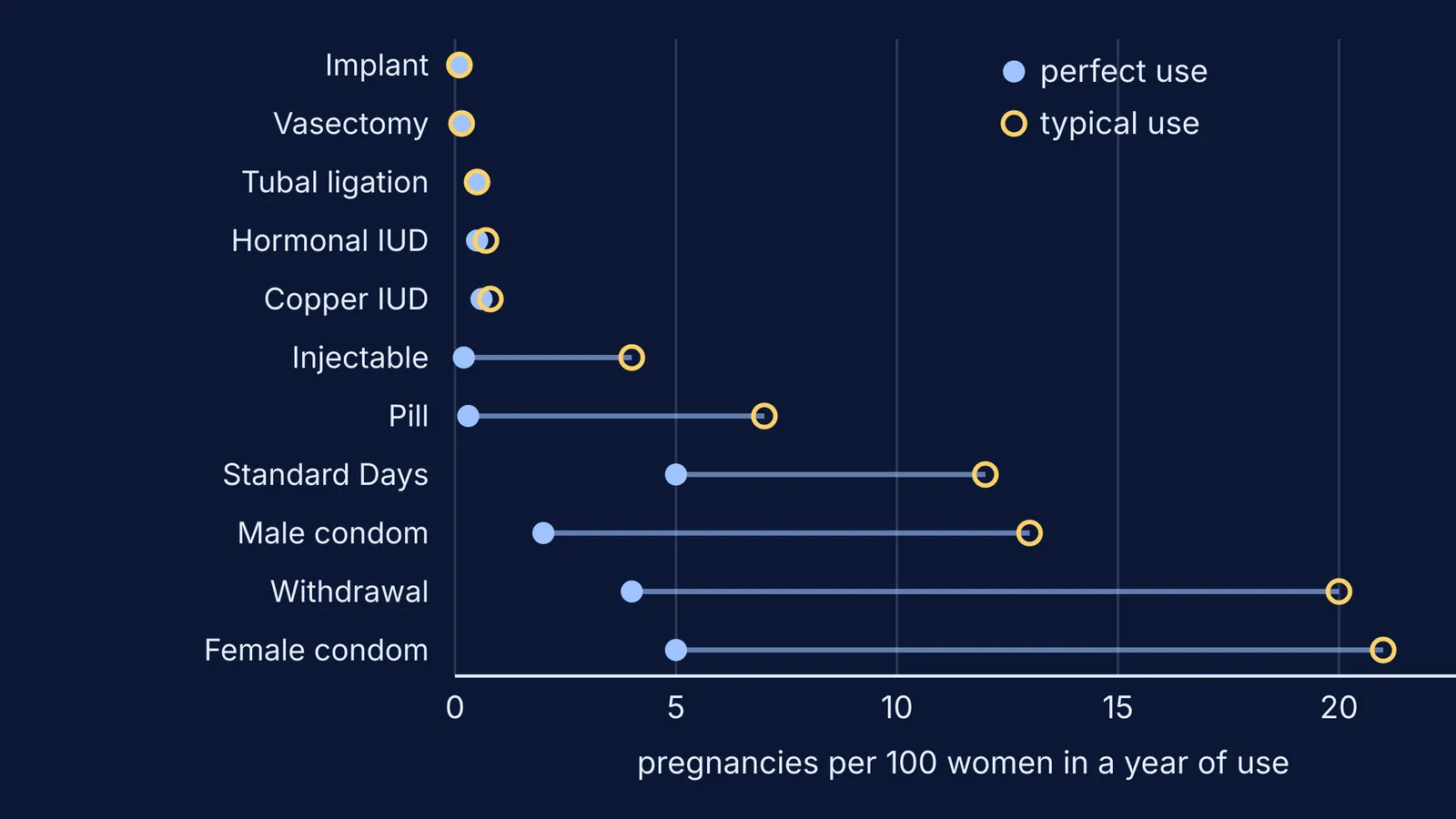
If you are revising reproductive health for Class 12 boards or NEET-UG, you will see two failure rates for most contraceptive methods, and they can look contradictory. The World Health Organization's table of mechanisms of action and effectiveness of contraceptive methods gives both numbers, side by side, as pregnancies per 100 women per year. Here they are ranked, with the reason they differ.
Which contraceptive method is most effective?
Ranked by what happens in real life (WHO's "as commonly used" column), with the "consistent and correct use" figure in brackets, from the WHO effectiveness table:
Implant: 0.1 (0.1)
Vasectomy (male sterilisation): 0.15 (0.1)
Female sterilisation (tubal ligation): 0.5 (0.5)
Levonorgestrel (hormonal) IUD: 0.7 (0.5)
Copper IUD such as Copper-T: 0.8 (0.6)
Sympto-thermal method: 2 (less than 1)
Monthly combined injectable: 3 (0.05)
Progestogen-only injectable: 4 (0.2)
Combined pill, minipill, patch or vaginal ring: 7 (0.3)
Standard Days Method: 12 (5)
Male condom: 13 (2)
TwoDay Method: 14 (4)
Withdrawal: 20 (4)
Female condom: 21 (5)
The same table gives the calendar or rhythm method 15 pregnancies per 100 women as commonly used and says reliable consistent-and-correct-use rates are not available. The lactational amenorrhea method is listed at 0.9 and 2, but those figures cover six months, not a year.
What is the difference between perfect use and typical use?
Perfect use means using a method correctly and consistently, according to a review by James Trussell of Princeton University, Contraceptive failure in the United States (Contraception, 2011). Typical use, in the same review, includes both incorrect and inconsistent use: missed pills, a condom put on late, a wrongly counted day.
WHO uses different words for the same idea: "consistent and correct use" for perfect use and "as commonly used" for typical use. WHO gives both per year, so a typical-use rate of 7 means that out of 100 women relying on the pill for a year, about 7 become pregnant.
Why are typical-use and perfect-use failure rates different?
Trussell's review puts the answer in one line: the gap between the two rates shows the consequences of imperfect use, and it depends on how unforgiving of imperfect use a method is and how hard the method is to use perfectly. Read the WHO table with that lens and three groups appear.
Nothing to remember. Implants, IUDs and sterilisation work without any daily action, so the two numbers are nearly identical (implant 0.1 and 0.1).
Remember on a schedule. The pill must be taken every day and injectables repeated on time. The pill goes from 0.3 to 7.
Act correctly every time. Condoms, withdrawal and fertility-awareness methods depend on what happens during each act or each cycle. The male condom goes from 2 to 13.
How do you use the ranking in an exam answer?
Turn the rates into counts. Here is a worked example using the WHO figures for 1,000 women using one method for a year.
Implant: 0.1 per 100 means 1 pregnancy with perfect use and 1 with typical use. Gap: 0.
Pill: 0.3 per 100 means 3 with perfect use, while 7 per 100 means 70 with typical use. Gap: 67 pregnancies, all from imperfect use.
Male condom: 2 per 100 means 20 with perfect use, while 13 per 100 means 130 with typical use. Gap: 110.
So the condom's typical-use rate is 6.5 times its perfect-use rate (13 divided by 2), while the implant's two rates are equal. If a question asks which method is "most forgiving", look for the smallest gap, not just the smallest number.
Before the exam, check yourself against these traps:
The unit is pregnancies per 100 women in a year of use, not a percentage of sexual acts.
The pill and the minipill share the same figures in the WHO table: 0.3 and 7.
Lactational amenorrhea figures are for six months only.
WHO's family planning fact sheet notes that condoms are the only method that also prevent sexually transmitted infections, including HIV, which is a separate point from pregnancy rates.
Where do you go next in this chapter?
If you want to know how each method works before learning its numbers, read how each type of contraceptive method works. For the full chapter, see reproductive health for NEET: key facts and question types and the reproductive health key terms for Class 12.
If the hormone side is shaky, such as how a pill stops ovulation, the Fermi Concept Library has a lesson for every concept in biology, with its place in the map. Once that is clear, the Fermi Problem Library has worked problems with a step-by-step solver that explains the reasoning, so you can check how you got to an answer, not just whether it was right.