On this page
By the time fluid reaches the collecting duct, the nephron has already taken most of it back. NCERT's Class 11 chapter gives the numbers: the kidneys form about 180 litres of filtrate a day but pass only about 1.5 litres of urine, so nearly 99 per cent is reabsorbed (NCERT, Excretory Products and their Elimination). The collecting duct does the final, adjustable part of that job, after the functions of the PCT and DCT and the two limbs of the loop of Henle.
What is the function of the collecting duct in the nephron?
NCERT describes the collecting duct as a long tube running from the cortex into the inner medulla, where large amounts of water can be reabsorbed to make concentrated urine (NCERT). For an exam answer, write its three jobs:
Reabsorbing water under ADH control, which sets the final volume and concentration of urine.
Letting small amounts of urea into the medullary interstitium, which keeps the medulla's osmolarity high.
Secreting H+ and K+ ions, which helps keep the blood's pH and ion balance steady.
How does ADH make the collecting duct absorb more water?
When the body loses too much fluid, osmoreceptors make the hypothalamus release antidiuretic hormone (ADH, also called vasopressin) from the neurohypophysis (NCERT). In the collecting duct, ADH makes the principal cells insert aquaporin channels into their apical membrane, the side facing the urine. With less ADH, fewer channels are inserted, less water is taken back and the urine is dilute (OpenStax, 25.6).
A review in Physiological Reviews by Søren Nielsen and colleagues names the channels: AQP2 is the main vasopressin-regulated water channel in collecting duct principal cells, and AQP3 and AQP4 let water out on the basolateral side, towards the blood (Nielsen et al., 2002).
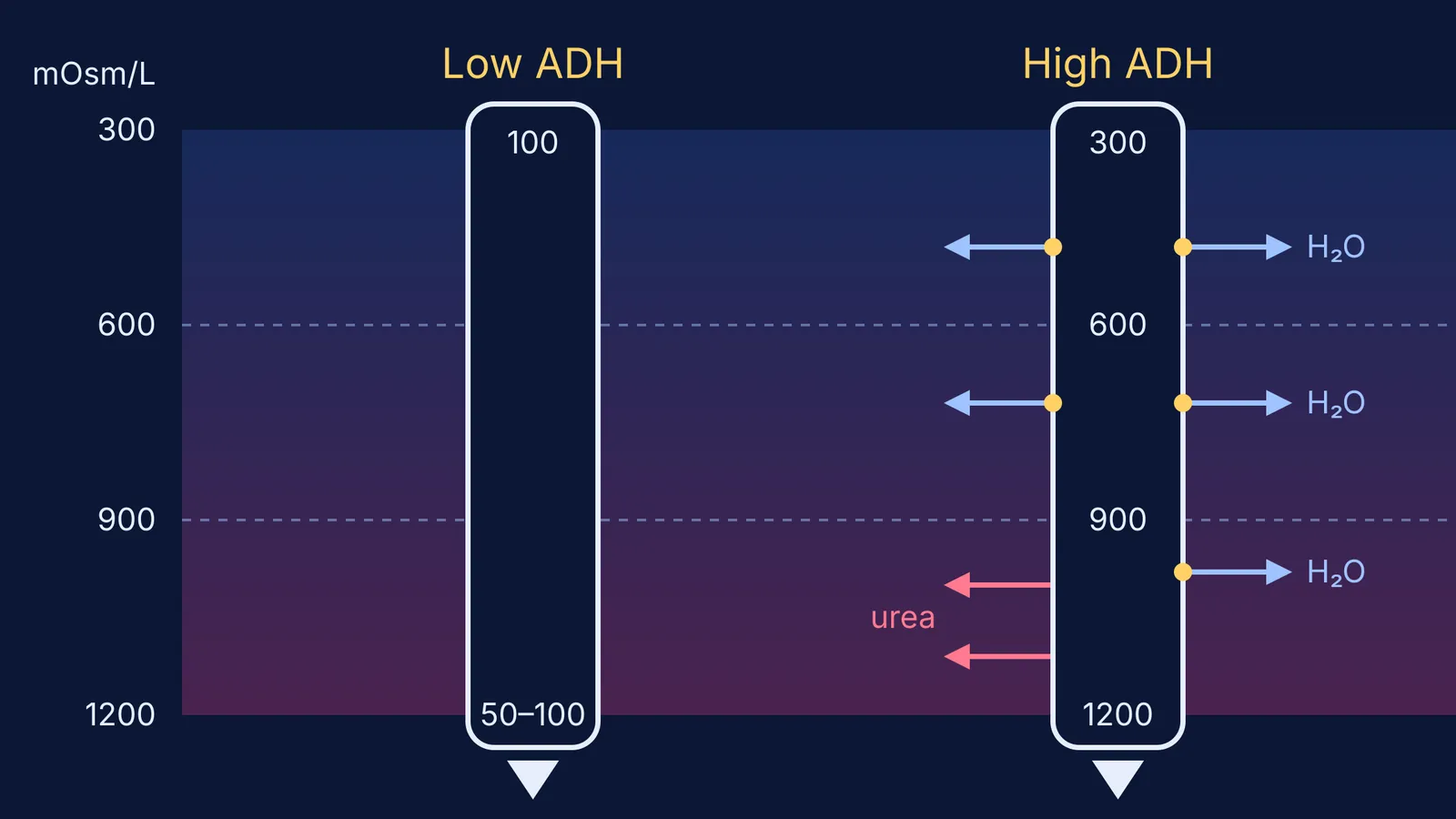
Aquaporins only open a route. What pulls water through is the salty medulla: its osmolarity rises from 300 mOsmol/L in the cortex to about 1200 mOsmol/L in the inner medulla, a gradient built mainly from NaCl and urea (NCERT).
Why does urea leave the collecting duct?
As water leaves the upper part of the duct, the urea left behind becomes more concentrated. In the inner medulla, urea transporters let it out. A review of knockout-mouse studies by Robert Fenton and Mark Knepper found that urea building up in the inner medulla depends on fast transport of urea out of the inner medullary collecting duct through the transporters UT-A1 and UT-A3 (Fenton and Knepper, 2007). The review says these transporters save water by preventing a urea-induced osmotic diuresis: urea left in the tubule would hold water in the urine.
Vasopressin controls both channels. Chou and colleagues describe UT-A1 and AQP2 as the transporters behind vasopressin-regulated urea and water transport in the inner medullary collecting duct (Chou et al., 2018).
Dilute versus concentrated urine: a worked comparison
Fluid leaving the ascending limb is already dilute, about 50 to 100 mOsmol/L (OpenStax, 25.6). The medullary values below come from NCERT's counter-current figure (NCERT). Follow the fluid down the duct in two situations.
Case A: a long afternoon of cricket in May with no water (high ADH)
Cortex: aquaporins are inserted, water leaves, and the fluid rises from about 100 to about 300 mOsmol/L, matching its surroundings.
Outer medulla: more water leaves; the fluid tracks the interstitium, about 600 mOsmol/L.
Inner medulla: urea exits through UT-A1 and UT-A3, water follows, and the fluid approaches 1200 mOsmol/L.
Result: a small volume of dark urine, up to 1200 mOsmol/L (OpenStax, 25.1), or, as NCERT puts it, nearly four times as concentrated as the filtrate first formed.
Case B: you have just drunk a big glass of nimbu paani (low ADH)
Few aquaporins are inserted, so the duct stays mostly watertight even though the medulla is still salty.
The fluid stays dilute all the way down.
Result: a large volume of pale urine, as low as 50 to 100 mOsmol/L (OpenStax, 25.1).
For the everyday version of Case A, read why urine turns dark yellow when you are dehydrated.
How should you revise the collecting duct for NEET-UG and boards?
Write the three jobs: ADH-controlled water reabsorption, urea into the medulla, H+ and K+ secretion.
Draw the duct beside the 300 to 1200 mOsmol/L gradient; mark where water and urea leave.
Learn the chain: more ADH, more aquaporins, less urine, higher osmolarity.
Keep ADH and aldosterone apart: in NCERT, aldosterone drives Na+ and water reabsorption from the distal parts of the tubule.
If a link in this chain is still shaky, the Fermi Concept Library has a lesson for each biology concept, so you can go back to osmosis first. To test yourself, the Fermi Problem Library has worked problems with a step-by-step solver that explains the reasoning rather than printing an answer.
Tonight, redraw both cases from memory and check your numbers.