On this page
If you have found a small brown capsule, like a tiny purse, behind a kitchen cupboard, you have seen a cockroach ootheca. It is also a standard definition in Class 11 biology. Here is what NCERT says, what research adds about how the female builds it, and a quick self-test.
One thing first. The cockroach section (7.4) appeared in earlier editions of NCERT Class 11 Biology, Chapter 7. The facts below come from a copy of that earlier NCERT chapter, pages 111-115. The current NCERT chapter (Reprint 2026-27) covers only the frog, so if you are preparing for NEET-UG, check the current official syllabus on the NMC or NTA website.
What is an ootheca in a cockroach?
An ootheca is the capsule in which a female cockroach's fertilised eggs are encased, as described in the earlier NCERT Class 11 chapter. The same text describes it as a dark reddish to blackish brown capsule, about 3/8 inch (8 mm) long.
NCERT adds that the ootheca is dropped or glued to a suitable surface, usually in a crack or crevice with high relative humidity near a food source. That is why you find them behind sinks and under kitchen cupboards.
How does the female cockroach form the ootheca?
Start with the female *Periplaneta americana* as the earlier NCERT chapter describes her. Two large ovaries lie in the 2nd to 6th abdominal segments, each made of eight ovarioles. The oviducts join into a common oviduct (vagina) that opens into the genital chamber, and a pair of spermathecae sits in the 6th segment. The boat-shaped 7th sternum, with the 8th and 9th sterna, forms a brood or genital pouch holding the female gonopore, spermathecal pores and collateral glands.
NCERT stops at "fertilised eggs are encased". A 2022 study in *Molecular Biology and Evolution* by Du and colleagues shows how the case is built. In *Periplaneta americana* the two collateral (colleterial) glands are unequal:
The large left gland makes structural proteins, calcium oxalate crystals and phenolic compounds stored as β-glucosides.
The small right gland supplies a β-glucosidase enzyme that turns those glucosides into protocatechuic acid.
A phenol oxidase enzyme converts protocatechuic acid into quinones, which harden and darken (tan) the case.
The study links the hardened case to protecting the eggs from water loss in warm, dry conditions.
The sequence you can write in an answer:
The male passes sperm to the female in bundles called spermatophores.
Eggs develop in the ovarioles and pass down the oviducts to the genital chamber.
Secretions from the collateral glands wrap the fertilised eggs in the genital pouch.
The case hardens and darkens into the ootheca.
The female drops it or glues it in a humid, sheltered spot near food.
How many eggs are in a cockroach ootheca?
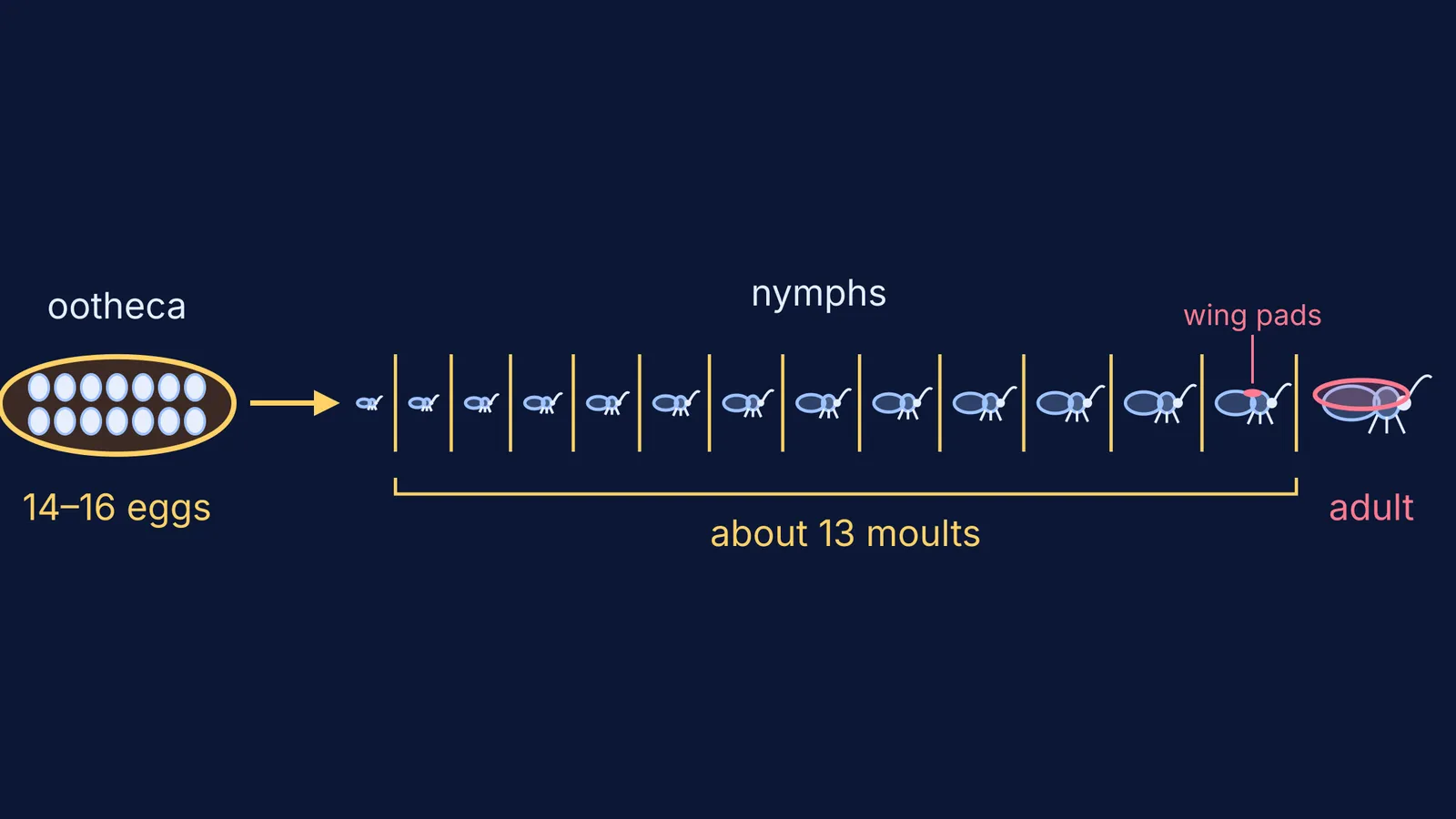
According to the earlier NCERT chapter, each ootheca contains 14-16 eggs. The same page says that, on average, a female produces 9-10 oothecae.
A worked example keeps the two numbers apart. Fewest: 9 oothecae × 14 eggs = 126. Most: 10 × 16 = 160. So one female lays roughly 126-160 eggs. NCERT does not print this total, so use it to check your memory, not as a quoted fact.
For the other cockroach numbers that turn up in exams, such as ommatidia and Malpighian tubules, see our guide to cockroach organ numbers in NCERT.
How do cockroach nymphs develop into adults?
NCERT calls the development of *P. americana* paurometabolous, meaning it goes through a nymphal stage, as the earlier Class 11 chapter puts it. There is no larva and no pupa. The nymphs look very much like adults.
The nymph grows by moulting about 13 times to reach the adult form. The next-to-last nymphal stage has wing pads, but only adult cockroaches have wings. Each moult is needed because the hard chitinous exoskeleton cannot stretch; our explainer on why insects and snakes shed their skin covers how ecdysis works. To compare this with a butterfly's egg-larva-pupa-adult route, read complete vs incomplete metamorphosis.
A five-minute self-test
Cover the answers, say each one aloud, then check. The numbers come from the earlier NCERT chapter.
What is an ootheca? (A dark brown capsule, about 8 mm long, encasing fertilised eggs.)
Eggs per ootheca? (14-16.)
Oothecae per female, on average? (9-10.)
Which glands form the case? (Collateral glands.)
Type of development? (Paurometabolous.)
Number of moults? (About 13.)
Which stage has wing pads? (The next-to-last nymphal stage.)
Miss two or more? Retest just those tomorrow instead of rereading everything tonight.
If words like paurometabolous keep slipping away, the Fermi Concept Library gives every biology concept its own lesson and shows where it sits in the map. And if you are not sure where to start with animal structure as a whole, Fermi's AI tutor can work out what you already know and build a plan for the session.