On this page
Hydra is a small freshwater polyp, and a common Class 11 question about it is simple: where does the waste go? It leaves the way the food came in. Once you see why, a big chunk of the Animal Kingdom chapter falls into place.
Why does Hydra have only one opening?
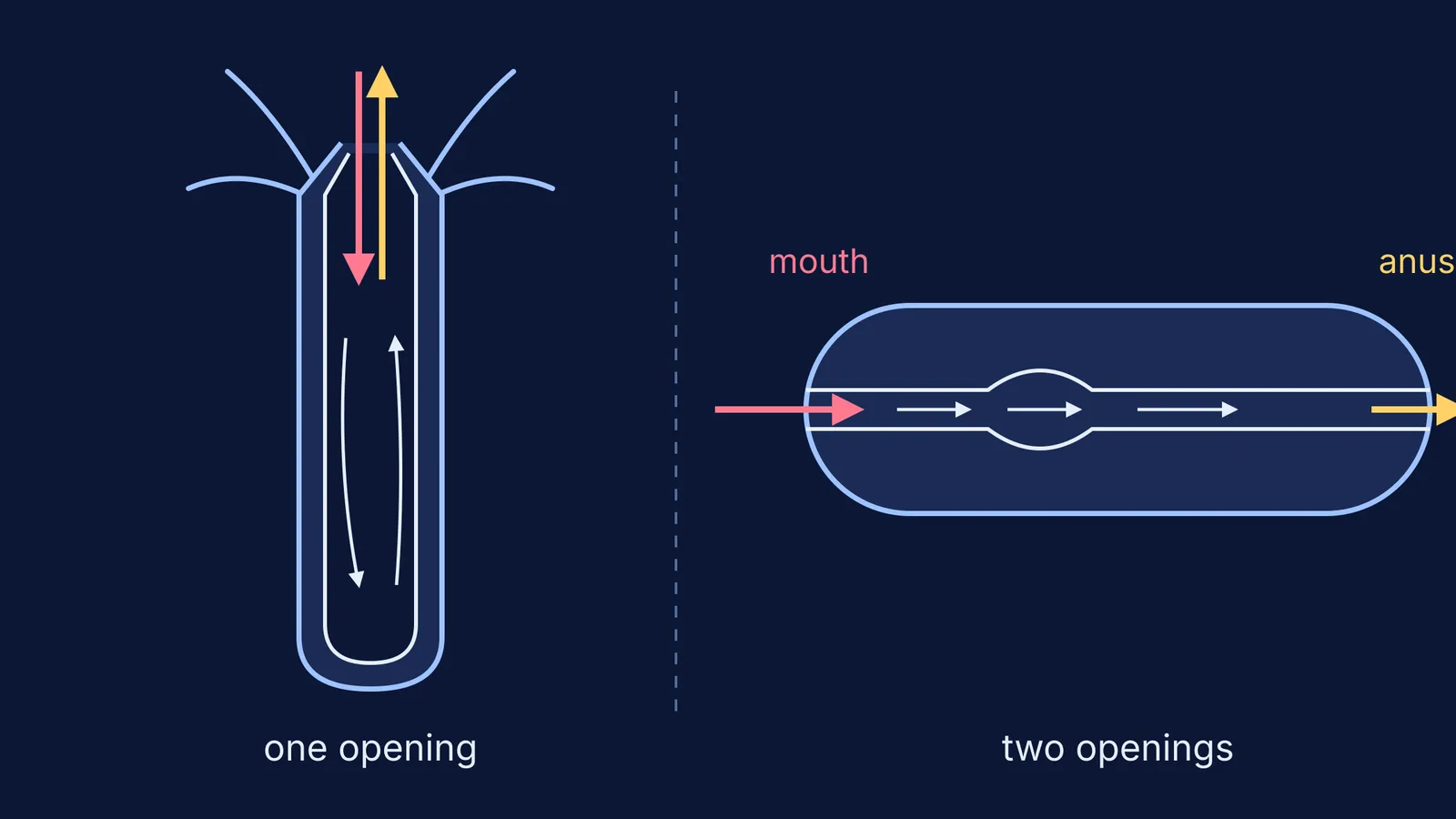
Hydra belongs to the phylum Cnidaria, which NCERT also calls Coelenterata. The NCERT Class 11 Biology chapter on the Animal Kingdom says cnidarians "have a central gastro-vascular cavity with a single opening, mouth on hypostome". The hypostome is the raised cone at the top of the body, inside the ring of tentacles.
The body is built like a two-layered bag. According to OpenStax Biology 2e, all cnidarians are diploblastic: an outer epidermis, an inner gastrodermis, and a non-living, jelly-like mesoglea between them. A bag has a mouth and a bottom. No tube runs through the body, so there is no far end where an anus could sit.
The mouth is not even a permanent hole. A 2016 study in the Biophysical Journal by Carter and colleagues describes how Hydra "must tear a hole through its epithelial tissue each time it opens its mouth". Its results support the idea that radial contractile fibres (myonemes) in the outer layer pull the mouth open.
How does one cavity digest and circulate at the same time?
The name gives it away: gastro for stomach, vascular for circulation. One cavity does both jobs. Here is the sequence, using OpenStax's cnidarian section and its digestive systems section:
Prey caught by stinging cells (cnidoblasts) on the tentacles enters through the mouth.
Cells lining the cavity release enzymes into it, so digestion starts outside the cells (extracellular).
Those lining cells engulf the food particles and finish digesting them inside (intracellular). NCERT sums this up as "Digestion is extracellular and intracellular."
The cavity spreads nutrients through the body, which pass "from the digestive cavity across the mesoglea to the epidermal cells".
Oxygen and carbon dioxide move by diffusion, and nitrogenous wastes diffuse out into the water or into the cavity.
Whatever cannot be digested leaves through the same single opening.
To see how Hydra coordinates feeding without a brain, read our post on the Hydra nerve net.
Why was a gut with two openings a big step up?
OpenStax calls the alimentary canal "a more advanced system": one tube with a mouth at one end and an anus at the other. Its earthworm example shows why. Food is stored in the crop, churned in the gizzard, absorbed in the intestine, and the waste leaves through the anus.
The key idea is one-way traffic. In a sac, a new meal and old waste share the same space and the same door. In a tube, food moves in order past regions that can each specialise in one job, and the animal can take in food at one end while waste leaves at the other.
How the anus first evolved is still being worked out. A 2015 review by Hejnol and Martín-Durán states that "the evolutionary origin of the hindgut with the anal opening remains unclear". A 2016 Current Biology paper by Presnell and colleagues showed that comb jellies, long described as having a blind gut, actually have a one-way through-gut with anal pores. For exams, stick to NCERT.
Blind sac or one-way tube: how do they compare?
Here is the comparison, sac first, tube second:
Openings: one, serving as mouth and anus, versus two.
Food flow: in and out by the same route, versus one way only.
Digestion: in the cavity, then inside lining cells, versus in stages along the tube (crop, gizzard, intestine in the earthworm).
Moving nutrients: the cavity does it, versus, in many tube-gut animals, a separate circulatory system (NCERT notes annelids have a closed one).
Label: incomplete versus complete.
Examples: Hydra, Aurelia and Adamsia, and also flatworms, versus roundworms such as Ascaris, whose "alimentary canal is complete".
How do you write this answer in an exam?
A three-mark answer to "Why does Hydra have one opening?" can follow this outline:
Name the structure: a gastrovascular cavity with a single opening on the hypostome.
Say what it does: extracellular plus intracellular digestion, and nutrient distribution.
Name the consequence: the mouth also works as the anus, so the system is incomplete.
Watch for three traps. NCERT's classification chart places Coelenterata among the acoelomates, so a gut cavity is not a coelom. Flatworms also have only one opening, even though they are bilateral and triploblastic. And sponges have no gut: their spongocoel is a channel for water, not a digestive cavity. Our Animal Kingdom Class 11 guide puts all the phyla side by side, and the labelled alimentary canal figure shows the complete tube in humans.
If terms like diploblastic, mesoglea and hypostome blur together, the Fermi Concept Library has every concept in biology, each with its own lesson and its place in the map.